 Woyɛ dino bɛn? Nsɛmmisa agoro
 Dino ko
 Dino mmirikatuo
 Dino agodie nketewa
 Stika nwoma
 Dino TOP nhyehyɛeɛ
 Ma me nwanwa!
Ugrunaaluk
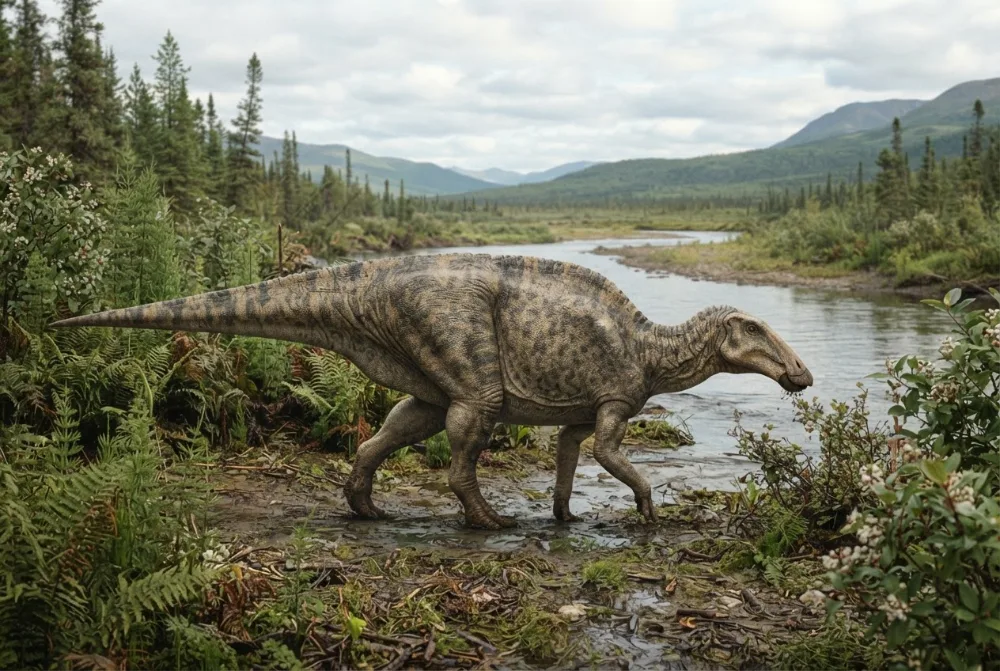
Ugrunaaluk was a duck-billed dinosaur that lived in the ancient Arctic, where it was cold and dark for part of the year. It had a long, flat beak and hundreds of teeth for chewing tough plants. This dinosaur is special because it shows that some dinosaurs could survive in polar regions.51
Berɛ bɛn na ɛtenaa ase?
Na ne kɛseɛ yɛ sɛn?
Na ne tenten yɛ sɛn?
Na ne korɔn yɛ sɛn?
nsusuiɛ
Na ne mu yɛ duru sɛn?
 ne tenten te sɛ kaa 2.5 a wɔde agyina toatoa so🍌ne tenten te sɛ kwadu 67 a wɔde abɔ toatoa so
 ne mu duru bɛyɛ sɛ ɔsono🍉ne mu duru te sɛ watamɛlɔn 1100🎒ne mu duru te sɛ sukuu klaas mũ 7 mu mmofra🐻❄️ne mu duru te sɛ polar bea 12🏃anka ɔbɛtumi atu mmirika mita 100 wɔ sikɛn 17 mu (onipa a ɔyɛ ntɛm sen biara hia 9.6)
Ugrunaaluk kɛseɛ yɛ sɛn sɛ wode toto WO ho a?
Akontaa nko ara wɔ wo browser mu. Yɛnkora biribiara so, na yɛmmfa biribiara nkɔ baabiara.
Na ɛyɛ ntɛm sɛn?


Nsɛm a ɛyɛ anigye
Ugrunaaluk lived in the Arctic about 69 million years ago, when the climate was much cooler than today, with average temperatures around 5 to 6°C.1
Most of the Ugrunaaluk fossils found are from young animals, not fully grown adults. Scientists think a whole herd of juveniles may have died together in a flood.1
Its name comes from the Iñupiaq language of Alaska. Ugruŋnaq means a grazing animal with grinding teeth, and -aluk means old, so Ugrunaaluk is 'ancient grazer'.1
Ugrunaaluk was a close relative of Edmontosaurus, but scientists found enough differences in its skull bones to give it its own name.1
The Liscomb bonebed where Ugrunaaluk was found has thousands of bones, mostly from this dinosaur, along with a few teeth from tyrannosaurs and other small dinosaurs.1
During the time of Ugrunaaluk, the Arctic had polar woodlands with flowering plants in the understory, and the days were dark for months in winter.1
Nsɛm a wɔbisa bebree fa Ugrunaaluk ho
?How big was Ugrunaaluk?
Ugrunaaluk was about 7.6 to 9.1 meters (25 to 30 feet) long and stood about 1.8 to 2.1 meters (6 to 7 feet) tall at the hip.4
?What did Ugrunaaluk eat?
It was a plant-eater, with a flat beak and hundreds of teeth for chewing tough plants. Its jaw had at least 1,000 teeth with coarse surfaces perfect for pulverizing plants.4
?Did Ugrunaaluk live in the Arctic?
Yes, Ugrunaaluk lived in the ancient Arctic, above the Arctic Circle, about 69 million years ago. It endured cold and dark winters, with average temperatures around 5 to 6°C.41
?Was Ugrunaaluk a duck-billed dinosaur?
Yes, Ugrunaaluk belonged to the hadrosaur group of duck-billed dinosaurs. It had a long, flat beak and hundreds of teeth for chewing plants.4
?Why is Ugrunaaluk special?
Ugrunaaluk is special because it shows that some dinosaurs could survive in polar regions. It lived above the Arctic Circle, enduring months of darkness and cold.4
?How many teeth did Ugrunaaluk have?
Ugrunaaluk had at least 1,000 teeth in its jaw, with coarse surfaces perfect for pulverizing plants.4
?When did Ugrunaaluk live?
Ugrunaaluk lived about 69 million years ago, during the Late Cretaceous period, in the ancient Arctic.4
?Is Ugrunaaluk related to Edmontosaurus?
Yes, Ugrunaaluk is closely related to Edmontosaurus, but scientists found enough differences in its skull bones to give it its own name.1
?Where was Ugrunaaluk found?
Ugrunaaluk fossils were found in the Liscomb bonebed in the Prince Creek Formation of northern Alaska, along the Colville River.1
Atosɛm sɛefoɔ
Atosɛm: Ugrunaaluk is just a young Edmontosaurus and not a real separate dinosaur.
Nokorɛ: Scientists showed that Ugrunaaluk has unique skull features that make it a distinct species, even when accounting for age differences.1
Ma dino ho animdefoɔ
- Nyansahu din
- Ugrunaaluk
- Obi a ɔtoo din
- Mori et al. 20165
- Kuo
- Dabodabo ano dino
- Abusua / kuo kɛseɛ
- Hadrosauridae5
- Nkyekyɛmu
- Ornithischia > Ornithopoda > Iguanodontia > Hadrosauridae5
- Abotan no mfeɛ
- mfeɛ ɔpepem 72 kɔsi 66 (Maastrichtian)5
- Abotan nhyehyɛeɛ
- Prince Creek5
- Aman
- Amerika5
- Fɔsil nkyerɛwee
- 1 wɔ The Paleobiology Database mu5
- Nhunumu
- Ugrunaaluk was named in 2016 by Hirotsugu Mori, Patrick Druckenmiller, and Gregory Erickson. The fossils were found in the Liscomb bonebed along the Colville River in northern Alaska.51
- Wɔda so gye ho akyinnye
- Scientists are not sure exactly how big adult Ugrunaaluk grew, because almost all the fossils are from juveniles.1
Baabi a nsɛm no firi
- Formation (lower Maastrichtian) of northern Alaska (app.pan.pl)
- Edmontosaurus (en.wikipedia.org)
- Edmontosaurus regalis (en.wikipedia.org)
- New Dinosaur Species Probably Endured Snow and Darkness for Months on End | NOVA | PBS (pbs.org)
- Ugrunaaluk in The Paleobiology Database (CC BY 4.0): mfeɛ, mmeaeɛ, abotan nhyehyɛeɛ, nkyekyɛmu.
Asɛm biara a ɛwɔ krataafa yi so wɔ nɔma a ɛkyerɛ baabi a ɛfiri. Sɛ yɛfom biribi a, kafra, yɛyɛ dino dɔfoɔ, yɛnyɛ nyansahu nsɛmma krataa. Ka kyerɛ yɛn wɔ [email protected] na yɛbɛsiesie.
 Ɔkɔm de Rex! Dino Wiki yɛ agya bi adwuma a ɔyɛɛ maa ne babarima a ɔdɔ dino. Ɛyɛ kwa, dawurubɔ biara nni mu, akyidifoɔ biara nni mu. Mpanimfoɔ bɛtumi ama Rex aduane kakra, na aboa ama Dino Wiki atena intanɛt so.Ma Rex aduane
 Parasaurolophus
 Edmontosaurus
 Saurolophus
 Hypacrosaurus
 Corythosaurus
 Kritosaurus
 Tyrannosaurus
 Triceratops
 Velociraptor
 Spinosaurus
 Ankylosaurus
 Pteranodon