
Amargasaurus
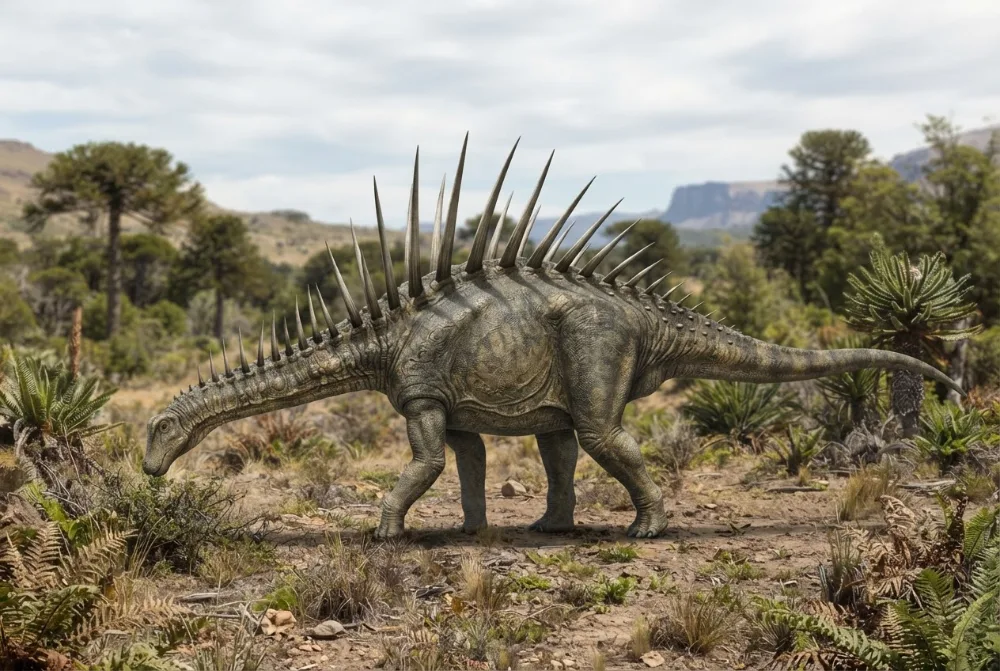
Amargasaurus was a sauropod with a very unusual back. It had long, sharp spines sticking up from its neck and back, like a row of spikes. Scientists think these spikes might have been used for defense or to impress other Amargasaurus.1
When did it live?
How big was it?
How long was it?
How tall was it?
head height
How heavy was it?
How big was Amargasaurus compared to YOU?
Just maths in your browser. Nothing is saved or sent anywhere.
Fun facts
Amargasaurus had very long, sharp spines on its neck and back vertebrae. These spines were much longer than those of its relative Dicraeosaurus.1
The spines on its neck were so long that they probably stuck out like a sail or a row of spikes. Scientists think they could have been used for defense or to show off to other Amargasaurus.1
Amargasaurus was a dicraeosaurid, a family of sauropods with shorter necks than other long-necked dinosaurs. Its closest relatives include Dicraeosaurus and Bajadasaurus.6
The only known skeleton of Amargasaurus is mostly complete. It includes the back of the skull, most of the backbone, and parts of the legs and hips.1
Amargasaurus lived about 125 to 121 million years ago, during the Early Cretaceous period. That is about 15 to 20 million years after its African relative Dicraeosaurus.61
Scientists think Amargasaurus could not rear up on its hind legs like some other sauropods. Its legs were built for slow, steady walking, not speed.1
Most asked questions about Amargasaurus
?How big was Amargasaurus?
Amargasaurus was about 9 to 13 metres long and weighed around 2.5 to 4 metric tons. That is small for a sauropod.25
?What did Amargasaurus eat?
Amargasaurus was a herbivore that ate tough plants. It had pencil-like teeth for grinding and chewing.52
?When did Amargasaurus live?
Amargasaurus lived during the Early Cretaceous period, about 130 to 120 million years ago.25
?Where was Amargasaurus found?
Amargasaurus was found in Argentina, in the La Amarga Formation of Neuquén Province. The only known skeleton was discovered in 1984.25
?Why did Amargasaurus have spines?
Scientists think the spines might have been used for display, combat, or defense. They could have supported a sail or been covered in horn.23
?Was Amargasaurus a dinosaur?
Yes, Amargasaurus was a dinosaur. It was a sauropod, a type of long-necked plant-eating dinosaur.25
?How fast could Amargasaurus run?
Scientists think Amargasaurus could not run fast. Its legs were built for slow, steady walking, not speed.2
?Is Amargasaurus bigger than T. rex?
Amargasaurus was longer than T. rex, reaching 9 to 13 metres, but it was much lighter, weighing only 2.5 to 4 metric tons.2
Ask Rex about Amargasaurus
Rex only answers questions about this page. 3 questions a day.
Rex is an AI and can make mistakes. He runs on servers in the EU and questions are never saved. Never type your name or other personal things.
For dino experts
- Scientific name
- Amargasaurus
- Named by
- Bonaparte 19846
- Group
- Long-necks
- Family / clade
- Dicraeosauridae6
- Classification
- Sauropodomorpha > Sauropoda > Diplodocoidea6
- Age of the rocks
- 126 to 121 million years (Barremian)6
- Rock formations
- La Amarga6
- Countries
- Argentina6
- Fossil records
- 2 in the Paleobiology Database6
- Discovery
- Amargasaurus was named by Argentine paleontologist José Bonaparte in 1984. The skeleton was found in the La Amarga Formation in Neuquén Province, Argentina.61
- Still debated
- Scientists are not sure exactly what the long spines on Amargasaurus's neck were used for. They might have been for defense, to attract mates, or to help control body temperature.1
Where the facts come from
- p (naturalhistory.si.edu)
- Amargasaurus (en.wikipedia.org)
- Amargasaurus | Western Australian Museum (museum.wa.gov.au)
- Giants and Bizarres: Body Size of Some Southern South American Cretaceous Dinosaurs (miketaylor.org.uk)
- Amargasaurus | Natural History Museum (nhm.ac.uk)
- Amargasaurus in The Paleobiology Database (CC BY 4.0): age, places, rock formations, classification.
Every fact on this page has a number that points to its source. If we got something wrong, sorry, we are dino fans, not a science journal. Tell us at [email protected] and we will fix it.
 Rex is hungry! Dino Wiki is a dad's project for his dino-loving son, free with no ads. Grown-ups can feed Rex a snack to help keep it online.Feed Rex
 Brachiosaurus
 Diplodocus
 Brontosaurus
 Argentinosaurus
 Camarasaurus
 Morosaurus
 Stegosaurus
 Iguanodon
 Archaeopteryx
 Giganotosaurus
 Microraptor
 Deinonychus