 Home
 All dinos
 Dino groups
 Explore
 Dinos by country
 Dino vs dino
 How big were they?
 Dinos A to Z
 Who ate what?
 What dino are you? Quiz
 Dino games
 Dino battle
 Dino race
 Dino mini-games
 Sticker album
 Dino TOP lists
 Timeline
 Surprise me!
 Language: English

Iguanodon
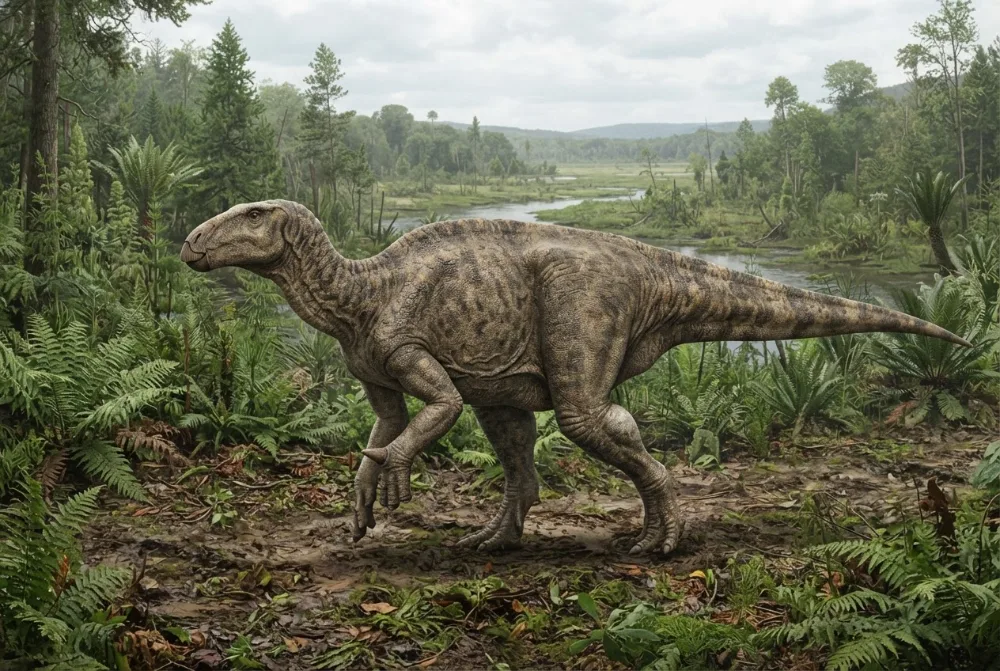
Iguanodon was a big, plant-eating dinosaur that lived during the Early Cretaceous period. It had a thumb spike like a sharp weapon and a beak for snipping leaves. This dinosaur could walk on two legs or all fours.12
 United Kingdom
 Spain
 Germany
 Belgium
When did it live?
Iguanodon: 155 to 66 million years ago
How big was it?
How long was it?
How tall was it?
at the hips
How heavy was it?
 as long as 2.5 cars parked in a row🍌as long as 61 bananas end to end
 about as heavy as an elephant🍉as heavy as 1000 watermelons🎒as heavy as 6 whole school classes of kids🐻❄️as heavy as 11 polar bears🏃could run 100 metres in 15 seconds (the fastest human needs 9.6)
How big was Iguanodon compared to YOU?
Just maths in your browser. Nothing is saved or sent anywhere.
How fast was it?


Fun facts
Iguanodon was named in 1825 by Gideon Mantell after he found teeth that looked like iguana teeth.1
Its thumb had a big, sharp spike that scientists think was used for defense against predators.1
Iguanodon had a flexible little finger that could grasp objects, unlike its other fingers which were more like hooves.1
When Iguanodon closed its mouth, the bones in its upper jaw would bow out, making the teeth grind against each other like a chewing motion.1
The front of Iguanodon's mouth had no teeth, just a bony beak covered with a hard material for cropping plants.1
Iguanodon could reach food from ground level up to 4 to 5 metres (13 to 16 feet) high, so it ate both low plants and tree leaves.1
In 1878, many complete Iguanodon skeletons were found in a coal mine in Bernissart, Belgium, which helped scientists understand the dinosaur much better.1
Most asked questions about Iguanodon
?How big was Iguanodon?
Iguanodon was about 9 to 11 metres (30 to 36 feet) long and weighed around 4.5 metric tons (5 short tons).1
?What did Iguanodon eat?
Iguanodon was a plant-eater. It used its beak to snip leaves and its cheek teeth to grind tough plants like cycads.3
?Did Iguanodon have a thumb spike?
Yes, Iguanodon had a large, sharp spike on each thumb. It may have been used for defense or for breaking into fruits and seeds.34
?Could Iguanodon walk on two legs?
Yes, Iguanodon could walk on two legs or on all fours. It was one of the few dinosaurs that could do both.3
?When did Iguanodon live?
Iguanodon lived during the Early Cretaceous period, about 126 to 122 million years ago.1
?Who discovered Iguanodon?
Iguanodon was named by Gideon Mantell in 1825 after teeth were found in Sussex, England. His wife Mary Ann Mantell is often credited with finding the first teeth.41
?Was Iguanodon a dinosaur?
Yes, Iguanodon was a dinosaur. It was one of the first dinosaurs ever named, after Megalosaurus.1
?How fast could Iguanodon run?
Iguanodon could probably run at up to about 24 km/h (15 mph) on two legs.1
?Where have Iguanodon fossils been found?
Iguanodon fossils have been found in Belgium, England, Germany, Spain, and other parts of Europe.1
Myth buster
Myth: Iguanodon was a slow, clumsy dinosaur that always walked on four legs.
Truth: Iguanodon could walk on two legs or all fours, and it was probably quite agile for its size.2
For dino experts
- Scientific name
- Iguanodon
- Named by
- Mantell 18255
- Group
- Beaked plant-eaters
- Family / clade
- Ankylopollexia5
- Classification
- Ornithischia > Ornithopoda > Iguanodontia5
- Age of the rocks
- 155 to 66 million years (Kimmeridgian / Maastrichtian)5
- Rock formations
- Arcillas de Morella, Weald Clay, Wessex5
- Countries
- United Kingdom, Spain, Germany, France, Portugal, Belgium5
- Fossil records
- 133 in the Paleobiology Database5
- Also known as
- Heterosaurus, Iguanosaurus, Struthopus, Therosaurus (older names now counted as the same animal)5
- Discovery
- Iguanodon was first named by Gideon Mantell in 1825 based on fossil teeth found in Sussex, England. Later, in 1878, many complete skeletons were discovered in a Belgian coal mine and studied by Louis Dollo.1
- Still debated
- Scientists still debate exactly what plants Iguanodon ate. Some think it ate horsetails, cycads, and conifers, while others link it to the spread of flowering plants.1
Where the facts come from
- Iguanodon (en.wikipedia.org)
- Iguanodon | Diet, Habitat & Extinction (britannica.com)
- Iguanodon | National Geographic Kids (kids.nationalgeographic.com)
- Iguanodon: the teeth that led to a dinosaur discovery | Natural History Museum (nhm.ac.uk)
- Iguanodon in The Paleobiology Database (CC BY 4.0): age, places, rock formations, classification.
Every fact on this page has a number that points to its source. If we got something wrong, sorry, we are dino fans, not a science journal. Tell us at hello@dinowiki.app and we will fix it.
 Rex is hungry! Dino Wiki is a dad's project for his dino-loving son, free with no ads and no cookies. Grown-ups can feed Rex a snack to help keep it online.Feed Rex
 Tenontosaurus
 Thescelosaurus
 Zalmoxes
 Camptosaurus
 Rhabdodon
 Nanosaurus
 Archaeopteryx
 Giganotosaurus
 Microraptor
 Deinonychus
 Baryonyx
 Asiamericana