
Astrophocaudia
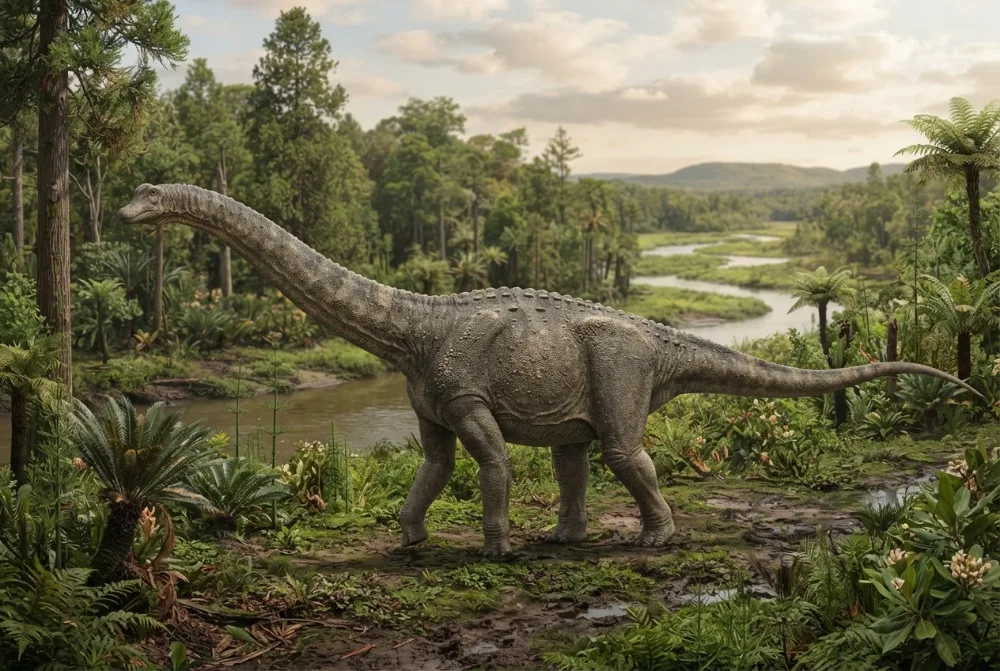
Astrophocaudia was a huge, long-necked plant-eater that walked on four legs. It lived in what is now Texas, USA, during the Early Cretaceous Period, about 112 to 106 million years ago.1
When did it live?
How big was it?
How long was it?
How tall was it?
shoulder height
How heavy was it?
How big was Astrophocaudia compared to YOU?
Just maths in your browser. Nothing is saved or sent anywhere.
Fun facts
The name Astrophocaudia has a double meaning: 'non-twisting tail' because the tail bones were tightly connected, and 'star tail' because the tail bones look like a three-pointed star from behind.1
Scientists are not sure how big Astrophocaudia was. One study said it was about 10.9 metres (36 feet) long and weighed 2.85 tonnes (6,300 pounds), but another said 18.3 metres (60 feet) long and 20 tonnes (44,000 pounds).1
Most of the bones from one single Astrophocaudia were found together, including 24 tail bones, parts of the neck and back, ribs, a shoulder blade, and a hip bone.1
Astrophocaudia's fossils were first discovered in the 1960s by paleontologist Robert Slaughter, but they were not fully studied until the 2010s.1
The species name slaughteri honors Robert Slaughter, who dug up the bones.1
Most asked questions about Astrophocaudia
?How big was Astrophocaudia?
Scientists are not sure. One study estimated it at 10.9 metres (36 feet) long and 2.85 tonnes (6,300 pounds), while another estimated 18.3 metres (60 feet) long and 20 tonnes (44,000 pounds).1
?What did Astrophocaudia eat?
It was a herbivore, meaning it ate plants.3
?When did Astrophocaudia live?
It lived during the Early Cretaceous Period, about 112 to 106 million years ago.1

Ask Rex about Astrophocaudia
Rex only answers questions about this page. 3 questions a day.
Rex is an AI and can make mistakes. He runs on servers in the EU and questions are never saved. Never type your name or other personal things.
For dino experts
- Scientific name
- Astrophocaudia
- Named by
- D'Emic 20133
- Group
- Long-necks
- Family / clade
- Somphospondyli3
- Classification
- Sauropodomorpha > Sauropoda > Macronaria3
- Age of the rocks
- 113 to 110 million years (Albian)3
- Rock formations
- Paluxy3
- Countries
- USA3
- Fossil records
- 1 in the Paleobiology Database3
- Discovery
- Astrophocaudia was named in 2012 (published 2013) by Michael D. D'Emic based on fossils found in the 1960s by Robert Slaughter in the Paluxy Formation of Texas.13
- Still debated
- Scientists are not sure exactly how large Astrophocaudia grew because different estimates give very different sizes.1
Where the facts come from
- Astrophocaudia (en.wikipedia.org)
- Astrophocaudia (ru.wikipedia.org)
- Astrophocaudia in The Paleobiology Database (CC BY 4.0): age, places, rock formations, classification.
Every fact on this page has a number that points to its source. If we got something wrong, sorry, we are dino fans, not a science journal. Tell us at [email protected] and we will fix it.
 Rex is hungry! Dino Wiki is a dad's project for his dino-loving son, free with no ads. Grown-ups can feed Rex a snack to help keep it online.Feed Rex
 Brachiosaurus
 Diplodocus
 Brontosaurus
 Argentinosaurus
 Camarasaurus
 Morosaurus
 Stegosaurus
 Iguanodon
 Archaeopteryx
 Giganotosaurus
 Microraptor
 Deinonychus