 Home
 All dinos
 Dino groups
 Explore
 Dinos by country
 Dino vs dino
 How big were they?
 Dinos A to Z
 Who ate what?
 What dino are you? Quiz
 Dino games
 Dino battle
 Dino race
 Dino mini-games
 Sticker album
 Dino TOP lists
 Timeline
 Surprise me!
 Language: English

Batrachognathus
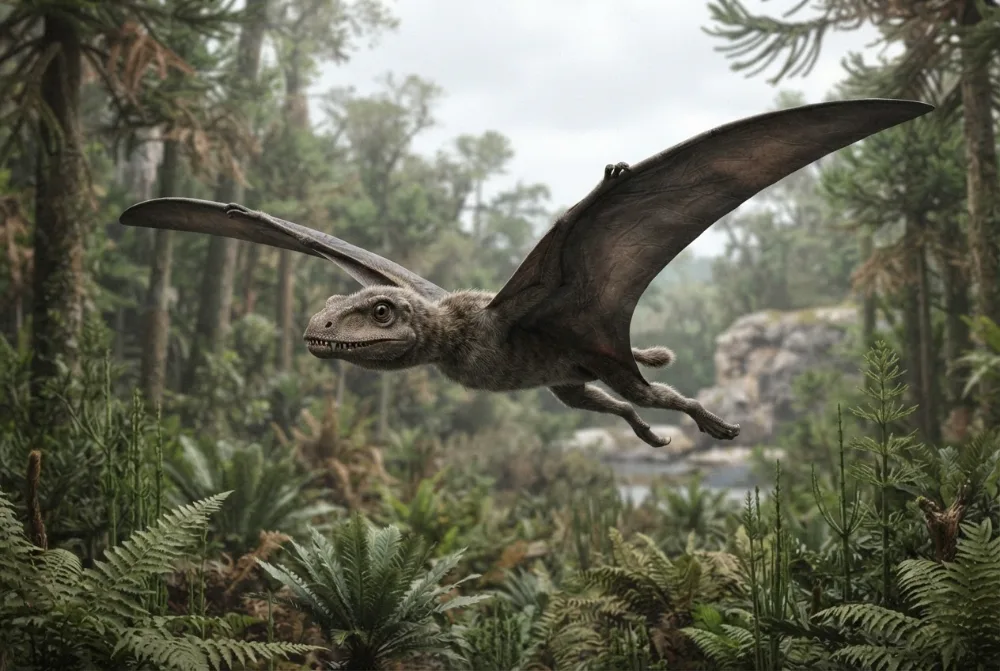
Batrachognathus was a small flying reptile that lived during the Jurassic period. It had a short, wide head like a frog and probably snapped up insects in the air.413
 Kazakhstan
When did it live?
Batrachognathus: 162 to 155 million years ago
How big was it?
How wide were its wings?
How heavy was it?
How big was Batrachognathus compared to YOU?
Just maths in your browser. Nothing is saved or sent anywhere.
How fast was it?


Fun facts
Batrachognathus means 'frog jaw' because its skull was short and wide, just like a frog's mouth.4
It lived about 161 to 155 million years ago, during the Late Jurassic period.2
Its fossils were found in very fine-grained shale, which was once the mud at the bottom of a large mountain lake.2
Batrachognathus belonged to a group of pterosaurs called Anurognathidae, which were small and often had short tails.4
Most asked questions about Batrachognathus
?How big was Batrachognathus?
It was small, with a wingspan of about 50 to 75 centimetres and a body mass of around 40 grams.3
?What did Batrachognathus eat?
It likely ate insects and maybe small fish, catching them in its wide mouth while flying.31
For dino experts
- Scientific name
- Batrachognathus
- Named by
- Riabinin 19484
- Group
- Flying reptiles
- Family / clade
- Anurognathidae4
- Classification
- Pterosauria4
- Age of the rocks
- 162 to 155 million years (Oxfordian)4
- Rock formations
- Karabastau4
- Countries
- Kazakhstan4
- Fossil records
- 1 in the Paleobiology Database4
- Discovery
- Batrachognathus was named by Russian paleontologist A. N. Riabinin in 1948, based on fossils found in the Karatau Mountains of Kazakhstan.4
Where the facts come from
- Batrachognathus Ryabinin 1948 - Encyclopedia of Life (eol.org)
- PBDB Collection (paleobiodb.org)
- en.wikipedia.org Batrachognathus (en.wikipedia.org)
- Batrachognathus in The Paleobiology Database (CC BY 4.0): age, places, rock formations, classification.
Every fact on this page has a number that points to its source. If we got something wrong, sorry, we are dino fans, not a science journal. Tell us at hello@dinowiki.app and we will fix it.
 Rex is hungry! Dino Wiki is a dad's project for his dino-loving son, free with no ads and no cookies. Grown-ups can feed Rex a snack to help keep it online.Feed Rex
 Pteranodon
 Quetzalcoatlus
 Dorygnathus
 Rhamphorhynchus
 Anhanguera
 Pterodactylus
 Stegosaurus
 Brachiosaurus
 Diplodocus
 Allosaurus
 Brontosaurus
 Compsognathus