

Pterodactylus
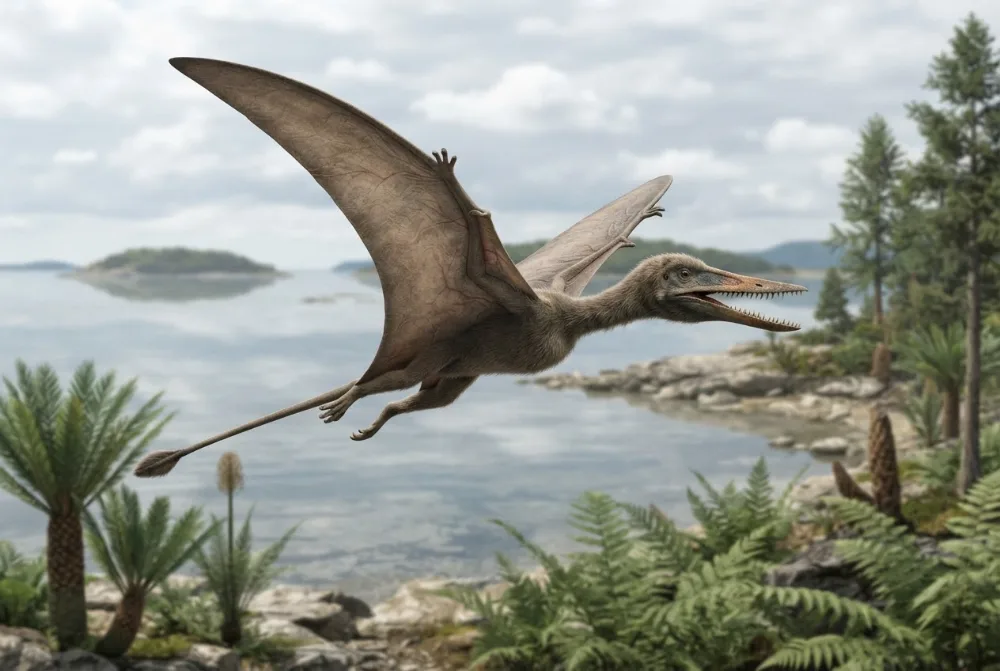
Pterodactylus was one of the first flying reptiles ever discovered. It lived during the Late Jurassic period, about 150 million years ago, and had wings made of skin and muscle that stretched from its long fourth finger to its back legs. It was a small pterosaur that probably ate insects and other small animals.12
When did it live?
How big was it?
How long was it?
How big was Pterodactylus compared to YOU?
Just maths in your browser. Nothing is saved or sent anywhere.
Fun facts
Pterodactylus was the first pterosaur ever named and identified as a flying reptile, in 1809 by French scientist Georges Cuvier.1
Its fossils are often found in the Solnhofen limestone of Germany, which preserved soft body parts like jellyfish and feathers.12
Pterodactylus lived alongside other pterosaurs such as Rhamphorhynchus and Anurognathus, as well as the early bird Archaeopteryx.1
Unlike birds, pterosaurs like Pterodactylus were reptiles and their wings were made of skin and muscle, not feathers.2
Pterodactylus had a relatively high bite force for its size, which helped it crush the shells of invertebrates.1
The name Pterodactylus means 'winged finger' because its wing was supported by one very long finger.1
Most asked questions about Pterodactylus
?How big was Pterodactylus?
Pterodactylus was a small pterosaur with an estimated adult wingspan of about 1.04 metres (3.4 feet).1
?What did Pterodactylus eat?
Pterodactylus was a generalist carnivore that probably ate invertebrates and small vertebrates. It had a relatively high bite force that helped it crush the shells of invertebrates.1
?When did Pterodactylus live?
Pterodactylus lived during the Late Jurassic period, about 150.8 to 148.5 million years ago.1
?Where were Pterodactylus fossils found?
Most Pterodactylus fossils have been found in the Solnhofen limestone of Bavaria, Germany. A few fragmentary remains have also been tentatively identified from elsewhere in Europe and Africa.1
?Was Pterodactylus a dinosaur?
No, Pterodactylus was not a dinosaur. It was a pterosaur, a type of flying reptile that lived at the same time as dinosaurs.12
?How did Pterodactylus fly?
Pterodactylus had wings made of skin and muscle that stretched from its very long fourth finger to its hind legs. The wings were supported by fibres inside and ridges on the outside.1
?Why is it called Pterodactylus?
The name Pterodactylus means 'winged finger' because its wing was supported by one very long finger.1
?Who discovered Pterodactylus?
The first Pterodactylus fossil was described by Italian scientist Cosimo Alessandro Collini in 1784. It was later named Pterodactylus by French scientist Georges Cuvier in 1809.1
?Did Pterodactylus have teeth?
Yes, Pterodactylus had teeth. The shape, size and arrangement of its teeth show it was a carnivore that ate small animals.1
?What animals lived with Pterodactylus?
Pterodactylus lived alongside other small pterosaurs like Rhamphorhynchus and Anurognathus, as well as the early bird Archaeopteryx and small dinosaurs like Compsognathus.1

Ask Rex about Pterodactylus
Rex only answers questions about this page. 3 questions a day.
Rex is an AI and can make mistakes. He runs on servers in the EU and questions are never saved. Never type your name or other personal things.
Myth buster
Myth: Many people think all pterosaurs are called pterodactyls and that they are dinosaurs.
Truth: Pterodactylus is just one genus of pterosaur, and pterosaurs are flying reptiles, not dinosaurs.2
For dino experts
- Scientific name
- Pterodactylus
- Named by
- Cuvier 18093
- Group
- Flying reptiles
- Family / clade
- Monofenestrata3
- Classification
- Pterosauria3
- Age of the rocks
- 201 to 133 million years (Hettangian / Valanginian)3
- Rock formations
- Solnhofener Plattenkalk, Solnhofen, Tendaguru3
- Countries
- Germany, Tanzania, France, Portugal, United Kingdom3
- Fossil records
- 15 in the Paleobiology Database3
- Also known as
- Diopecephalus, Macrotrachelus, Pterotherium (older names now counted as the same animal)3
- Discovery
- The first known pterosaur fossil was discovered in the Solnhofen limestone of Germany in 1784. It was later named Pterodactylus by Georges Cuvier in 1809, making it the first pterosaur ever scientifically described.12
- Still debated
- Scientists still debate exactly how many species of Pterodactylus existed, with some suggesting that many fossils belong to just one species, Pterodactylus antiquus.1
Where the facts come from
- Pterodactylus (en.wikipedia.org)
- Pterosaurs: The truth about these ‘flying dinosaurs’ | Natural History Museum (nhm.ac.uk)
- Pterodactylus in The Paleobiology Database (CC BY 4.0): age, places, rock formations, classification.
Every fact on this page has a number that points to its source. If we got something wrong, sorry, we are dino fans, not a science journal. Tell us at [email protected] and we will fix it.
Rex is hungry! Dino Wiki is a dad's project for his dino-loving son, free with no ads. Grown-ups can feed Rex a snack to help keep it online.Feed Rex Pteranodon
 Quetzalcoatlus
 Dorygnathus
 Rhamphorhynchus
 Anhanguera
 Eudimorphodon
 Ichthyosaurus
 Khudiakovia
 Ophthalmosaurus
 Peloneustes
 Gongbusaurus
 Shunosaurus