
Callawayia
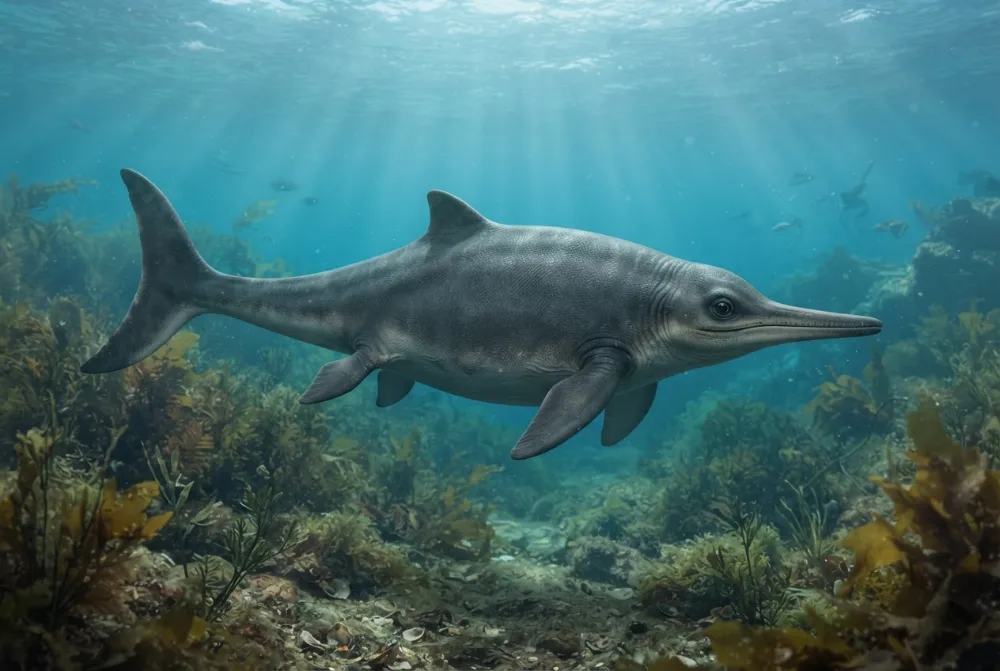
Callawayia was a small, fast-swimming marine reptile that lived in the Late Triassic oceans. It looked a bit like a dolphin but was actually an ichthyosaur, not a dinosaur.12
When did it live?
How big was it?
How long was it?
How big was Callawayia compared to YOU?
Just maths in your browser. Nothing is saved or sent anywhere.
Fun facts
Callawayia had more than 54 vertebrae in front of its hips, giving it a long, flexible body.1
Its front flippers had four digits, but its back flippers only had three.1
The first two neck vertebrae of Callawayia were not fused together, unlike in some other ichthyosaurs.1
A tiny bone called a pisiform was present in each foreflipper, which is unusual for ichthyosaurs.1
The humerus (upper arm bone) was short and wide with a notched front edge.1

Ask Rex about Callawayia
Rex only answers questions about this page. 3 questions a day.
Rex is an AI and can make mistakes. He runs on servers in the EU and questions are never saved. Never type your name or other personal things.
Myth buster
Myth: Callawayia is sometimes called a dinosaur.
Truth: Callawayia was an ichthyosaur, a marine reptile that lived in the ocean, not a dinosaur. Dinosaurs lived on land.1
For dino experts
- Scientific name
- Callawayia
- Named by
- Maisch and Matzke 20003
- Group
- Ichthyosaurs
- Family / clade
- Californosauridae3
- Classification
- Ichthyosauria > Ichthyosauromorpha3
- Age of the rocks
- 227 to 206 million years (Norian)3
- Rock formations
- Pardonet3
- Countries
- Canada3
- Fossil records
- 2 in the Paleobiology Database3
- Discovery
- The first fossil was found in 1987 on the shore of Williston Lake in British Columbia, Canada. It was named Callawayia in 2000 by Michael Maisch and Andreas Matzke.1
- Still debated
- Scientists still debate whether a species from China called 'Callawayia wolonggangense' really belongs to the same genus.1
Where the facts come from
- Callawayia (en.wikipedia.org)
- PBDB Taxon (paleobiodb.org)
- Callawayia in The Paleobiology Database (CC BY 4.0): age, places, rock formations, classification.
Every fact on this page has a number that points to its source. If we got something wrong, sorry, we are dino fans, not a science journal. Tell us at [email protected] and we will fix it.
 Rex is hungry! Dino Wiki is a dad's project for his dino-loving son, free with no ads. Grown-ups can feed Rex a snack to help keep it online.Feed Rex
 Ichthyosaurus
 Platypterygius
 Stenopterygius
 Khudiakovia
 Ophthalmosaurus
 Chonespondylus
 Nothosaurus
 Massospondylus
 Plateosaurus
 Coelophysis
 Podokesaurus
 Simosaurus