 Home
 All dinos
 Dino groups
 Explore
 Dinos by country
 Dino vs dino
 How big were they?
 Dinos A to Z
 Who ate what?
 What dino are you? Quiz
 Dino games
 Dino battle
 Dino race
 Dino mini-games
 Sticker album
 Dino TOP lists
 Timeline
 Surprise me!
 Language: English

Cienciargentina
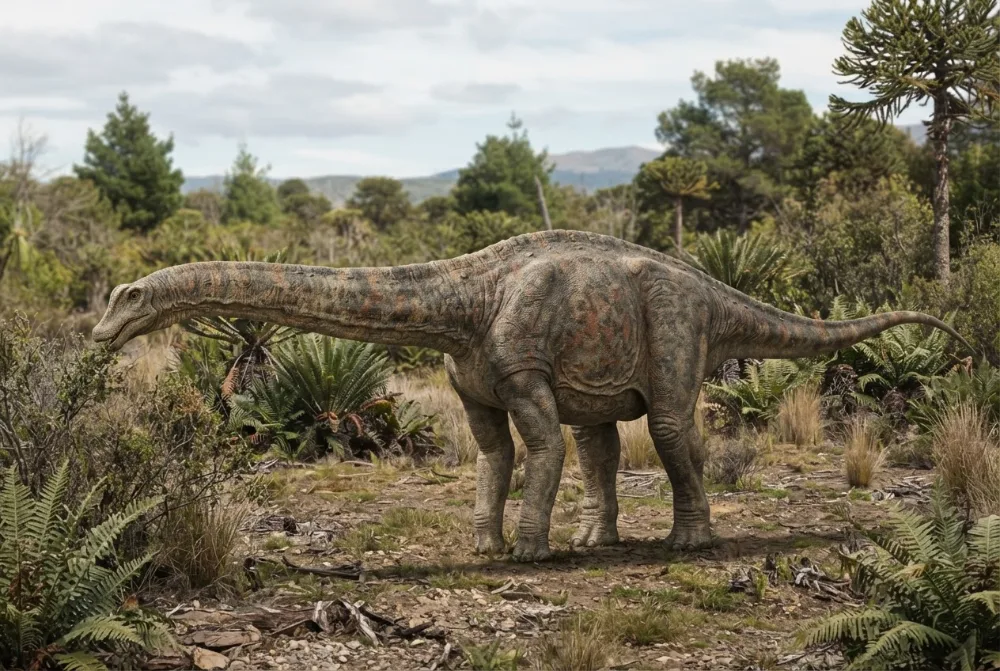
Cienciargentina was a long-necked plant eater that lived in Argentina about 106 million years ago. It had a small head, a huge body, and a whip-like tail. This dinosaur belongs to a family called the rebbachisaurids.614
 Argentina
When did it live?
Cienciargentina: 107 to 105 million years ago
How fast was it?


Fun facts
Cienciargentina is known from three partial skeletons of different sizes, found together.1
Its name honors the science and technology system of Argentina.1
Cienciargentina lived alongside the titanosaur Choconsaurus in the same area.1
It is the fourth rebbachisaurid dinosaur named from the Huincul Formation.1
Cienciargentina had a special hip bone shape: the top of its thigh bone pointed upward, above the greater trochanter.2
Its tail vertebrae had a length-to-height ratio of 5 or more, making the tail very long and slender.2
Most asked questions about Cienciargentina
?How big was Cienciargentina?
Scientists do not know its exact size yet, but it was a medium to large sauropod, like other rebbachisaurids. It is known from three partial skeletons of different sizes, so the largest was probably quite big.15
?What did Cienciargentina eat?
It was a plant eater. Like other rebbachisaurids, it was a non-selective, ground-level browser that ate low-growing plants.5
?When did Cienciargentina live?
It lived about 106 million years ago, during the Early Cretaceous period (Albian stage).1
For dino experts
- Scientific name
- Cienciargentina
- Named by
- Simón and Salgado 20256
- Group
- Long-necks
- Family / clade
- Rebbachisauridae6
- Classification
- Sauropodomorpha > Sauropoda > Diplodocoidea6
- Age of the rocks
- 107 to 105 million years (Albian)6
- Rock formations
- Huincul6
- Countries
- Argentina6
- Fossil records
- 1 in the Paleobiology Database6
- Discovery
- Cienciargentina was named in 2025 by María Edith Simón and Leonardo Salgado. The fossils were found at the La Antena site in Villa El Chocón, Argentina.61
- Still debated
- Scientists are not sure how big Cienciargentina grew, because only partial skeletons have been found.1
Where the facts come from
- Cienciargentina (en.wikipedia.org)
- New rebbachisaurid (Dinosauria, Sauropoda) from the Huincul Formation (upper Cenomanian-Turonian) of Villa El Chocón (Neuquén Province, Argentina) (ri.conicet.gov.ar)
- en.wikipedia.org Rebbachisauridae (en.wikipedia.org)
- doi.org j.gr.2026.06.020 (doi.org)
- New rebbachisaurid (Dinosauria, Sauropoda) from the Huincul Formation (upper Cenomanian-Turonian) of Villa El Chocón (Neuquén Province, Argentina) (sciencedirect.com)
- Cienciargentina in The Paleobiology Database (CC BY 4.0): age, places, rock formations, classification.
Every fact on this page has a number that points to its source. If we got something wrong, sorry, we are dino fans, not a science journal. Tell us at hello@dinowiki.app and we will fix it.
 Rex is hungry! Dino Wiki is a dad's project for his dino-loving son, free with no ads and no cookies. Grown-ups can feed Rex a snack to help keep it online.Feed Rex
 Brachiosaurus
 Diplodocus
 Brontosaurus
 Argentinosaurus
 Camarasaurus
 Morosaurus
 Iguanodon
 Archaeopteryx
 Giganotosaurus
 Microraptor
 Deinonychus
 Baryonyx