
Cuspicephalus
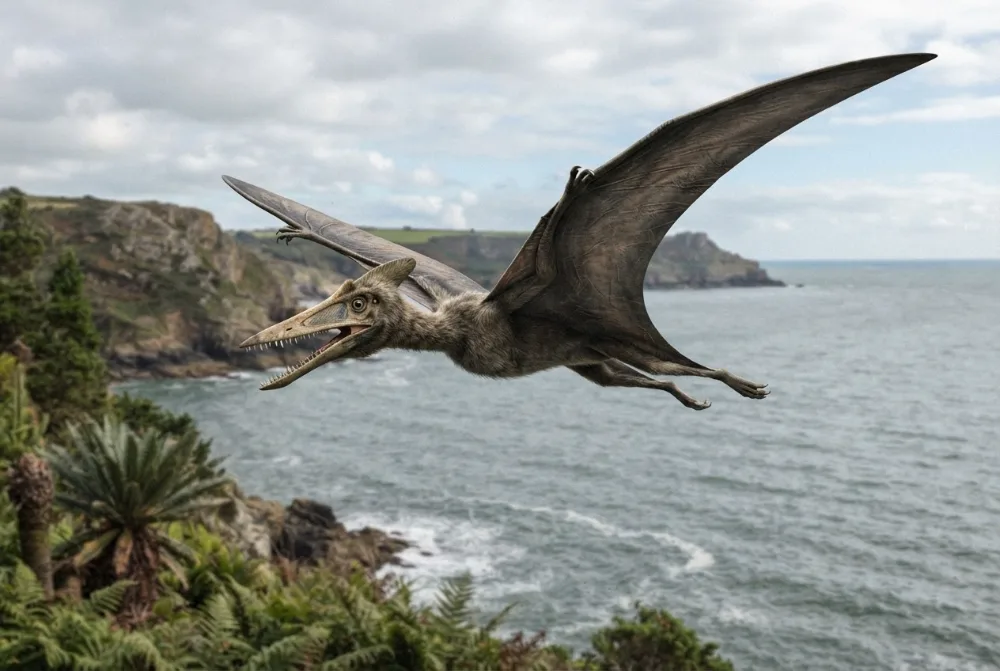
Cuspicephalus was a flying reptile that lived near the sea in what is now England. It had a very long, pointy skull and caught fish with its many teeth.23
When did it live?
How big was it?
How big was Cuspicephalus compared to YOU?
Just maths in your browser. Nothing is saved or sent anywhere.
Fun facts
Cuspicephalus had a skull that was almost five and a half times longer than it was tall. That is the most extreme ratio of any pterosaur.2
Its name means 'pointed head' and it was named after the cartoonist Gerald Scarfe, whose drawings often have very pointy noses.1
Cuspicephalus is one of the first non-pterodactyloid monofenestratan pterosaurs found outside China.1
The only known fossil is a flattened skull found on a beach at Kimmeridge Bay, part of the Jurassic Coast World Heritage Site.21
Cuspicephalus had at least 12 or 13 pairs of teeth in front of a large hole in its skull called the nasoantorbital fenestra.1
Most asked questions about Cuspicephalus

Ask Rex about Cuspicephalus
Rex only answers questions about this page. 3 questions a day.
Rex is an AI and can make mistakes. He runs on servers in the EU and questions are never saved. Never type your name or other personal things.
For dino experts
- Scientific name
- Cuspicephalus
- Named by
- Martill and Etches 20133
- Group
- Flying reptiles
- Family / clade
- Monofenestrata3
- Classification
- Pterosauria3
- Age of the rocks
- 155 to 152 million years (Kimmeridgian)3
- Rock formations
- Kimmeridge Clay3
- Countries
- United Kingdom3
- Fossil records
- 1 in the Paleobiology Database3
- Discovery
- Fossil collector Steve Etches found the partial skull in December 2009 at Kimmeridge Bay, Dorset, England. Scientists David Martill and Steve Etches named it Cuspicephalus scarfi in 2013.21
- Still debated
- Scientists are not sure whether Cuspicephalus was more closely related to Darwinopterus or to pterodactyloids like Germanodactylus.1
Where the facts come from
- A new monofenestratan pterosaur from the Kimmeridge (app.pan.pl)
- Cuspicephalus (en.wikipedia.org)
- Cuspicephalus in The Paleobiology Database (CC BY 4.0): age, places, rock formations, classification.
Every fact on this page has a number that points to its source. If we got something wrong, sorry, we are dino fans, not a science journal. Tell us at [email protected] and we will fix it.
Rex is hungry! Dino Wiki is a dad's project for his dino-loving son, free with no ads. Grown-ups can feed Rex a snack to help keep it online.Feed Rex Pteranodon
 Quetzalcoatlus
 Dorygnathus
 Rhamphorhynchus
 Anhanguera
 Pterodactylus
 Brachiosaurus
 Diplodocus
 Allosaurus
 Brontosaurus
 Compsognathus
 Camarasaurus