
Germanodactylus
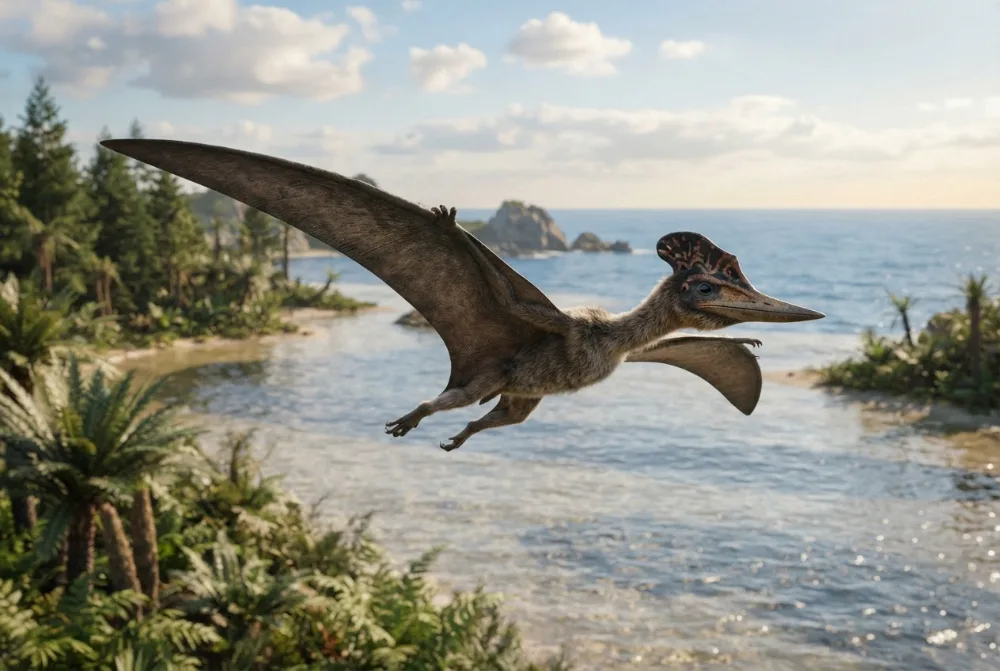
Germanodactylus was a small pterosaur that flew over warm lagoons during the Late Jurassic. It had a pointed beak and a fancy crest on its head, which may have been used to attract mates.1
When did it live?
How big was it?
How wide were its wings?
How big was Germanodactylus compared to YOU?
Just maths in your browser. Nothing is saved or sent anywhere.
Fun facts
Germanodactylus had a head crest with a bony part and a soft-tissue part that more than doubled its height. The soft part was probably made of skin-like material.1
Its skull was about 13 centimeters (5.1 inches) long for G. cristatus, and 21 centimeters (8.3 inches) for G. rhamphastinus.1
Germanodactylus had sharp teeth, with about 13 teeth in each side of the upper jaw for G. cristatus, and 16 for G. rhamphastinus.1
For a long time, scientists thought Germanodactylus was just a species of Pterodactylus, but it got its own genus in 1964.1
Some scientists think the two species of Germanodactylus might not be closely related, and one might belong to a different group.1
Germanodactylus lived about 150 to 148 million years ago, during the Late Jurassic period.1
Most asked questions about Germanodactylus
?Was Germanodactylus a dinosaur?
No, Germanodactylus was a pterosaur, a flying reptile that lived during the time of dinosaurs, but it is not a dinosaur.1
?How big was Germanodactylus?
Germanodactylus was about the size of a raven. G. cristatus had a wingspan of about 0.98 meters (3.2 feet), and G. rhamphastinus was a bit larger with a wingspan of 1.08 meters (3.5 feet).1
?What did Germanodactylus eat?
Scientists are not sure exactly what it ate, but its sharp teeth suggest it may have eaten fish or other small animals.1
?Why did Germanodactylus have a crest?
The crest may have been used to attract mates, like a peacock's tail. It had a bony part and a soft part that more than doubled its height.1
Ask Rex about Germanodactylus
Rex only answers questions about this page. 3 questions a day.
Rex is an AI and can make mistakes. He runs on servers in the EU and questions are never saved. Never type your name or other personal things.
Myth buster
Myth: Germanodactylus was a dinosaur.
Truth: Germanodactylus was a pterosaur, a flying reptile that is not a dinosaur.1
For dino experts
- Scientific name
- Germanodactylus
- Named by
- Young 19642
- Group
- Flying reptiles
- Family / clade
- Lophocratia2
- Classification
- Pterosauria > Pterodactyloidea2
- Age of the rocks
- 155 to 145 million years (Kimmeridgian / Tithonian)2
- Rock formations
- Solnhofen, Kimmeridge Clay, Altmühltal2
- Countries
- Germany, United Kingdom2
- Fossil records
- 5 in the Paleobiology Database2
- Discovery
- The first specimen was found in the Solnhofen Limestone of Germany and was named Pterodactylus cristatus by Carl Wiman in 1925. Yang Zhongjian gave it its own genus, Germanodactylus, in 1964.1
- Still debated
- Scientists still debate whether the two species of Germanodactylus belong in the same genus, or if one should be moved to a new genus.1
Where the facts come from
- Germanodactylus (en.wikipedia.org)
- Germanodactylus in The Paleobiology Database (CC BY 4.0): age, places, rock formations, classification.
Every fact on this page has a number that points to its source. If we got something wrong, sorry, we are dino fans, not a science journal. Tell us at [email protected] and we will fix it.
 Rex is hungry! Dino Wiki is a dad's project for his dino-loving son, free with no ads. Grown-ups can feed Rex a snack to help keep it online.Feed Rex
 Pteranodon
 Quetzalcoatlus
 Dorygnathus
 Rhamphorhynchus
 Anhanguera
 Pterodactylus
 Brachiosaurus
 Diplodocus
 Allosaurus
 Brontosaurus
 Compsognathus
 Camarasaurus