
Hudsonelpidia
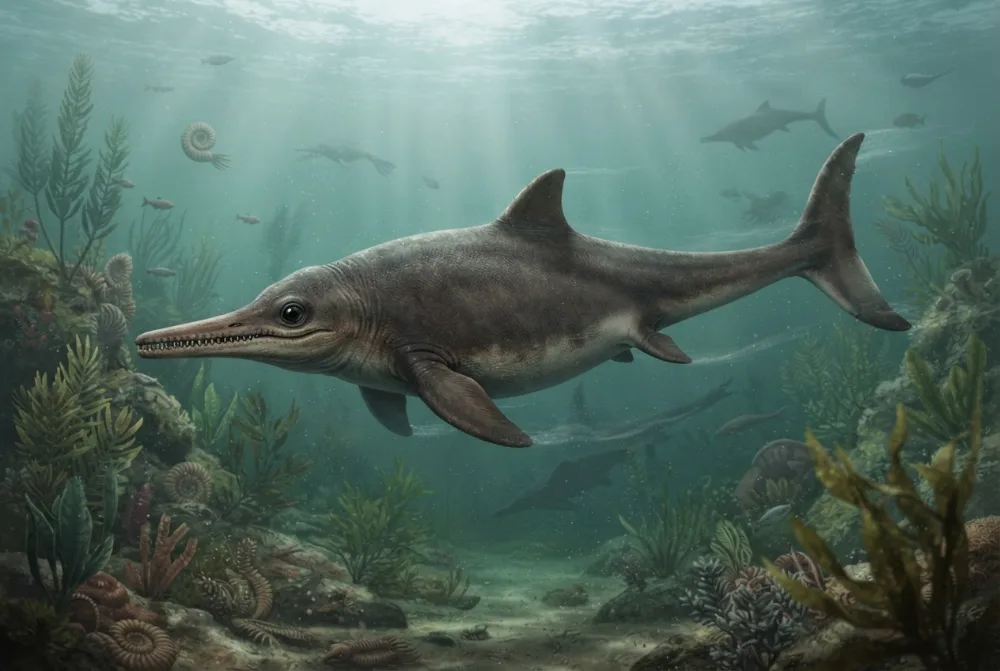
Hudsonelpidia was a small, fast-swimming marine reptile that lived in the Late Triassic oceans. It looked a bit like a dolphin but was actually an ichthyosaur, not a dinosaur. It had a short snout and huge eyes to hunt in dim water.12
When did it live?
How big was it?
How long was it?
How big was Hudsonelpidia compared to YOU?
Just maths in your browser. Nothing is saved or sent anywhere.
Fun facts
Hudsonelpidia had very long, straight spines on its back vertebrae, which helped support a tall fin or ridge.1
Its front flipper bones (the zeugopodials) were much wider than long, while its back flipper bones were much longer than wide.1
This ichthyosaur had a short snout and very large eye sockets, suggesting it relied on good vision to hunt.1
Hudsonelpidia lived during the Norian age of the Late Triassic, about 227 to 205 million years ago.1
It was a small ichthyosaur, less than 2 metres (about 6.5 feet) long, making it one of the smaller members of its group.1
The name Hudsonelpidia means 'Hudson's eyelid', referring to the Hudson's Hope area in British Columbia where it was found.1

Ask Rex about Hudsonelpidia
Rex only answers questions about this page. 3 questions a day.
Rex is an AI and can make mistakes. He runs on servers in the EU and questions are never saved. Never type your name or other personal things.
For dino experts
- Scientific name
- Hudsonelpidia
- Named by
- McGowan 19952
- Group
- Ichthyosaurs
- Family / clade
- Parvipelvia2
- Classification
- Ichthyosauria > Ichthyosauromorpha2
- Age of the rocks
- 227 to 206 million years (Norian)2
- Countries
- Canada2
- Fossil records
- 2 in the Paleobiology Database2
- Discovery
- Hudsonelpidia was named by paleontologist Chris McGowan in 1995, based on fossils found in British Columbia, Canada.1
- Still debated
- Scientists are not sure exactly how Hudsonelpidia is related to other ichthyosaurs, as different studies place it in different families.1
Where the facts come from
- PBDB Taxon (paleobiodb.org)
- Hudsonelpidia in The Paleobiology Database (CC BY 4.0): age, places, rock formations, classification.
Every fact on this page has a number that points to its source. If we got something wrong, sorry, we are dino fans, not a science journal. Tell us at [email protected] and we will fix it.
 Rex is hungry! Dino Wiki is a dad's project for his dino-loving son, free with no ads. Grown-ups can feed Rex a snack to help keep it online.Feed Rex
 Ichthyosaurus
 Platypterygius
 Stenopterygius
 Khudiakovia
 Ophthalmosaurus
 Chonespondylus
 Nothosaurus
 Massospondylus
 Plateosaurus
 Coelophysis
 Podokesaurus
 Simosaurus