
Tenontosaurus
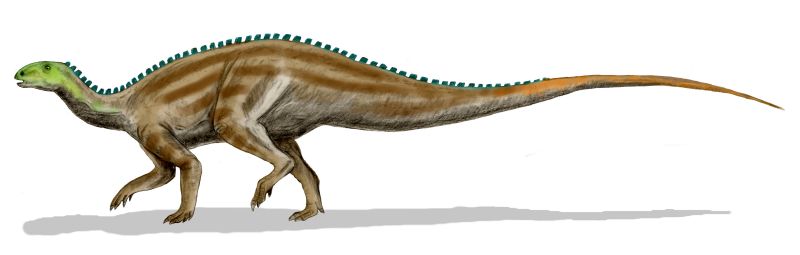
Tenontosaurus was a big plant-eating dinosaur with a very long, stiff tail. It lived in North America during the Early Cretaceous period, about 115 to 108 million years ago.1
When did it live?
How big was it?
Fun facts
Tenontosaurus had an unusually long and broad tail, stiffened by a network of bony tendons, which is why it is called 'sinew lizard'.1
An adult Tenontosaurus could reach a browsing height of about 3 meters (10 feet) if it stood on its hind legs, but it usually walked on all fours.1
Its beak was U-shaped and thick, and its lower jaw had a special bone called a predentary that helped form the lower beak.1
Tenontosaurus lived alongside the predator Deinonychus, and fossils of both are common in the same rocks.1
The first Tenontosaurus fossil was found in 1903 in Montana, but it was not named until 1970.1
There are two species: Tenontosaurus tilletti and Tenontosaurus dossi. T. dossi is known from only a few specimens in Texas.1
Myth buster
Myth: Some people think Tenontosaurus was a slow, clumsy dinosaur.
Truth: Scientists think it was a common and successful herbivore, and its stiff tail may have helped it balance.1
For dino experts
- Scientific name
- Tenontosaurus
- Named by
- Ostrom 19703
- Group
- Beaked plant-eaters
- Family / clade
- Tenontosauridae3
- Classification
- Ornithischia > Ornithopoda > Iguanodontia3
- Age of the rocks
- 121 to 94 million years (Aptian to Cenomanian)3
- Rock formations
- Cloverly, Antlers, Cedar Mountain3
- Countries
- USA3
- Fossil records
- 83 in the Paleobiology Database3
- Discovery
- The first fossil was found in 1903 by an American Museum of Natural History expedition in Montana. John Ostrom named it Tenontosaurus tilletti in 1970 after studying many specimens.1
- Still debated
- Scientists still debate exactly how Tenontosaurus moved, whether it was mostly quadrupedal or could run on two legs.1
Where the facts come from
- Tenontosaurus (en.wikipedia.org)
- Tenontosaurus | Natural History Museum (nhm.ac.uk)
- Tenontosaurus in The Paleobiology Database (CC BY 4.0): age, places, rock formations, classification.
Every fact on this page has a number that points to its source. If we got something wrong, sorry, we are dino fans, not a science journal. Tell us at [email protected] and we will fix it.
 Rex is hungry! Dino Wiki is free with no ads. Grown-ups can feed Rex a snack to keep it that way.Feed Rex
 Iguanodon
 Thescelosaurus
 Zalmoxes
 Camptosaurus
 Rhabdodon
 Nanosaurus
 Stegosaurus
 Archaeopteryx
 Giganotosaurus
 Microraptor
 Deinonychus
 Baryonyx