 Home
 All dinos
 Dino groups
 Explore
 Dinos by country
 Dino vs dino
 How big were they?
 Dinos A to Z
 Who ate what?
 What dino are you? Quiz
 Dino games
 Dino battle
 Dino race
 Dino mini-games
 Sticker album
 Dino TOP lists
 Timeline
 Surprise me!
 Language: English

Invictibellatrix
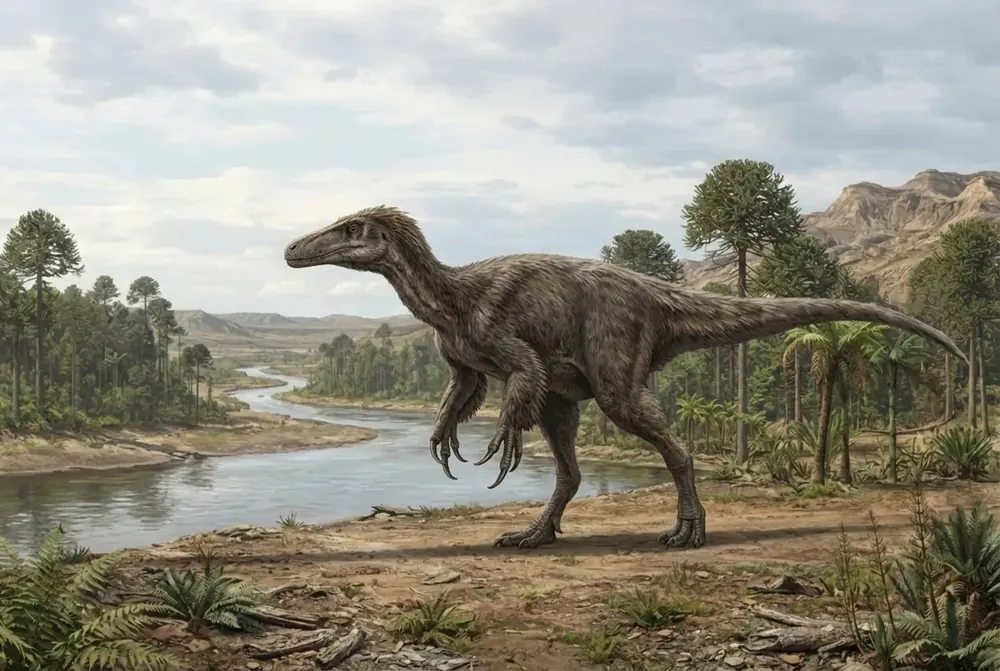
Invictibellatrix was a meat-eating dinosaur that lived on the Isle of Wight in England more than 120 million years ago. It belonged to the megaraptorans, meat-eaters with long curved hand claws. It is the first megaraptoran ever found in Europe.1
When did it live?
Invictibellatrix: 126 to 121 million years ago
How big was it?
How long was it?
How tall was it?
estimate from close relatives
 as long as 4 dogs nose to tail🍌as long as 22 bananas end to end
How big was Invictibellatrix compared to YOU?
Just maths in your browser. Nothing is saved or sent anywhere.
Fun facts
Its name comes from Latin and means "unconquered female warrior". Later megaraptorans became giant top hunters.1
The second part of its name, amberina, is for the amber found in the rocks where it was discovered.1
It may have had hand claws about 10 to 20 cm long.1
The fossil sat in a museum drawer for about 100 years before scientists saw it was a new dinosaur.1
Scientists made 3D models of its skull and brain space from CT scans.1
Most asked questions about Invictibellatrix
For dino experts
- Scientific name
- Invictibellatrix
- Named by
- Morrison et al. 20263
- Group
- Meat-eating dinos
- Family / clade
- Megaraptora3
- Classification
- Theropoda > Megaraptora3
- Age of the rocks
- 126 to 121 million years (Barremian)3
- Rock formations
- Wessex3
- Discovery
- Amateur fossil hunter Reginald Walter Hooley collected the fossil. The Natural History Museum in London got it in 1924, and it sat in the collection for about 100 years. In 2026 Cassius Morrison, Charlie Scherer and Paul Barrett studied it with CT scans and named it as a new dinosaur.1
- Still debated
- Only a piece of the back of its skull has been found. Its size and its claws are estimated from its close relatives, and it probably had feathers, but none were found.1
Where the facts come from
- UK dinosaur fossil identified as new long-clawed predator (Natural History Museum)
- Invictibellatrix (Wikipedia)
- A new megaraptoran dinosaur from the Lower Cretaceous Wessex Formation, UK, and its implications for theropod evolution and biogeography (Royal Society Open Science, 2026): age, places, rock formations, classification.
Every fact on this page has a number that points to its source. If we got something wrong, sorry, we are dino fans, not a science journal. Tell us at hello@dinowiki.app and we will fix it.
 Rex is hungry! Dino Wiki is a dad's project for his dino-loving son, free with no ads and no cookies. Grown-ups can feed Rex a snack to help keep it online.Feed Rex
 Allosaurus
 Carnotaurus
 Dilophosaurus
 Giganotosaurus
 Compsognathus
 Paronychodon
 Iguanodon
 Archaeopteryx
 Microraptor
 Deinonychus
 Baryonyx
 Asiamericana