
Leninia
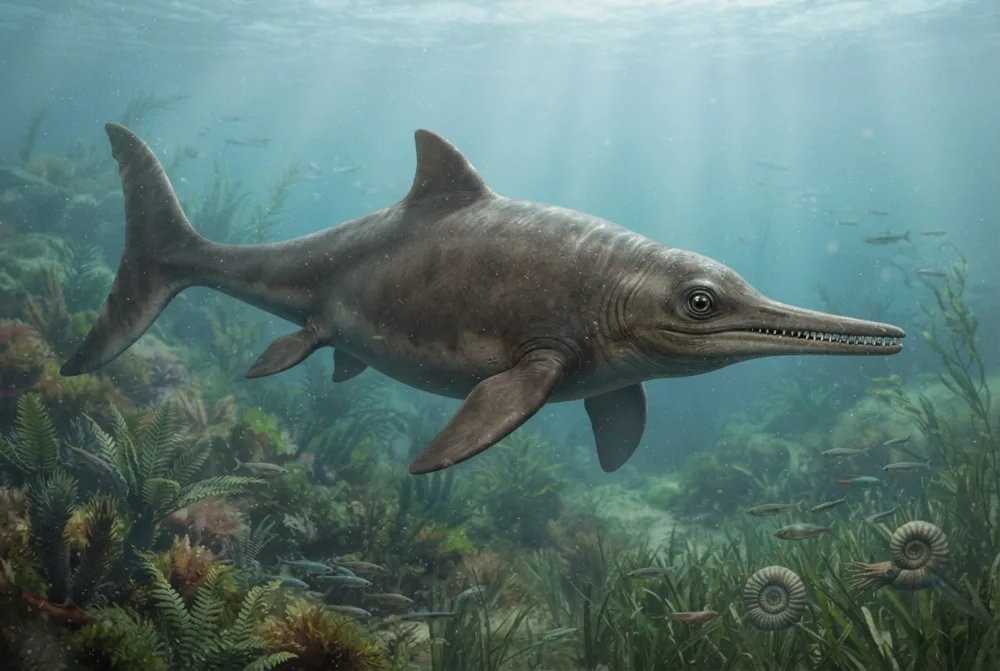
Leninia was a marine reptile that lived in the Early Cretaceous seas, not a dinosaur. It had huge eyes and probably dove deep to hunt for fish and squid.1
When did it live?
Fun facts
Only part of the skull was found, about 45 centimetres (18 inches) long. Scientists think the whole skull was between 65 and 90 centimetres (26 to 35 inches) long.1
Leninia had one of the largest scleral rings (the bony ring that supports the eye) of any ichthyosaur. Only Baptanodon and the giant Temnodontosaurus had bigger ones.1
Its skull bones form a star-shaped pattern, which is why its species name is stellans, meaning 'shining' or 'star-like'.1
Leninia lived about 119 to 113 million years ago, during the Early Cretaceous Period.1
It is one of the latest-living members of the ophthalmosaurine group, which were deep-diving ichthyosaurs with very large eyes.1
The fossil was discovered in 2012 in a limestone nodule on the banks of the Volga River, near the town of Kriushi.1

Ask Rex about Leninia
Rex only answers questions about this page. 3 questions a day.
Rex is an AI and can make mistakes. He runs on servers in the EU and questions are never saved. Never type your name or other personal things.
For dino experts
- Scientific name
- Leninia
- Named by
- Fischer et al. 20133
- Group
- Ichthyosaurs
- Family / clade
- Ophthalmosauridae3
- Classification
- Ichthyosauria > Ichthyosauromorpha3
- Age of the rocks
- 121 to 120 million years (Aptian)3
- Countries
- Russia3
- Fossil records
- 1 in the Paleobiology Database3
- Discovery
- Leninia was named in 2013 by Valentin Fischer and colleagues. The only known fossil is a partial skull found in 2012 on the Volga River banks in Russia.13
- Still debated
- Scientists are not sure exactly how long the whole animal was, because only a piece of the skull has been found.1
Where the facts come from
- Leninia (en.wikipedia.org)
- PBDB Taxon (paleobiodb.org)
- Leninia in The Paleobiology Database (CC BY 4.0): age, places, rock formations, classification.
Every fact on this page has a number that points to its source. If we got something wrong, sorry, we are dino fans, not a science journal. Tell us at [email protected] and we will fix it.
 Rex is hungry! Dino Wiki is a dad's project for his dino-loving son, free with no ads. Grown-ups can feed Rex a snack to help keep it online.Feed Rex
 Ichthyosaurus
 Platypterygius
 Stenopterygius
 Khudiakovia
 Ophthalmosaurus
 Chonespondylus
 Stegosaurus
 Iguanodon
 Archaeopteryx
 Giganotosaurus
 Microraptor
 Deinonychus