
Lepidus
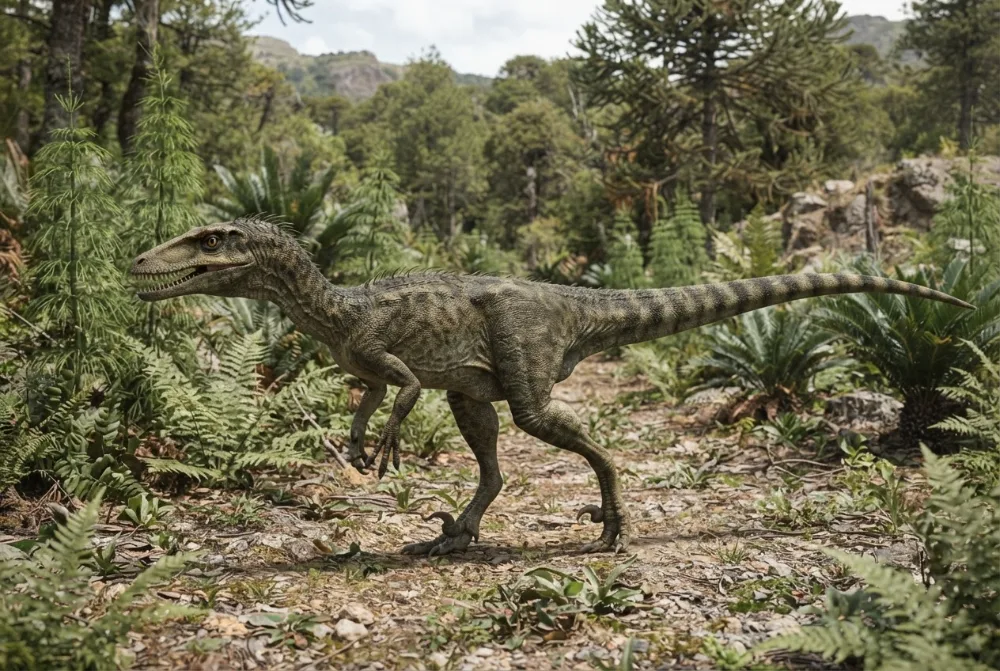
Lepidus was a small, meat-eating dinosaur that lived in what is now Texas, USA, during the Late Triassic period. It was one of the earliest neotheropods, a group that includes famous dinosaurs like Coelophysis. Scientists know it from just a few bones, including an ankle and a piece of its upper jaw.21
When did it live?
Fun facts
Lepidus was named in 2015 by scientists Sterling Nesbitt and Martín Ezcurra.2
Its name comes from Latin and means 'fascinating' or 'charming'.1
Lepidus is known from only a few bones: an ankle, a piece of the upper jaw, and a thigh bone.1
It lived during the Norian stage of the Late Triassic, about 227 to 205 million years ago.2
Lepidus was a coelophysoid neotheropod, meaning it was more closely related to Coelophysis than to Allosaurus.1
The fossils were found near the famous Otis Chalk localities in Texas, which are among the oldest dinosaur sites in North America.1

Ask Rex about Lepidus
Rex only answers questions about this page. 3 questions a day.
Rex is an AI and can make mistakes. He runs on servers in the EU and questions are never saved. Never type your name or other personal things.
For dino experts
- Scientific name
- Lepidus
- Named by
- Nesbitt and Ezcurra 20152
- Group
- Other meat-eaters
- Family / clade
- Coelophysidae2
- Classification
- Theropoda > Coelophysoidea2
- Age of the rocks
- 227 to 206 million years (Norian)2
- Countries
- USA2
- Fossil records
- 1 in the Paleobiology Database2
- Discovery
- Lepidus was discovered by a Works Progress Administration paleontology team in the 1940s, but it was not named until 2015 by Sterling Nesbitt and Martín Ezcurra.1
- Still debated
- Scientists are not sure exactly how old the Lepidus fossils are, because the rocks where they were found have not been dated with radiometric methods.1
Where the facts come from
- The early fossil record of dinosaurs in North America: A new neotheropod from the base of the Upper Triassic Dockum Group of Texas (app.pan.pl)
- Lepidus in The Paleobiology Database (CC BY 4.0): age, places, rock formations, classification.
Every fact on this page has a number that points to its source. If we got something wrong, sorry, we are dino fans, not a science journal. Tell us at [email protected] and we will fix it.
Rex is hungry! Dino Wiki is a dad's project for his dino-loving son, free with no ads. Grown-ups can feed Rex a snack to help keep it online.Feed Rex Allosaurus
 Carnotaurus
 Dilophosaurus
 Giganotosaurus
 Compsognathus
 Paronychodon
 Nothosaurus
 Massospondylus
 Plateosaurus
 Simosaurus
 Thecodontosaurus
 Eudimorphodon