
Eudimorphodon
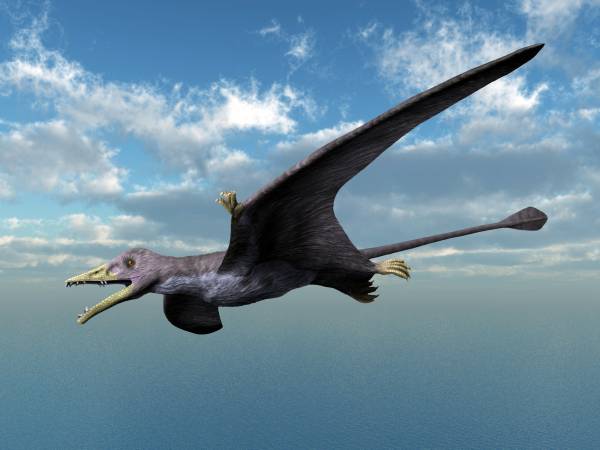
Eudimorphodon was a small flying reptile that lived during the Late Triassic, about 219 to 215 million years ago. It was one of the oldest pterosaurs ever found, with a wingspan about as long as a meter stick. Its name means 'true two-formed tooth' because it had two different kinds of teeth in its mouth.1
When did it live?
How big was it?
Fun facts
Eudimorphodon had 110 teeth packed into a jaw only 6 centimeters (2.4 inches) long. That is more teeth than most pterosaurs.1
Its teeth had multiple points, or cusps, with most having five cusps. This is very unusual for a pterosaur.1
When Eudimorphodon closed its mouth, the top and bottom teeth touched each other. This is the strongest tooth-to-tooth contact known in any pterosaur.1
Young Eudimorphodon had fewer teeth than adults and may have eaten insects instead of fish.1
The first Eudimorphodon fossil was discovered in 1973 by Mario Pandolfi in Cene, Italy. It was a nearly complete skeleton.1
Eudimorphodon lived during the Late Triassic, about 219 to 215 million years ago, making it one of the oldest known pterosaurs.1
For dino experts
- Scientific name
- Eudimorphodon
- Named by
- Zambelli 19732
- Group
- Flying reptiles
- Family / clade
- Campylognathoididae2
- Classification
- Pterosauria2
- Age of the rocks
- 227 to 201 million years (Norian to Rhaetian)2
- Rock formations
- Dolomia di Forni, Klettgau, Zorzino Limestone2
- Countries
- Italy, Switzerland, Luxembourg, France2
- Fossil records
- 13 in the Paleobiology Database2
- Discovery
- Eudimorphodon was discovered in 1973 by Mario Pandolfi in Cene, Italy. It was named the same year by Rocco Zambelli, who called the type species Eudimorphodon ranzii after Professor Silvio Ranzi.12
- Still debated
- Scientists are not sure where pterosaurs like Eudimorphodon fit in the reptile family tree. Some think they are close to dinosaurs, while others suggest different relatives.1
Where the facts come from
- Eudimorphodon (en.wikipedia.org)
- Eudimorphodon in The Paleobiology Database (CC BY 4.0): age, places, rock formations, classification.
Every fact on this page has a number that points to its source. If we got something wrong, sorry, we are dino fans, not a science journal. Tell us at [email protected] and we will fix it.
 Rex is hungry! Dino Wiki is free with no ads. Grown-ups can feed Rex a snack to keep it that way.Feed Rex
 Pteranodon
 Quetzalcoatlus
 Dorygnathus
 Rhamphorhynchus
 Anhanguera
 Pterodactylus
 Nothosaurus
 Massospondylus
 Plateosaurus
 Coelophysis
 Podokesaurus
 Simosaurus