 Home
 All dinos
 Dino groups
 Explore
 Dinos by country
 Dino vs dino
 How big were they?
 Dinos A to Z
 Who ate what?
 What dino are you? Quiz
 Dino games
 Dino battle
 Dino race
 Dino mini-games
 Sticker album
 Dino TOP lists
 Timeline
 Surprise me!
 Language: English

Liaodactylus
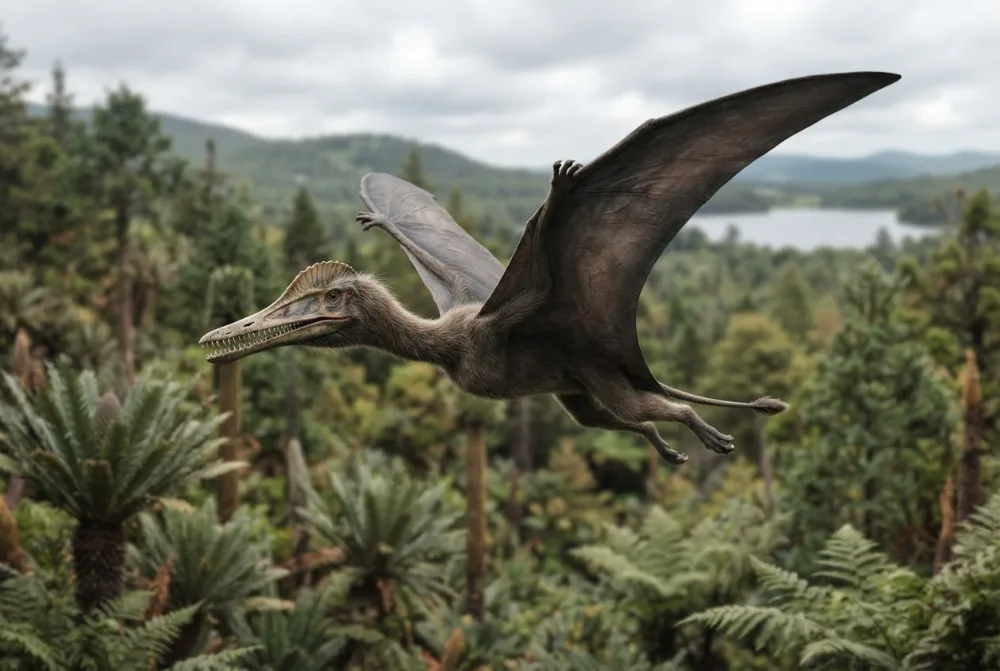
Liaodactylus was an early pterosaur that used its long jaws like a strainer. It had more than 150 thin, comb-like teeth to catch tiny creatures in the water. This flying reptile lived about 160 million years ago in what is now China.1
 China
When did it live?
Liaodactylus: 162 to 155 million years ago
How fast was it?


Fun facts
Liaodactylus is the oldest known filter-feeding pterosaur, living about 160 million years ago in the Late Jurassic.1
Its skull was only 133 mm long, but it held 152 teeth in total, arranged like a comb to trap food.1
The name Liaodactylus means 'Liaoning finger', after the province in China where it was found.1
Liaodactylus belonged to a group called Ctenochasmatidae, which were all filter-feeders with long snouts and many teeth.1
This pterosaur lived alongside small dinosaurs, mammals, and salamanders in the Yanliao Biota of China.1
Liaodactylus had a large opening in its skull called a nasoantorbital fenestra, which is a feature of advanced pterosaurs.1
Most asked questions about Liaodactylus
Myth buster
Myth: Some people think all pterosaurs ate fish or meat.
Truth: Liaodactylus was a filter-feeder, straining tiny creatures from water with its comb-like teeth, not catching fish.1
For dino experts
- Scientific name
- Liaodactylus
- Named by
- Zhou et al. 20173
- Group
- Flying reptiles
- Family / clade
- Ctenochasmatidae3
- Classification
- Pterosauria > Pterodactyloidea3
- Age of the rocks
- 162 to 155 million years (Oxfordian)3
- Rock formations
- Tiaojishan3
- Countries
- China3
- Fossil records
- 1 in the Paleobiology Database3
- Discovery
- Liaodactylus was named in 2017 by Zhou and colleagues based on a nearly complete skull and jaws found at Daxishan in Liaoning, China.31
- Still debated
- Scientists are not sure about the exact size of Liaodactylus because only its skull and neck bones have been found.1
Where the facts come from
- Earliest filter-feeding pterosaur from the Jurassic of China and ecological evolution of Pterodactyloidea - PMC (pmc.ncbi.nlm.nih.gov)
- en.wikipedia.org Liaodactylus (en.wikipedia.org)
- Liaodactylus in The Paleobiology Database (CC BY 4.0): age, places, rock formations, classification.
Every fact on this page has a number that points to its source. If we got something wrong, sorry, we are dino fans, not a science journal. Tell us at hello@dinowiki.app and we will fix it.
 Rex is hungry! Dino Wiki is a dad's project for his dino-loving son, free with no ads and no cookies. Grown-ups can feed Rex a snack to help keep it online.Feed Rex
 Pteranodon
 Quetzalcoatlus
 Dorygnathus
 Rhamphorhynchus
 Anhanguera
 Pterodactylus
 Stegosaurus
 Brachiosaurus
 Diplodocus
 Allosaurus
 Brontosaurus
 Compsognathus