
Neovenator
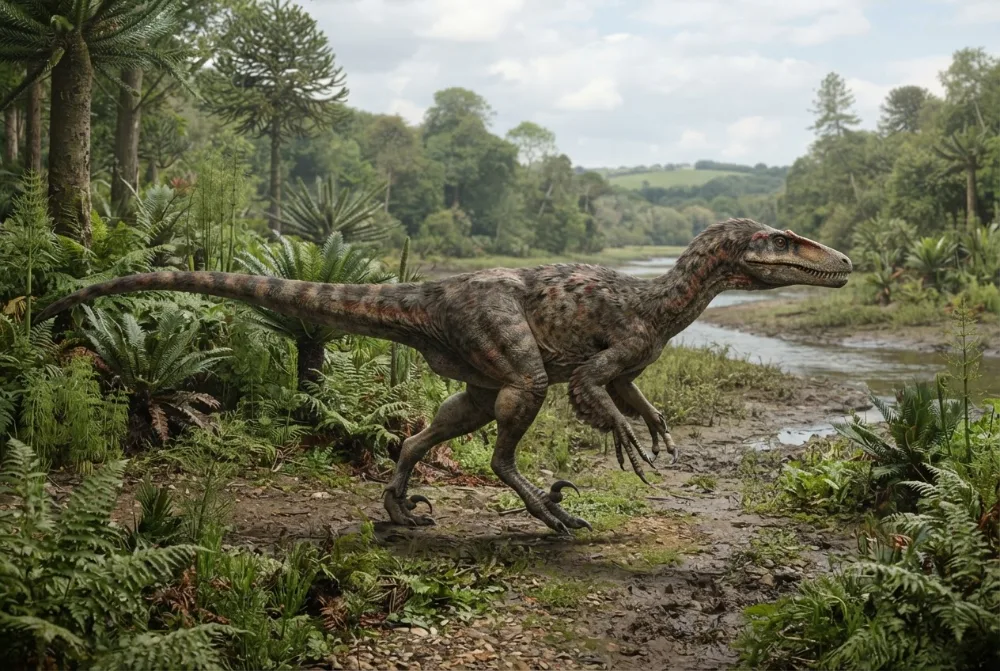
Neovenator was a big, meat-eating dinosaur that lived in what is now England. It was a fast and slender hunter, with sharp teeth and claws. Scientists found about 70% of its skeleton, making it one of the most complete theropod dinosaurs from Europe.2
When did it live?
How big was it?
How big was Neovenator compared to YOU?
Just maths in your browser. Nothing is saved or sent anywhere.
Fun facts
Neovenator lived during the Early Cretaceous period, about 127 to 121 million years ago.1
It was a close relative of Allosaurus from North America and Sinraptor from Asia.2
Neovenator was a gracile (slender and lightly built) dinosaur, unlike some other big theropods.2
Its fossils were found in the Wessex Formation on the Isle of Wight, a famous spot for dinosaur discoveries.42
The name Neovenator means 'new hunter' in Latin.1
Most asked questions about Neovenator
?How big was Neovenator?
Neovenator was about 7 to 7.5 metres (23 to 25 feet) long and weighed around 1 metric ton (1.1 short tons). One possible specimen might have been 10 metres (33 feet) long, but that is uncertain.31
?What did Neovenator eat?
Neovenator was a carnivore that ate other dinosaurs. Bite marks on a fossil of the plant-eater Mantellisaurus show that Neovenator hunted or scavenged it.3
?When did Neovenator live?
Neovenator lived during the Early Cretaceous period, about 127 to 121 million years ago.1
?Where was Neovenator found?
Neovenator fossils were found on the Isle of Wight in England, in the Wessex Formation. Some teeth possibly from Neovenator have also been found in France.31
?Was Neovenator bigger than T. rex?
No, Neovenator was much smaller than T. rex. Neovenator was about 7 metres long, while T. rex could be over 12 metres long.3
?Did Neovenator have feathers?
Nobody knows for sure. No feathers have been found with Neovenator fossils, and it is not clear if this dinosaur had them.3
?How fast could Neovenator run?
Scientists do not know its exact speed, but Neovenator was lightly built and probably a fast runner, like its relative Allosaurus.3

Ask Rex about Neovenator
Rex only answers questions about this page. 3 questions a day.
Rex is an AI and can make mistakes. He runs on servers in the EU and questions are never saved. Never type your name or other personal things.
For dino experts
- Scientific name
- Neovenator
- Named by
- Hutt et al. 19964
- Group
- Other meat-eaters
- Family / clade
- Neovenatoridae4
- Classification
- Theropoda > Allosauroidea4
- Age of the rocks
- 126 to 121 million years (Barremian)4
- Rock formations
- Wessex4
- Countries
- United Kingdom4
- Fossil records
- 1 in the Paleobiology Database4
- Discovery
- Neovenator was named by scientists Steve Hutt, David M. Martill, and Michael J. Barker in 1996. They described it from a partial skull and skeleton found on the Isle of Wight, England.41
- Still debated
- Scientists are not sure exactly which group of theropod dinosaurs Neovenator belongs to. Some place it in Carcharodontosauridae, while others put it in its own family Neovenatoridae.14
Where the facts come from
- Neovenator (nhm.ac.uk)
- The first European allosaurid dinosaur (Lower Cretaceous, Wealden Group, England) - Neues Jahrbuch für Geologie und Paläontologie - Monatshefte Jg. 1996 Heft 10, Schweizerbart science publishers (schweizerbart.de)
- Neovenator (en.wikipedia.org)
- Neovenator in The Paleobiology Database (CC BY 4.0): age, places, rock formations, classification.
Every fact on this page has a number that points to its source. If we got something wrong, sorry, we are dino fans, not a science journal. Tell us at [email protected] and we will fix it.
Rex is hungry! Dino Wiki is a dad's project for his dino-loving son, free with no ads. Grown-ups can feed Rex a snack to help keep it online.Feed Rex Allosaurus
 Carnotaurus
 Dilophosaurus
 Giganotosaurus
 Compsognathus
 Paronychodon
 Stegosaurus
 Iguanodon
 Archaeopteryx
 Microraptor
 Deinonychus
 Baryonyx