
Nesodactylus
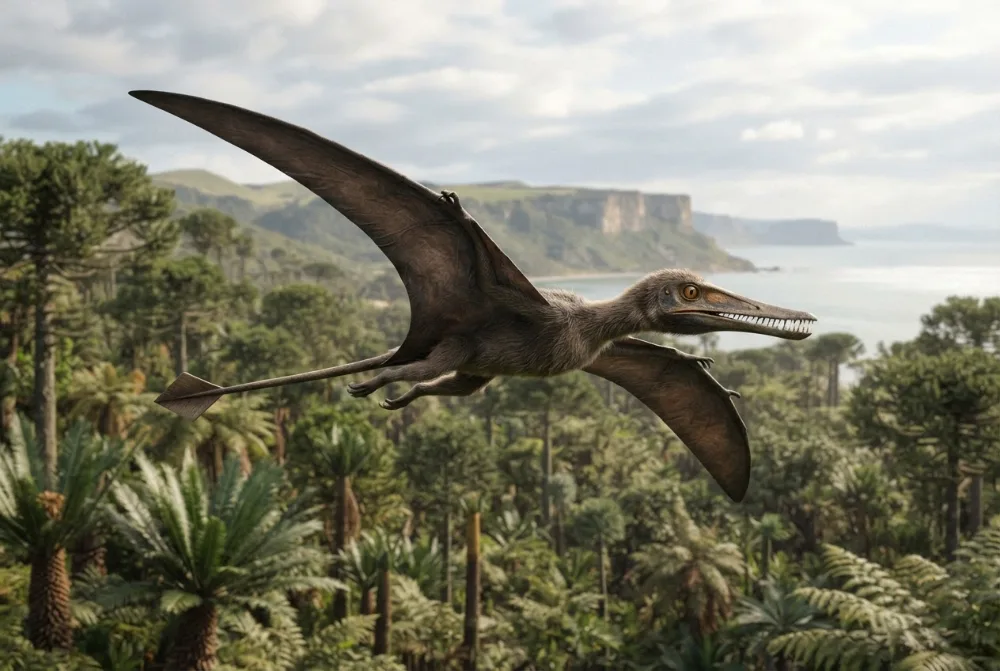
Nesodactylus was a pterosaur, a flying reptile that lived during the Late Jurassic. It had long wings and strong legs, and it probably flew over the sea catching fish to eat.12
When did it live?
Fun facts
Nesodactylus lived about 156 million years ago, during the Late Jurassic.1
Its fossils were collected in 1918 by Barnum Brown, but they were not prepared until 1966, when Richard Lund dissolved the rock in acid to reveal the bones.1
The name Nesodactylus means 'island finger', because it was found on the island of Cuba and pterosaurs have a long wing finger.1
Nesodactylus had longer wings and more robust limbs than its relative Rhamphorhynchus, though it was about the same size.1
The only known skeleton is a partial one, including parts of the skull, spine, wings, legs, and a deeply keeled breastbone.1

Ask Rex about Nesodactylus
Rex only answers questions about this page. 3 questions a day.
Rex is an AI and can make mistakes. He runs on servers in the EU and questions are never saved. Never type your name or other personal things.
For dino experts
- Scientific name
- Nesodactylus
- Named by
- Colbert 19692
- Group
- Flying reptiles
- Family / clade
- Rhamphorhynchidae2
- Classification
- Pterosauria > Rhamphorhynchidae2
- Age of the rocks
- 162 to 143 million years (Oxfordian / Tithonian)2
- Rock formations
- Jagua2
- Countries
- Cuba2
- Fossil records
- 2 in the Paleobiology Database2
- Discovery
- Nesodactylus was named by Edwin H. Colbert in 1969, based on a partial skeleton collected by Barnum Brown in 1918 from the Jagua Formation in Cuba.12
- Still debated
- Scientists are not sure whether Nesodactylus was a rhamphorhynchine or a more basal rhamphorhynchid, because the fossils are incomplete.1
Where the facts come from
- Nesodactylus (en.wikipedia.org)
- Nesodactylus in The Paleobiology Database (CC BY 4.0): age, places, rock formations, classification.
Every fact on this page has a number that points to its source. If we got something wrong, sorry, we are dino fans, not a science journal. Tell us at [email protected] and we will fix it.
Rex is hungry! Dino Wiki is a dad's project for his dino-loving son, free with no ads. Grown-ups can feed Rex a snack to help keep it online.Feed Rex Pteranodon
 Quetzalcoatlus
 Dorygnathus
 Rhamphorhynchus
 Anhanguera
 Pterodactylus
 Brachiosaurus
 Diplodocus
 Allosaurus
 Brontosaurus
 Compsognathus
 Camarasaurus