
Nqwebasaurus
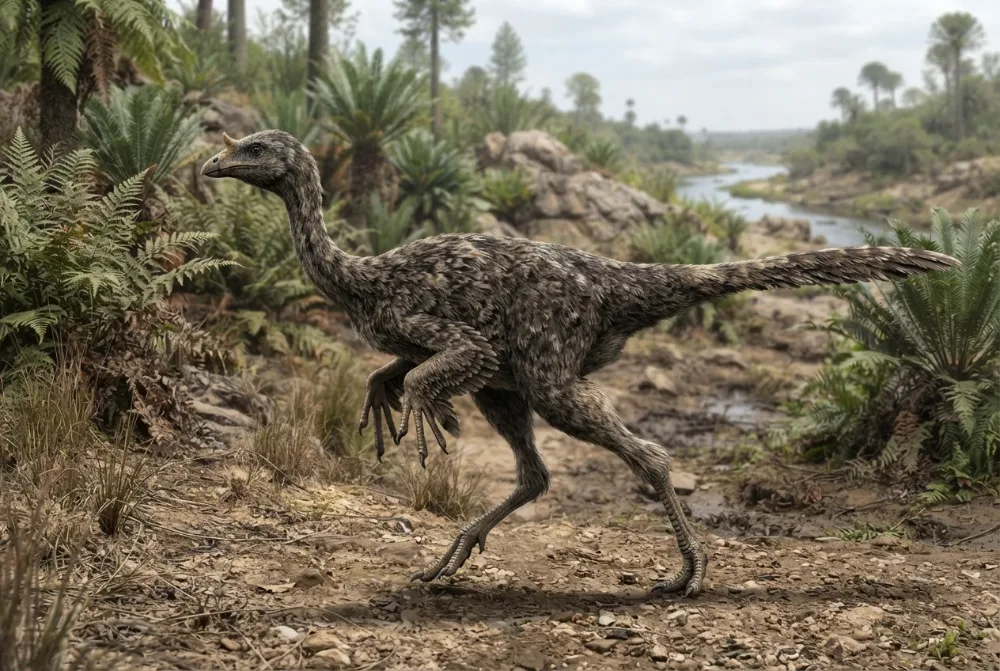
Nqwebasaurus was a small, fast-running dinosaur that lived in what is now South Africa. It had a long, three-fingered hand with a thumb that could partly grip things, and it swallowed stones to help grind up its food.12
When did it live?
How big was it?
How big was Nqwebasaurus compared to YOU?
Just maths in your browser. Nothing is saved or sent anywhere.
Fun facts
Nqwebasaurus is the oldest coelurosaur dinosaur ever found in Africa, pushing the record back about 50 million years.2
Its hands had three fingers, and the first finger (like a thumb) was partly opposable, meaning it could grasp things a little bit.1
The claws on its first and second fingers were curved, but the third claw was straight, which is unusual for a theropod dinosaur.1
Scientists found gastroliths (stomach stones) in its belly, which it used to help grind up tough plant food, just like some birds do today.2
Its species name, thwazi, means 'fast runner' in the Xhosa language.1
The only known fossil is a nearly complete skeleton nicknamed 'Kirky' because it was found in the Kirkwood Formation.1
Most asked questions about Nqwebasaurus
?How big was Nqwebasaurus?
About 1 metre (3.3 feet) long and 1 kilogram (2.2 pounds) in weight, based on estimates by Gregory S. Paul. The only known fossil was a late juvenile about 0.9 metres (3 feet) long.1
?What did Nqwebasaurus eat?
It probably ate both plants and small animals. Scientists found gastroliths (stomach stones) in its belly, which it used to grind up tough plant food, and its teeth were reduced and not serrated.1
?How fast could Nqwebasaurus run?
Its species name thwazi means 'fast runner' in the Xhosa language, so it was built for speed. No exact speed is known from the fossils.1
?When did Nqwebasaurus live?
It lived during the Early Cretaceous period, about 140 million years ago.1
?Where was Nqwebasaurus found?
In South Africa, in the Kirkwood Formation. The only fossil was discovered in July 1996.1
?Is Nqwebasaurus a dinosaur?
Yes, it is a small theropod dinosaur, specifically a basal coelurosaur.1

Ask Rex about Nqwebasaurus
Rex only answers questions about this page. 3 questions a day.
Rex is an AI and can make mistakes. He runs on servers in the EU and questions are never saved. Never type your name or other personal things.
For dino experts
- Scientific name
- Nqwebasaurus
- Named by
- de Klerk et al. 20003
- Group
- Ostrich dinos
- Family / clade
- Ornithomimosauria3
- Classification
- Theropoda > Ornithomimosauria3
- Age of the rocks
- 143 to 133 million years (Berriasian / Valanginian)3
- Rock formations
- Kirkwood3
- Countries
- South Africa3
- Fossil records
- 1 in the Paleobiology Database3
- Discovery
- Nqwebasaurus was discovered in July 1996 by William J. de Klerk and Callum Ross during a joint expedition in the Kirkwood Formation of South Africa. It was named and described in 2000.1
- Still debated
- Scientists are not sure exactly where Nqwebasaurus fits in the dinosaur family tree. Some studies say it is a basal ornithomimosaur, but others have placed it among coelurosaurs, compsognathids, or alvarezsaurids.1
Where the facts come from
- Nqwebasaurus (en.wikipedia.org)
- A new coelurosaurian dinosaur from the Early Cretaceous of South Africa (tandfonline.com)
- Nqwebasaurus in The Paleobiology Database (CC BY 4.0): age, places, rock formations, classification.
Every fact on this page has a number that points to its source. If we got something wrong, sorry, we are dino fans, not a science journal. Tell us at [email protected] and we will fix it.
Rex is hungry! Dino Wiki is a dad's project for his dino-loving son, free with no ads. Grown-ups can feed Rex a snack to help keep it online.Feed Rex Gallimimus
 Ornithomimus
 Struthiomimus
 Deinocheirus
 Dromiceiomimus
 Archaeornithomimus
 Stegosaurus
 Iguanodon
 Archaeopteryx
 Giganotosaurus
 Microraptor
 Deinonychus