
Padillasaurus
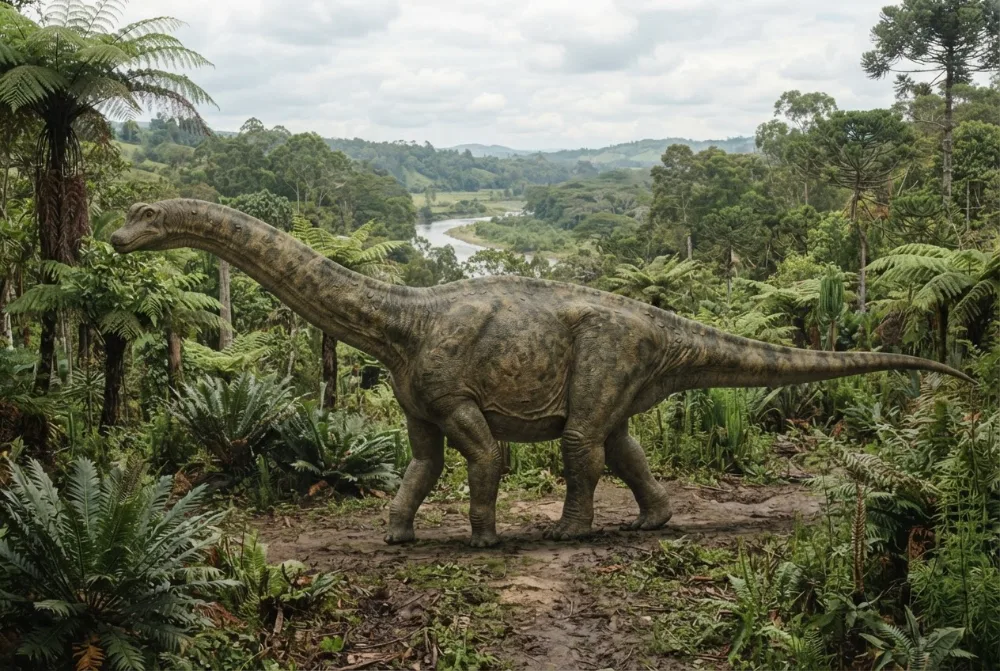
Padillasaurus was a huge, long-necked plant-eater that lived in what is now Colombia about 130 million years ago. It is one of the few sauropods ever found in northern South America from the Early Cretaceous period.12
When did it live?
How big was it?
How big was Padillasaurus compared to YOU?
Just maths in your browser. Nothing is saved or sent anywhere.
Fun facts
Padillasaurus was first thought to be a brachiosaurid, a group of sauropods with very long front legs, but newer studies place it as a basal somphospondylan.1
The only known fossils of Padillasaurus are vertebrae from the back, sacrum, and tail, all from one animal.1
Its fossils were found in marine rocks, meaning the dinosaur's body washed into the sea after death.2
Padillasaurus lived about 130 million years ago, during the Barremian stage of the Early Cretaceous.1
The dinosaur was named after Carlos Bernardo Padilla, who helped start a paleontology center in Villa de Leyva.1
Ammonite fossils found with Padillasaurus helped scientists date the rocks to the late Barremian.1
Most asked questions about Padillasaurus
?How big was Padillasaurus?
It was about 16 to 18 metres long and weighed around 10 tonnes. That is roughly as long as two school buses.13
?What did Padillasaurus eat?
It was a plant-eater. As a sauropod, it ate leaves and other plants.1
?When did Padillasaurus live?
It lived about 130 million years ago, during the Early Cretaceous period.1

Ask Rex about Padillasaurus
Rex only answers questions about this page. 3 questions a day.
Rex is an AI and can make mistakes. He runs on servers in the EU and questions are never saved. Never type your name or other personal things.
For dino experts
- Scientific name
- Padillasaurus
- Named by
- Carballido et al. 20154
- Group
- Long-necks
- Family / clade
- Somphospondyli4
- Classification
- Sauropodomorpha > Sauropoda > Macronaria4
- Age of the rocks
- 126 to 121 million years (Barremian)4
- Rock formations
- Paja4
- Countries
- Colombia4
- Fossil records
- 1 in the Paleobiology Database4
- Discovery
- Local farmers found the fossils in a limestone nodule in the 1990s near Villa de Leyva, Colombia. Scientists named it Padillasaurus leivaensis in 2015.1
- Still debated
- Scientists are not sure exactly how big Padillasaurus was because only a few vertebrae have been found.1
Where the facts come from
- Padillasaurus (en.wikipedia.org)
- UJVP_A_980505_O (staff.mef.org.ar)
- Padillasaurus leivaensis (es.wikipedia.org)
- Padillasaurus in The Paleobiology Database (CC BY 4.0): age, places, rock formations, classification.
Every fact on this page has a number that points to its source. If we got something wrong, sorry, we are dino fans, not a science journal. Tell us at [email protected] and we will fix it.
Rex is hungry! Dino Wiki is a dad's project for his dino-loving son, free with no ads. Grown-ups can feed Rex a snack to help keep it online.Feed Rex Brachiosaurus
 Diplodocus
 Brontosaurus
 Argentinosaurus
 Camarasaurus
 Morosaurus
 Stegosaurus
 Iguanodon
 Archaeopteryx
 Giganotosaurus
 Microraptor
 Deinonychus