
Rhamphocephalus
Rhamphocephalus was a flying reptile that lived during the Middle Jurassic. It soared over the warm seas of what is now England, snatching fish with its sharp beak. But scientists now think some of its bones actually belong to a different kind of reptile, a marine crocodylomorph!1
When did it live?
Fun facts
Rhamphocephalus was originally thought to be a pterosaur, but the type species, R. prestwichi, is now considered a thalattosuchian (a marine crocodylomorph).1
The name Rhamphocephalus was used as a 'wastebasket taxon' for many British Jurassic pterosaur remains, meaning it was a catch-all for fossils that didn't fit elsewhere.1
Fossils of Rhamphocephalus range from about 168 to 155 million years old, from the Bathonian to the Oxfordian stages of the Jurassic.2
Several species once placed in Rhamphocephalus, like Pterodactylus bucklandii, are now considered pterosaurs but not within this genus.1
The holotype (original specimen) of Rhamphocephalus prestwichi is just a fragment of skull roof, which made it hard for scientists to identify correctly.1
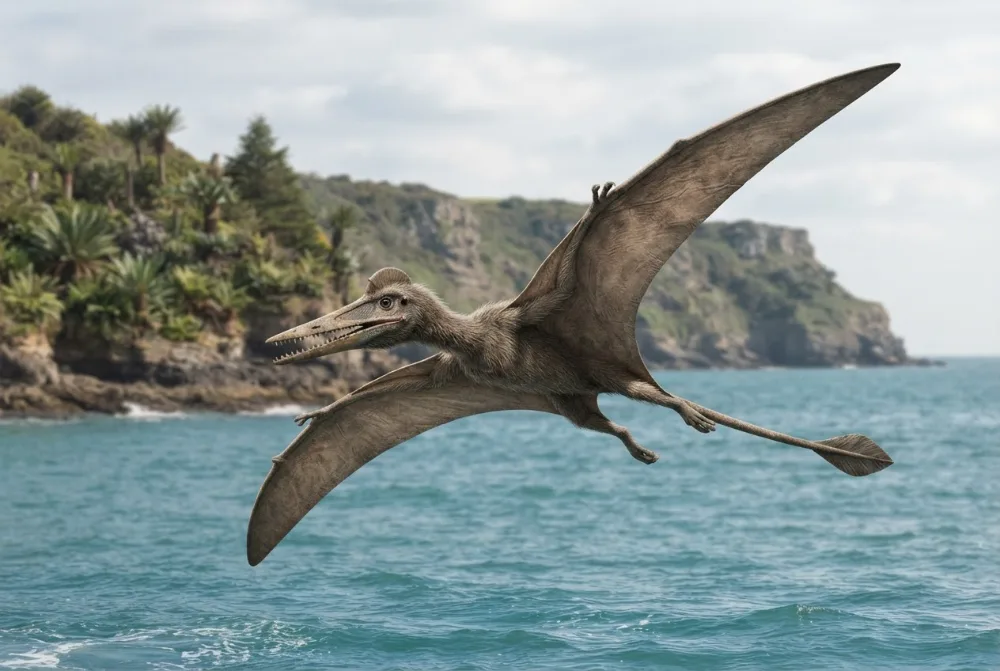
Myth buster
Myth: Rhamphocephalus is definitely a pterosaur.
Truth: The type species is actually a thalattosuchian (a marine crocodylomorph). The pterosaur species once grouped with it are now considered separate.1
For dino experts
- Scientific name
- Rhamphocephalus
- Named by
- Seeley 18803
- Group
- Flying reptiles
- Family / clade
- Rhamphorhynchidae3
- Classification
- Pterosauria > Rhamphorhynchidae3
- Age of the rocks
- 168 to 155 million years (Bathonian to Oxfordian)3
- Rock formations
- Taynton Limestone, Cotswold Slate, Chipping Norton Limestone3
- Countries
- United Kingdom3
- Fossil records
- 10 in the Paleobiology Database3
- Also known as
- Dolichorhamphus (older names now counted as the same animal)3
- Discovery
- Harry Seeley named Rhamphocephalus prestwichi in 1880 based on a skull roof fragment found by Professor Prestwich in Gloucestershire, England.1
- Still debated
- Scientists are still unsure which pterosaur species belong to Rhamphocephalus, because many of the fossils are incomplete or poorly preserved.1
Where the facts come from
- Rhamphocephalus (en.wikipedia.org)
- PBDB Taxon (paleobiodb.org)
- Rhamphocephalus in The Paleobiology Database (CC BY 4.0): age, places, rock formations, classification.
Every fact on this page has a number that points to its source. If we got something wrong, sorry, we are dino fans, not a science journal. Tell us at [email protected] and we will fix it.
 Rex is hungry! Dino Wiki is free with no ads. Grown-ups can feed Rex a snack to keep it that way.Feed Rex
 Pteranodon
 Quetzalcoatlus
 Dorygnathus
 Rhamphorhynchus
 Anhanguera
 Pterodactylus
 Ichthyosaurus
 Khudiakovia
 Ophthalmosaurus
 Peloneustes
 Gongbusaurus
 Shunosaurus