 Get the Dino Wiki app
 Home
 All dinos
 Dino groups
 Explore
 Dinos by country
 Dino vs dino
 How big were they?
 Dinos A to Z
 Who ate what?
 What dino are you? Quiz
 Dino games
 Dino battle
 Dino race
 Dino mini-games
 Sticker album
 Dino TOP lists
 Timeline
 Surprise me!
 Language: English

Sauroposeidon
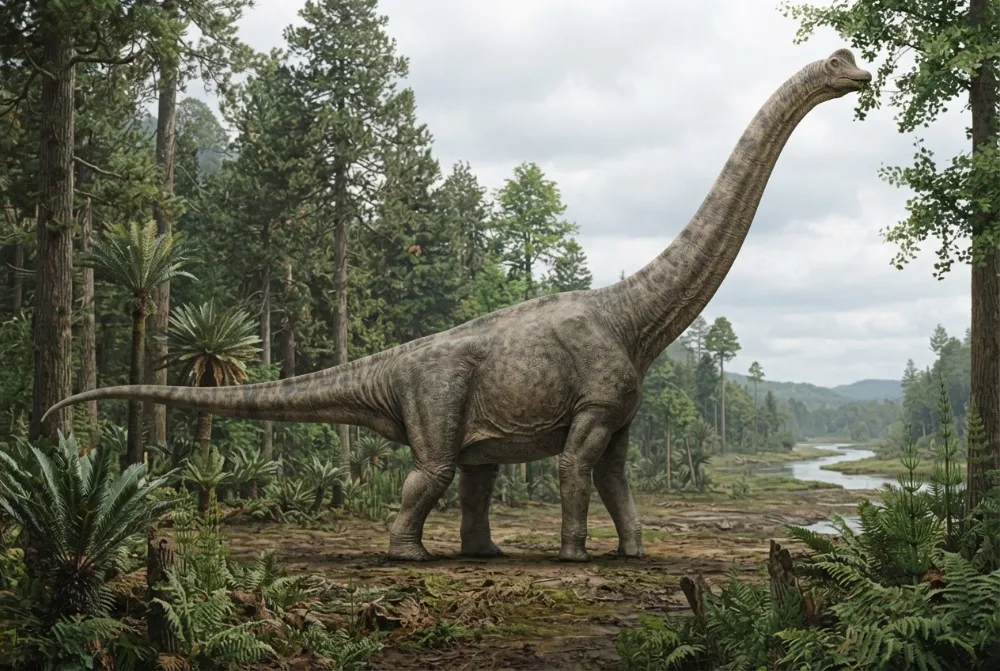
Sauroposeidon was one of the tallest dinosaurs that ever lived. It had an incredibly long neck that helped it reach high into trees to eat leaves. This giant plant-eater lived in North America during the Early Cretaceous period.12
 USA
When did it live?
Sauroposeidon: 121 to 94 million years ago
How big was it?
How long was it?
How tall was it?
at the highest point of the neck
How heavy was it?

 as long as 8 cars parked in a row🍌as long as 190 bananas end to end🍉as heavy as 12000 watermelons🦒as tall as 3 giraffes standing on each other🎒as heavy as 75 whole school classes of kids🏢tall enough to peek into a window on floor 7🏃could run 100 metres in 40 seconds (the fastest human needs 9.6)
How big was Sauroposeidon compared to YOU?
Just maths in your browser. Nothing is saved or sent anywhere.
How fast was it?


Fun facts
Sauroposeidon's neck vertebrae were extremely long and light, filled with air sacs like a bird's bones.2
It lived about 113 to 110 million years ago, near the end of the Early Cretaceous.1
Sauroposeidon was one of the last sauropods in North America before a 40-million-year gap without them.1
The first fossils were four neck bones found in Oklahoma in 1994.1
Scientists once thought the Texas fossils were a separate dinosaur called Paluxysaurus, but now they are considered the same as Sauroposeidon.1
Sauroposeidon is the official state dinosaur of Texas.1
Its neck could reach about 11 to 12 meters (36 to 39 feet) long, letting it browse from treetops without moving its body.1
Get the Dino Wiki app
Every dino, the quiz and the games on your phone or tablet. The full version also works offline in your language.


Most asked questions about Sauroposeidon
?How tall was Sauroposeidon?
Its head could reach about 16.5 to 18 metres (54 to 59 feet) high with its neck stretched up, making it one of the tallest dinosaurs ever.1
?How long was Sauroposeidon?
It was about 27 to 34 metres (89 to 112 feet) long, which is similar to the length of a blue whale.1
?How much did Sauroposeidon weigh?
It weighed about 40 to 60 tonnes (44 to 66 short tons), as heavy as a herd of elephants.1
?What did Sauroposeidon eat?
It was a plant-eater. Its very long neck let it lift its head about 17 metres high, so it could probably reach leaves high in the trees.31
?When did Sauroposeidon live?
It lived about 113 to 110 million years ago, during the Early Cretaceous period.1
?Where was Sauroposeidon found?
Its fossils were found in the U.S. states of Oklahoma, Texas, and Wyoming.1
?Why did Sauroposeidon have such a long neck?
Its long neck helped it reach high into trees to eat leaves without moving its whole body, like a giraffe's neck.1
?Is Sauroposeidon a dinosaur?
Yes, it is a sauropod dinosaur, a type of long-necked plant-eater.1
Myth buster
Myth: Sauroposeidon was the largest dinosaur ever.
Truth: While very tall, Sauroposeidon was not the heaviest or longest. Other sauropods like Argentinosaurus were bigger overall.1
For dino experts
- Scientific name
- Sauroposeidon
- Named by
- Wedel et al. 20004
- Group
- Long-necks
- Family / clade
- Somphospondyli4
- Classification
- Sauropodomorpha > Sauropoda > Macronaria4
- Age of the rocks
- 121 to 94 million years (Aptian / Cenomanian)4
- Rock formations
- Cloverly, Antlers, Twin Mountains4
- Countries
- USA4
- Fossil records
- 6 in the Paleobiology Database4
- Also known as
- Paluxysaurus (older names now counted as the same animal)4
- Discovery
- Sauroposeidon was named in 2000 by paleontologists Mathew Wedel, Richard Cifelli, and Kent Sanders based on neck bones found in Atoka County, Oklahoma.41
- Still debated
- Scientists still debate whether Sauroposeidon was a brachiosaurid or more closely related to titanosaurs.1
Where the facts come from
- Sauroposeidon (en.wikipedia.org)
- Osteology, paleobiology, and relationships of the sauropod ... (app.pan.pl)
- Sauropoda - Wikipedia (citing Taylor & Wedel 2013, PeerJ) (en.wikipedia.org)
- Sauroposeidon in The Paleobiology Database (CC BY 4.0): age, places, rock formations, classification.
Every fact on this page has a number that points to its source. If we got something wrong, sorry, we are dino fans, not a science journal. Tell us at hello@dinowiki.app and we will fix it.
 Brachiosaurus
 Diplodocus
 Brontosaurus
 Argentinosaurus
 Camarasaurus
 Morosaurus
 Iguanodon
 Archaeopteryx
 Giganotosaurus
 Microraptor
 Deinonychus
 Baryonyx