
Uragasaurus
Uragasaurus was a long-necked plant-eater that lived in what is now Thailand. It had a snake-like neck and a backbone with air pockets that made it lighter. This dinosaur is one of the first of its family found in Southeast Asia.1
When did it live?
How big was it?
How long was it?
How big was Uragasaurus compared to YOU?
Just maths in your browser. Nothing is saved or sent anywhere.
Fun facts
Uragasaurus is known from just one well-preserved backbone bone from the front of the back, called an anterior dorsal vertebra.1
The backbone had a Y-shaped pattern of bony ridges that is unique to this dinosaur.1
CT scans showed that the inside of the backbone was filled with tiny air spaces, a feature called camellate structure, which made the skeleton lighter.1
Uragasaurus lived during the latest Jurassic period, about 149 to 137 million years ago.4
It belongs to a group called Mamenchisauridae, which were famous for their extremely long necks.1
This dinosaur was discovered in the Phu Kradung Formation, a rock layer that also contains fossils of sharks, turtles, and other dinosaurs.1
Uragasaurus is the first officially named mamenchisaurid dinosaur from Thailand.1
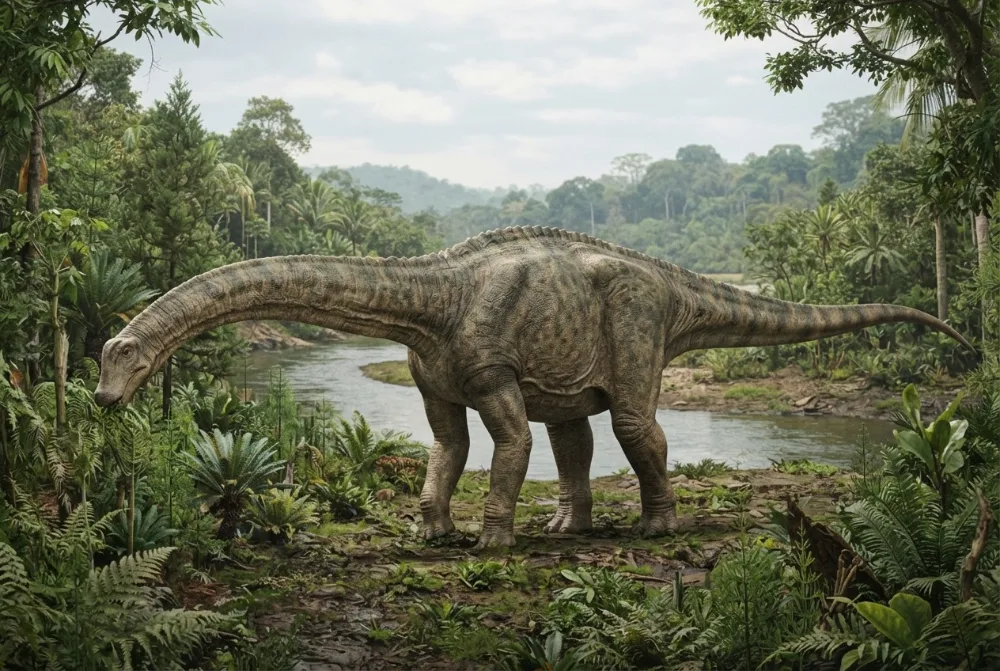
Most asked questions about Uragasaurus
?How big was Uragasaurus?
Scientists do not know for sure because only one backbone bone has been found. Based on its relatives, it was probably a large, long-necked plant-eater.31
?What did Uragasaurus eat?
It was a plant-eater, like all sauropods. It probably ate ferns, cycads, and other plants that grew in its habitat.3
?When did Uragasaurus live?
It lived during the late Jurassic to early Cretaceous periods, about 150 to 130 million years ago.3
?Where was Uragasaurus found?
Its fossils were found in Kalasin Province, northeastern Thailand, in the Phu Kradung Formation.31
?Is Uragasaurus a dinosaur?
Yes, it is a dinosaur. It is a type of long-necked sauropod dinosaur called a mamenchisaurid.3
?Why is it called Uragasaurus?
The name means 'serpent lizard' in Sanskrit and Greek, because its family is famous for having very long, snake-like necks.3
Ask Rex about Uragasaurus
Rex only answers questions about this page. 3 questions a day.
Rex is an AI and can make mistakes. He runs on servers in the EU and questions are never saved. Never type your name or other personal things.
For dino experts
- Scientific name
- Uragasaurus
- Named by
- Nilpanapan et al. 20264
- Group
- Long-necks
- Family / clade
- Mamenchisauridae4
- Classification
- Sauropodomorpha > Sauropoda4
- Age of the rocks
- 149 to 137 million years (Tithonian / Berriasian)4
- Rock formations
- Phu Kradung4
- Countries
- Thailand4
- Fossil records
- 1 in the Paleobiology Database4
- Discovery
- Uragasaurus was named in 2026 by a team of scientists led by A. Nilpanapan. The fossil was found at the Phu Noi site in Kalasin Province, Thailand, and is kept at Mahasarakham University.14
- Still debated
- Scientists are not sure exactly how old the rocks are that contained Uragasaurus, so its age is estimated as latest Jurassic, possibly into the earliest Cretaceous.1
Where the facts come from
- A new mamenchisaurid sauropod from the Lower Phu Kradung Formation, Upper Jurassic of northeastern Thailand | Scientific Reports (nature.com)
- Uragasaurus kalasinensis: New dinosaur discovered in Thailand - BBC News (bbc.co.uk)
- Uragasaurus (en.wikipedia.org)
- Uragasaurus in The Paleobiology Database (CC BY 4.0): age, places, rock formations, classification.
Every fact on this page has a number that points to its source. If we got something wrong, sorry, we are dino fans, not a science journal. Tell us at [email protected] and we will fix it.
 Rex is hungry! Dino Wiki is a dad's project for his dino-loving son, free with no ads. Grown-ups can feed Rex a snack to help keep it online.Feed Rex
 Brachiosaurus
 Diplodocus
 Brontosaurus
 Argentinosaurus
 Camarasaurus
 Morosaurus
 Stegosaurus
 Iguanodon
 Archaeopteryx
 Giganotosaurus
 Microraptor
 Deinonychus