
Volgatitan
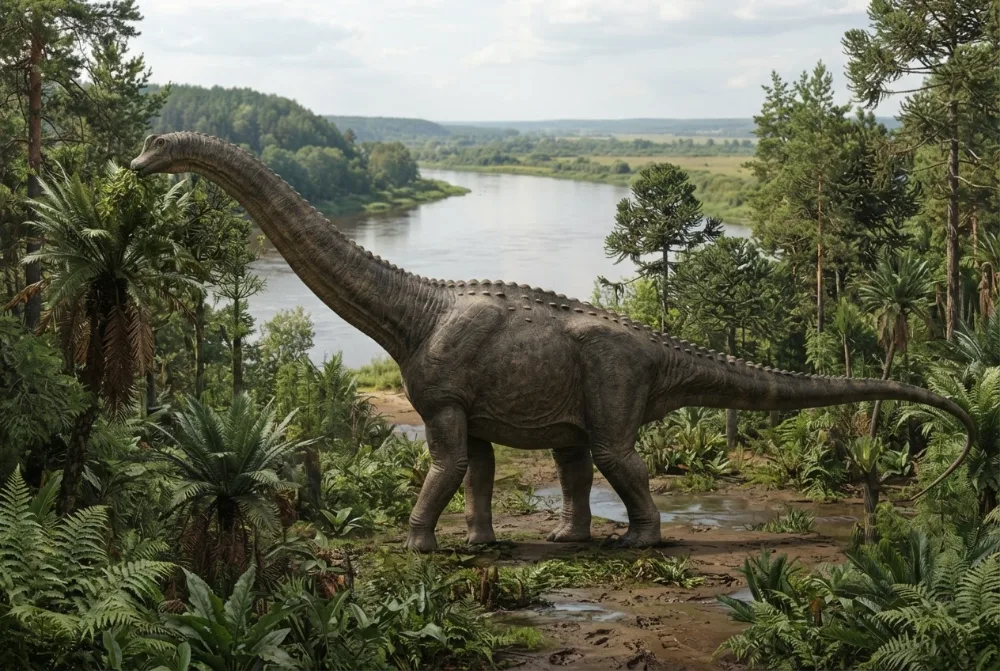
Volgatitan was a huge, long-necked dinosaur that munched on plants. It lived near the Volga River in Russia about 130 million years ago. This gentle giant weighed as much as three elephants!12
When did it live?
Fun facts
Most asked questions about Volgatitan
?How big was Volgatitan?
It weighed about 17.3 metric tons (19.1 short tons), as heavy as a big truck. Its length is not known exactly, but it was a large sauropod.12
?What did Volgatitan eat?
It was a herbivore, meaning it ate plants. It used its long neck to reach leaves and ferns.4
?When did Volgatitan live?
It lived about 130 million years ago, during the Early Cretaceous period. That's the time of the dinosaurs.14
?Is Volgatitan a dinosaur?
Yes, it is a dinosaur. It was a sauropod, a long-necked plant-eater.1

Ask Rex about Volgatitan
Rex only answers questions about this page. 3 questions a day.
Rex is an AI and can make mistakes. He runs on servers in the EU and questions are never saved. Never type your name or other personal things.
For dino experts
- Scientific name
- Volgatitan
- Named by
- Averianov and Efimov 20184
- Group
- Long-necks
- Family / clade
- Mamenchisauridae4
- Classification
- Sauropodomorpha > Sauropoda4
- Age of the rocks
- 133 to 126 million years (Hauterivian)4
- Countries
- Russia4
- Fossil records
- 1 in the Paleobiology Database4
- Discovery
- Volgatitan was named in 2018 by Russian paleontologists Alexander Averianov and Vladimir Efimov. They found the bones at a place called Slantsevy Rudnik near Ulyanovsk, Russia.123
- Still debated
- Scientists are not sure how long Volgatitan's neck and body were, because only tail bones have been found.13
Where the facts come from
- Volgatitan (en.wikipedia.org)
- The oldest titanosaurian sauropod of the Northern Hemisphere | Biological Communications (biocomm.spbu.ru)
- PBDB Taxon (paleobiodb.org)
- Volgatitan in The Paleobiology Database (CC BY 4.0): age, places, rock formations, classification.
Every fact on this page has a number that points to its source. If we got something wrong, sorry, we are dino fans, not a science journal. Tell us at [email protected] and we will fix it.
Rex is hungry! Dino Wiki is a dad's project for his dino-loving son, free with no ads. Grown-ups can feed Rex a snack to help keep it online.Feed Rex Brachiosaurus
 Diplodocus
 Brontosaurus
 Argentinosaurus
 Camarasaurus
 Morosaurus
 Stegosaurus
 Iguanodon
 Archaeopteryx
 Giganotosaurus
 Microraptor
 Deinonychus