 Home
 All dinos
 Dino groups
 Explore
 Dinos by country
 Dino vs dino
 How big were they?
 Dinos A to Z
 Who ate what?
 What dino are you? Quiz
 Dino games
 Dino battle
 Dino race
 Dino mini-games
 Sticker album
 Dino TOP lists
 Timeline
 Surprise me!
 Language: English
 China
When did it live?
Yanbeilong: 113 to 100 million years ago

How fast was it?


Fun facts
Yanbeilong is known from a single partial skeleton that includes vertebrae and hip bones.1
It lived about 113 to 100 million years ago, during the Albian age of the Early Cretaceous.2
The name 'ultimus' means 'last' in Latin, because it was one of the last stegosaurs.1
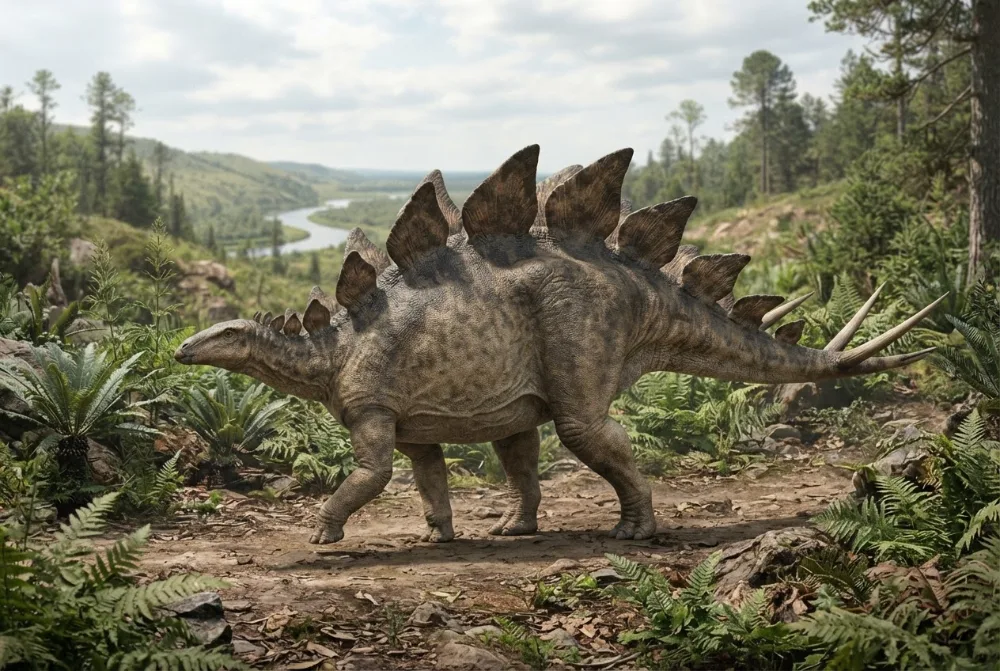
Yanbeilong was a close relative of Stegosaurus and Wuerhosaurus.1
Its fossils were discovered in 2011 in the Zuoyun Formation of China.1
Scientists think Yanbeilong was a ground-dwelling herbivore that walked on all four legs.2
Most asked questions about Yanbeilong
?How big was Yanbeilong?
Scientists do not know Yanbeilong's exact size because only a partial skeleton has been found. Estimates suggest it was a medium sized dinosaur, but a specific length is not currently known.2
?What did Yanbeilong eat?
Yanbeilong was a herbivore, meaning it ate plants. It was a ground-dwelling dinosaur that walked on all four legs.2
?When did Yanbeilong live?
Yanbeilong lived during the Albian age of the Early Cretaceous period, about 113 to 100 million years ago.12
?Where was Yanbeilong found?
Yanbeilong's fossils were discovered in 2011 in the Zuoyun Formation near Madaotou Township in Shanxi, China.1
?Is Yanbeilong a dinosaur?
Yes, Yanbeilong is a dinosaur. It is a stegosaur, a kind of plated ornithischian dinosaur.1
?Why is it called Yanbeilong ultimus?
Yanbeilong means 'north of Yanmen Pass dragon' in Chinese, and 'ultimus' means 'last' in Latin, because it was one of the last stegosaurs to exist.1
For dino experts
- Scientific name
- Yanbeilong
- Named by
- Jia et al. 20242
- Group
- Plated dinos
- Family / clade
- Stegosauridae2
- Classification
- Ornithischia > Stegosauria > Thyreophora2
- Age of the rocks
- 113 to 100 million years (Albian)2
- Rock formations
- Zuoyun2
- Countries
- China2
- Fossil records
- 1 in the Paleobiology Database2
- Discovery
- Yanbeilong was named in 2024 by Lei Jia and colleagues based on a partial skeleton found in 2011 in Shanxi, China.12
- Still debated
- Scientists are not sure exactly how many plates or spikes Yanbeilong had on its back, because only a partial skeleton has been found.1
Where the facts come from
- Yanbeilong (en.wikipedia.org)
- Yanbeilong in The Paleobiology Database (CC BY 4.0): age, places, rock formations, classification.
Every fact on this page has a number that points to its source. If we got something wrong, sorry, we are dino fans, not a science journal. Tell us at hello@dinowiki.app and we will fix it.
 Rex is hungry! Dino Wiki is a dad's project for his dino-loving son, free with no ads and no cookies. Grown-ups can feed Rex a snack to help keep it online.Feed Rex
 Stegosaurus
 Diracodon
 Hypsirophus
 Dacentrurus
 Miragaia
 Kentrosaurus
 Iguanodon
 Archaeopteryx
 Giganotosaurus
 Microraptor
 Deinonychus
 Baryonyx