 Zer dino zara? Galdetegia
 Dino borroka
 Dino lasterketa
 Dino minijokoak
 Pegatina-albuma
 Dino TOP zerrendak
 Harritu nazazu!
Austriadactylus
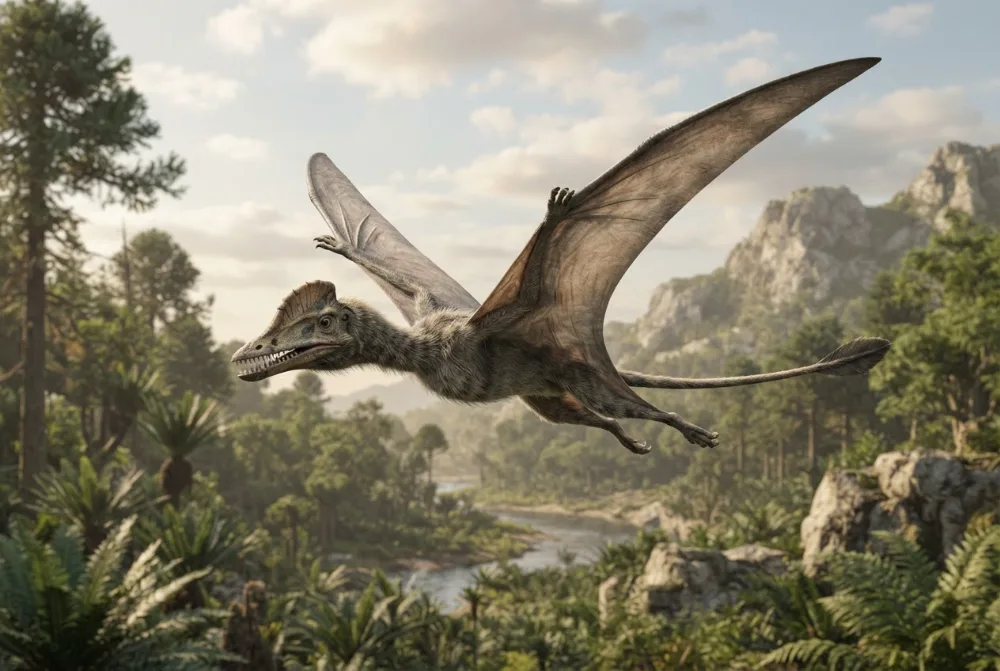
Austriadactylus was an early flying reptile with a long tail and a crest on its head. It lived about 215 million years ago in what is now Austria and Italy. This pterosaur had many different kinds of teeth, perfect for crunching hard-shelled bugs.12
Noiz bizi izan zen?
Zein handia zen?
Zein zabalak ziren bere hegoak?
 2,5 etxeko katu bezain luze, sudurretik buztanera⚽futbol zelai oso bat zeharkatu zezakeen hegan 9,7 segundotan
Zein handia zen Austriadactylus ZUREKIN alderatuta?
Zure nabigatzaileko kalkulu hutsak. Ez da ezer gordetzen ez inora bidaltzen.
Zein azkarra zen?


Datu dibertigarriak
Austriadactylus had a bony crest on its head that started at the tip of its snout and went back to above its eye. The crest was about 2 cm tall.21
Its teeth were very different from each other. It had tall, pointed teeth at the front, blade-like teeth with tiny serrations in the middle, and triangular teeth with up to 12 small points at the back.2
Unlike many other long-tailed pterosaurs, Austriadactylus had a flexible tail without stiff rods made of bone.21
The only known fossil of Austriadactylus was found in an abandoned mine near Ankerschlag in Tyrol, Austria.21
Austriadactylus lived during the Late Triassic period, about 215 million years ago, in a shallow sea environment with islands.12
The name Austriadactylus cristatus means 'crested Austrian finger', referring to the wing finger and the crest on its head.1
Austriadactylus: gehien egindako galderak
?What did Austriadactylus eat?
It mostly ate hard-shelled bugs. Scientists can tell from the tiny scratches on its teeth that it crunched hard invertebrates.1
?How big was Austriadactylus?
Its wingspan was about 120 cm (47 inches), and its skull was 11 cm long. It was about the size of a crow.1
?Did Austriadactylus have a crest?
Yes, it had a bony crest on its head that started at the tip of its snout and went back to above its eye. The crest was about 2 cm tall.1
?Is Austriadactylus a dinosaur?
No, it is a pterosaur, which is a flying reptile that lived at the same time as dinosaurs but is not a dinosaur.1
Dino adituentzat
- Izen zientifikoa
- Austriadactylus
- Izendatzailea:
- Dalla Vecchia et al. 20023
- Taldea
- Narrasti hegalariak
- Familia / klada
- Pterosauria3
- Sailkapena
- Pterosauria3
- Arroken adina
- 215 eta 206 milioi urte artean (Norian)3
- Arroka-formazioak
- Seefelder Schichten, Dolomia di Forni3
- Herrialdeak
- Austria, Italia3
- Fosil-erregistroak
- 2 The Paleobiology Database datu-basean3
- Aurkikuntza
- Austriadactylus was named in 2002 by Fabio Marco Dalla Vecchia and colleagues. The fossil was found in an abandoned mine in Tyrol, Austria, and is stored at the State Museum of Natural History in Stuttgart, Germany.31
- Oraindik eztabaidagai
- Scientists are not sure if Austriadactylus is a close relative of Eudimorphodon or if it belongs to a different group. Some think it might even be the same animal as Eudimorphodon.1
Datuak nondik datozen
- Austriadactylus (en.wikipedia.org)
- vrpa_22_124.196_199.tp (doc.rero.ch)
- Austriadactylus in The Paleobiology Database (CC BY 4.0): adina, tokiak, arroka-formazioak, sailkapena.
Orrialde honetako datu bakoitzak zenbaki bat du, bere iturrira eramaten zaituena. Zerbait gaizki badugu, barkatu, dino-zaleak gara, ez zientzia-aldizkari bat. Idatzi [email protected] helbidera eta konponduko dugu.
 Rex gose da! Dino Wiki aita baten proiektua da, dinosauroak maite dituen bere semearentzat, doakoa, iragarkirik eta jarraitzailerik gabe. Helduek mokadutxo bat eman diezaiokete Rexi, sarean jarraitzen laguntzeko.Eman jaten Rexi
 Pteranodon
 Quetzalcoatlus
 Dorygnathus
 Rhamphorhynchus
 Anhanguera
 Pterodactylus
 Nothosaurus
 Massospondylus
 Plateosaurus
 Coelophysis
 Podokesaurus
 Simosaurus