 Zer dino zara? Galdetegia
 Dino borroka
 Dino lasterketa
 Dino minijokoak
 Pegatina-albuma
 Dino TOP zerrendak
 Harritu nazazu!
Balaenognathus
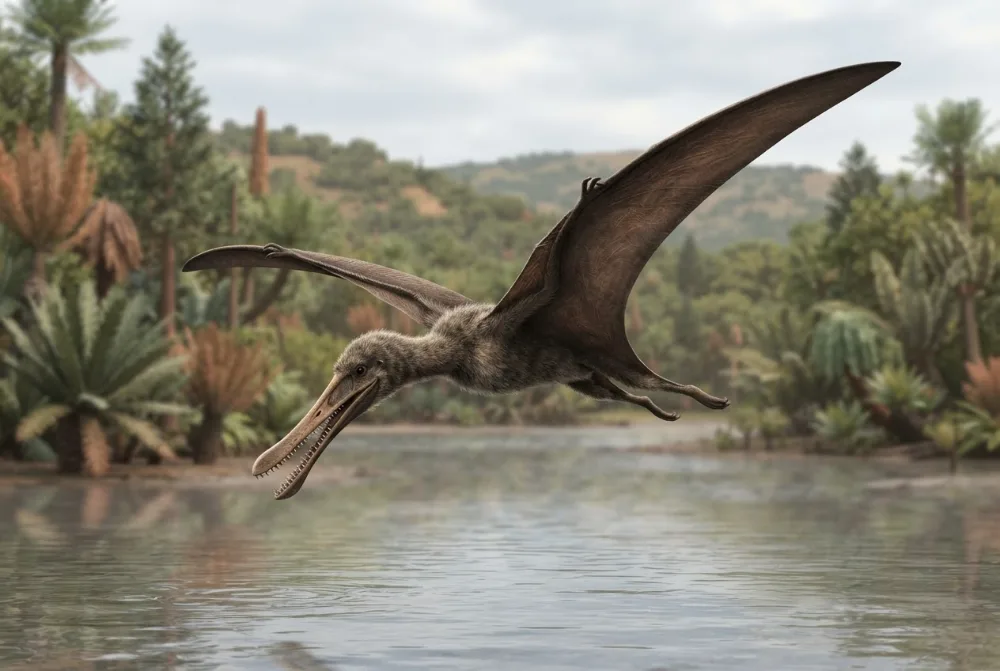
Balaenognathus was a flying reptile that lived about 150 million years ago. It had a strange, spoon-shaped snout with hundreds of tiny hooked teeth. It used its beak like a strainer to scoop up tiny shrimp from the water, just like a modern flamingo.12
Noiz bizi izan zen?
Zein handia zen?
Zein luzea zen?
 2 etxeko katu bezain luze, sudurretik buztanera🍌bata bestearen atzean jarritako 6 banana bezain luze⚽futbol zelai oso bat zeharkatu zezakeen hegan 9,9 segundotan
Zein handia zen Balaenognathus ZUREKIN alderatuta?
Zure nabigatzaileko kalkulu hutsak. Ez da ezer gordetzen ez inora bidaltzen.
Zein azkarra zen?


Datu dibertigarriak
Balaenognathus had at least 480 teeth, more than most other pterosaurs.1
The tips of its teeth had tiny hooks, which have never been seen in any other pterosaur. These hooks helped trap shrimp so they couldn't escape.12
The front of its snout was shaped like a spatula and had no teeth, so water could flow in easily.1
Its upper jaw was more curved than its lower jaw, so its mouth stayed slightly open at the front even when closed.1
The fossil was found by accident in a quarry in Germany, inside a block of stone that also contained bones of a crocodile-like animal.12
Balaenognathus lived during the Late Jurassic period, about 152 to 149 million years ago.3
It had long legs, which helped it wade through shallow seas while feeding.2
Balaenognathus: gehien egindako galderak
?What did Balaenognathus eat?
It ate tiny shrimp and other small plankton. It used its spoon-shaped beak and hundreds of tiny hooked teeth to strain them out of the water.12
?How big was Balaenognathus?
It was a medium-sized pterosaur with a wingspan of 1.17 metres (3.8 feet). Its body was about 1 metre long.5
Dino adituentzat
- Izen zientifikoa
- Balaenognathus
- Izendatzailea:
- Martill et al. 20236
- Taldea
- Narrasti hegalariak
- Familia / klada
- Ctenochasmatidae6
- Sailkapena
- Pterosauria > Pterodactyloidea6
- Arroken adina
- 152 eta 149 milioi urte artean (Kimmeridgian)6
- Herrialdeak
- Alemania6
- Fosil-erregistroak
- 1 The Paleobiology Database datu-basean6
- Aurkikuntza
- Balaenognathus was named by David Martill and colleagues in 2023. The only known fossil was found in September 2011 in a quarry near Wattendorf, Bavaria, Germany, by workers collecting a block of limestone.1
- Oraindik eztabaidagai
- Scientists are not sure exactly how Balaenognathus used its hooked teeth and spatula-like snout to filter food, but they think it may have pumped water in and out by moving its long neck.1
Datuak nondik datozen
- A new pterodactyloid pterosaur with a unique filter-feeding apparatus from the Late Jurassic of Germany | PalZ | Springer Nature Link (link.springer.com)
- Bizarre filter-feeding pterosaur described from Germany | Natural History Museum (nhm.ac.uk)
- PBDB Taxon (paleobiodb.org)
- Balaenognathus (en.m.wikipedia.org)
- Balaenognathus (Wikipedia) (Wikipedia)
- Balaenognathus in The Paleobiology Database (CC BY 4.0): adina, tokiak, arroka-formazioak, sailkapena.
Orrialde honetako datu bakoitzak zenbaki bat du, bere iturrira eramaten zaituena. Zerbait gaizki badugu, barkatu, dino-zaleak gara, ez zientzia-aldizkari bat. Idatzi [email protected] helbidera eta konponduko dugu.
 Rex gose da! Dino Wiki aita baten proiektua da, dinosauroak maite dituen bere semearentzat, doakoa, iragarkirik eta jarraitzailerik gabe. Helduek mokadutxo bat eman diezaiokete Rexi, sarean jarraitzen laguntzeko.Eman jaten Rexi
 Pteranodon
 Quetzalcoatlus
 Dorygnathus
 Rhamphorhynchus
 Anhanguera
 Pterodactylus
 Brachiosaurus
 Diplodocus
 Allosaurus
 Brontosaurus
 Compsognathus
 Camarasaurus