 Zer dino zara? Galdetegia
 Dino borroka
 Dino lasterketa
 Dino minijokoak
 Pegatina-albuma
 Dino TOP zerrendak
 Harritu nazazu!
Baryonyx
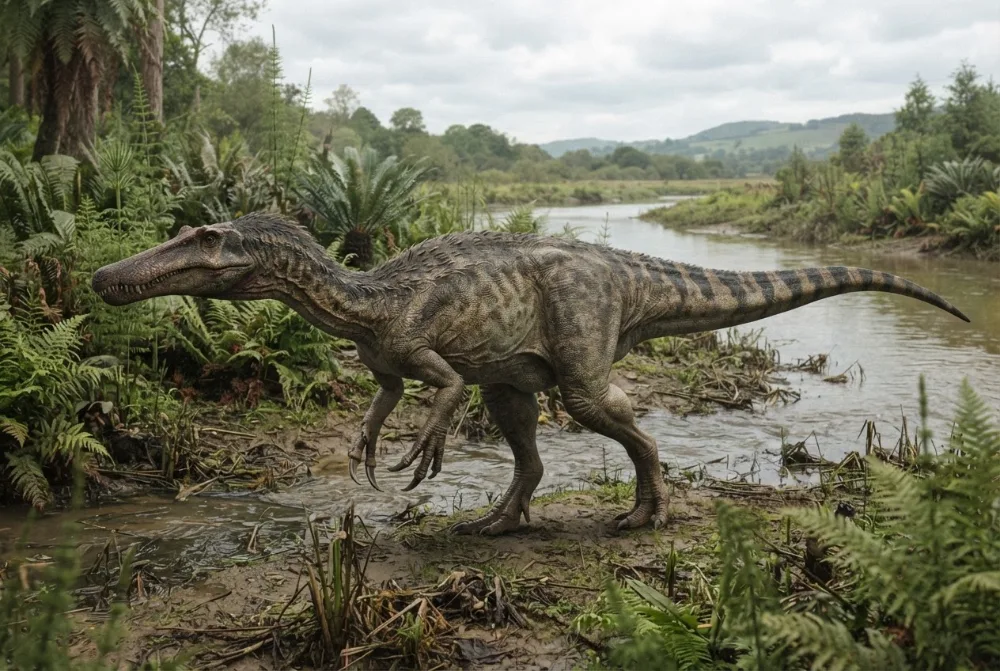
Baryonyx was a big, fish-eating dinosaur with a long snout like a crocodile and a huge claw on each hand. It lived about 130 to 125 million years ago in what is now England and other parts of Europe. It was one of the first dinosaurs shown to eat fish!1
Noiz bizi izan zen?
Zein handia zen?
Zein luzea zen?
Zein altua zen?
Zein astuna zen?
 ilaran aparkatutako 2 auto bezain luze🍌bata bestearen atzean jarritako 56 banana bezain luze
 100 txakur bezain astun🍉400 angurria bezain astun🎒haurrez betetako 2,5 ikasgela oso bezain astun🐻❄️4 hartz zuri bezain astun🏃100 metro 14 segundotan egin zitzakeen korrika (gizakirik azkarrenak 9,6 behar ditu)
Zein handia zen Baryonyx ZUREKIN alderatuta?
Zure nabigatzaileko kalkulu hutsak. Ez da ezer gordetzen ez inora bidaltzen.
Zein azkarra zen?


Datu dibertigarriak
Baryonyx had a huge claw on its first finger, about 30 centimeters (12 inches) long, which it may have used to catch fish.1
Its snout was long and narrow, like a crocodile's, with many small, serrated teeth, perfect for gripping slippery fish.1
The first Baryonyx skeleton was found in 1983 in a clay pit in Surrey, England, by an amateur fossil collector named William Walker.1
Baryonyx was the first theropod dinosaur proven to eat fish, because fish scales were found in its stomach area.1
It lived in a warm, swampy environment with rivers and lakes, alongside other dinosaurs like Iguanodon and small sauropods.1
Some scientists think Baryonyx may have waded in water like a heron, using its long snout to snap up fish.1
Baryonyx also had a notch in its upper jaw, similar to a gharial, which helped it hold onto wriggling prey.1
Baryonyx: gehien egindako galderak
?How big was Baryonyx?
About 7.5 to 10 metres (25 to 33 feet) long and weighed 1.2 to 2 metric tons (1.3 to 2.2 short tons).12
?What did Baryonyx eat?
It mainly ate fish, but also scavenged and ate young Iguanodon. Fish scales and bones were found in its stomach.12
?Did Baryonyx have feathers?
Nobody knows for sure. No feathers have been found with Baryonyx fossils, but some related dinosaurs may have had simple feathers.1
?Could Baryonyx swim?
It may have waded in shallow water and was probably a good swimmer, like a crocodile. It lived in a swampy environment.12
?Was Baryonyx bigger than T. rex?
No, Baryonyx was smaller. T. rex was about 12 metres (40 feet) long and weighed over 8 metric tons, while Baryonyx was up to 10 metres (33 feet) and 2 metric tons.1
?Why did Baryonyx have a big claw?
It used its 31-centimetre (12-inch) claw to catch fish and tear apart prey. The claw was on its thumb.12
?When did Baryonyx live?
It lived during the Early Cretaceous period, about 130 to 125 million years ago.12
?Where was Baryonyx found?
The first skeleton was found in 1983 in a clay pit in Surrey, England. Fossils have also been found in Spain.12
?Is Baryonyx a dinosaur?
Yes, Baryonyx is a theropod dinosaur. It is not a marine reptile or pterosaur.12
?How fast could Baryonyx run?
Scientists do not know its exact speed, but as a large theropod it probably ran at a moderate pace, maybe 25 to 40 km/h (15 to 25 mph).1
Mito-hauslea
Mitoa: Baryonyx was a slow, clumsy dinosaur that only ate fish.
Egia: While it ate fish, Baryonyx was also an active predator and scavenger, and it could probably move well on land.1
Dino adituentzat
- Izen zientifikoa
- Baryonyx
- Izendatzailea:
- Charig and Milner 19863
- Taldea
- Espinosauroak
- Familia / klada
- Spinosauridae3
- Sailkapena
- Theropoda > Spinosauridae3
- Arroken adina
- 139 eta 110 milioi urte artean (Berriasian / Albian)3
- Arroka-formazioak
- Pinilla de los Moros, Weald Clay, Wessex3
- Herrialdeak
- Espainia, Erresuma Batua, Portugal, Tunisia3
- Fosil-erregistroak
- 12 The Paleobiology Database datu-basean3
- Aurkikuntza
- The first Baryonyx skeleton was discovered in 1983 by amateur fossil collector William J. Walker in a clay pit in Surrey, England. It was named by Alan J. Charig and Angela C. Milner in 1986.1
- Oraindik eztabaidagai
- Scientists still debate whether Baryonyx mainly hunted fish or also scavenged on land, and whether some fossils from other places really belong to this genus.1
Datuak nondik datozen
- Baryonyx (en.wikipedia.org)
- Baryonyx | Natural History Museum (nhm.ac.uk)
- Baryonyx in The Paleobiology Database (CC BY 4.0): adina, tokiak, arroka-formazioak, sailkapena.
Orrialde honetako datu bakoitzak zenbaki bat du, bere iturrira eramaten zaituena. Zerbait gaizki badugu, barkatu, dino-zaleak gara, ez zientzia-aldizkari bat. Idatzi [email protected] helbidera eta konponduko dugu.
 Rex gose da! Dino Wiki aita baten proiektua da, dinosauroak maite dituen bere semearentzat, doakoa, iragarkirik eta jarraitzailerik gabe. Helduek mokadutxo bat eman diezaiokete Rexi, sarean jarraitzen laguntzeko.Eman jaten Rexi
 Spinosaurus
 Suchomimus
 Angaturama
 Camarillasaurus
 Ceratosuchops
 Iberospinus
 Stegosaurus
 Iguanodon
 Archaeopteryx
 Giganotosaurus
 Microraptor
 Deinonychus