 Zer dino zara? Galdetegia
 Dino borroka
 Dino lasterketa
 Dino minijokoak
 Pegatina-albuma
 Dino TOP zerrendak
 Harritu nazazu!
Giganotosaurus
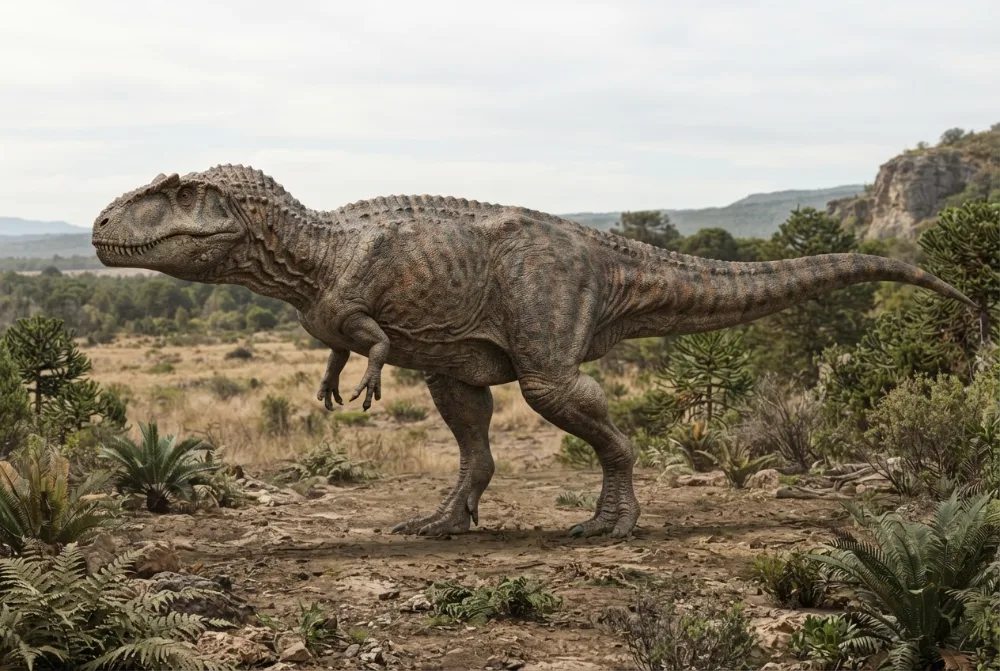
Giganotosaurus was one of the biggest meat-eating dinosaurs that ever lived. It stomped through ancient South America about 100 million years ago, hunting other dinosaurs. Its name means 'giant southern lizard' because it was found in Argentina.12
Noiz bizi izan zen?
Zein handia zen?
Zein luzea zen?
Zein altua zen?
Zein astuna zen?
 ilaran aparkatutako 3 auto bezain luze🍌bata bestearen atzean jarritako 72 banana bezain luze
 1,5 elefante bezain astun🍉1600 angurria bezain astun🦒jirafa bat baino altuagoa🎒haurrez betetako 10 ikasgela oso bezain astun🐻❄️18 hartz zuri bezain astun🏢3. solairuko leiho batetik begiratzeko bezain altua🏃100 metro 7,2 segundotan egin zitzakeen korrika (gizakirik azkarrenak 9,6 behar ditu)
Zein handia zen Giganotosaurus ZUREKIN alderatuta?
Zure nabigatzaileko kalkulu hutsak. Ez da ezer gordetzen ez inora bidaltzen.
Zein azkarra zen?


Datu dibertigarriak
Giganotosaurus lived about 100 to 95 million years ago, long before the big dinosaur extinction 66 million years ago.1
Scientists have not found a complete skeleton of Giganotosaurus, so some parts of its body are still a mystery.1
Some scientists think Giganotosaurus may have hunted in packs to take down huge sauropods, but others disagree because few meat-eaters today attack prey bigger than themselves.1
Giganotosaurus was an apex predator, meaning it was at the very top of the food chain in its environment.1
Giganotosaurus: gehien egindako galderak
?How big was Giganotosaurus?
Giganotosaurus was about 12 to 13 metres (39 to 43 feet) long and weighed between 6 and 8 tonnes (6.6 to 8.8 short tons).12
?Was Giganotosaurus bigger than T. rex?
Giganotosaurus was probably longer but more lightly built than Tyrannosaurus rex. Some scientists think it was larger, while others think they were roughly equal in size.13
?What did Giganotosaurus eat?
Giganotosaurus was a meat-eater and likely the top predator of its environment. It may have hunted large sauropod dinosaurs, possibly in packs, or scavenged on dead animals.1
?When did Giganotosaurus go extinct?
Giganotosaurus went extinct around 98 million years ago, long before the mass extinction that killed most dinosaurs 66 million years ago.1
?Where was Giganotosaurus found?
Giganotosaurus fossils were discovered in Patagonia, Argentina, near Lake Ezequiel in the Candeleros Formation.13
?How fast could Giganotosaurus run?
Maybe up to about 50 km/h (31 mph) for a short dash. That is the top limit scientists worked out for such a big meat-eater, so it was probably often slower. Nobody knows for sure.1
?Did Giganotosaurus have feathers?
No fossil evidence of feathers has been found for Giganotosaurus, and it is not known to have had feathers.3
?Is Giganotosaurus a dinosaur?
Yes, Giganotosaurus is a dinosaur. It is a large theropod dinosaur from the family Carcharodontosauridae.1
?What does the name Giganotosaurus mean?
The name Giganotosaurus means 'giant southern lizard' in Greek, because it was a huge dinosaur found in the Southern Hemisphere.1
?Could Giganotosaurus swim?
There is no evidence that Giganotosaurus could swim. It was a land-dwelling dinosaur.3
Dino adituentzat
- Izen zientifikoa
- Giganotosaurus
- Izendatzailea:
- Coria and Salgado 19954
- Taldea
- Dino haragijaleak
- Familia / klada
- Carcharodontosauridae4
- Sailkapena
- Theropoda > Allosauroidea > Carcharodontosauridae4
- Arroken adina
- 113 eta 106 milioi urte artean (Albian)4
- Arroka-formazioak
- Candeleros, Huincul4
- Herrialdeak
- Argentina4
- Fosil-erregistroak
- 4 The Paleobiology Database datu-basean4
- Aurkikuntza
- The first Giganotosaurus fossils were discovered in 1987 near Lake Ezequiel in Patagonia, Argentina. The species was officially named Giganotosaurus carolinii in 1995 by paleontologists Rodolfo Coria and Leonardo Salgado.124
- Oraindik eztabaidagai
- Scientists still debate whether Giganotosaurus hunted alone or in packs, and what exactly it ate.1
Datuak nondik datozen
- Giganotosaurus | Natural History Museum (nhm.ac.uk)
- Giganotosaurus (britannica.com)
- Giganotosaurus (Wikipedia) (Wikipedia)
- Giganotosaurus in The Paleobiology Database (CC BY 4.0): adina, tokiak, arroka-formazioak, sailkapena.
Orrialde honetako datu bakoitzak zenbaki bat du, bere iturrira eramaten zaituena. Zerbait gaizki badugu, barkatu, dino-zaleak gara, ez zientzia-aldizkari bat. Idatzi [email protected] helbidera eta konponduko dugu.
 Rex gose da! Dino Wiki aita baten proiektua da, dinosauroak maite dituen bere semearentzat, doakoa, iragarkirik eta jarraitzailerik gabe. Helduek mokadutxo bat eman diezaiokete Rexi, sarean jarraitzen laguntzeko.Eman jaten Rexi
 Allosaurus
 Carnotaurus
 Dilophosaurus
 Compsognathus
 Paronychodon
 Megalosaurus
 Stegosaurus
 Iguanodon
 Archaeopteryx
 Microraptor
 Deinonychus
 Baryonyx