 Zer dino zara? Galdetegia
 Dino borroka
 Dino lasterketa
 Dino minijokoak
 Pegatina-albuma
 Dino TOP zerrendak
 Harritu nazazu!
Bergamodactylus
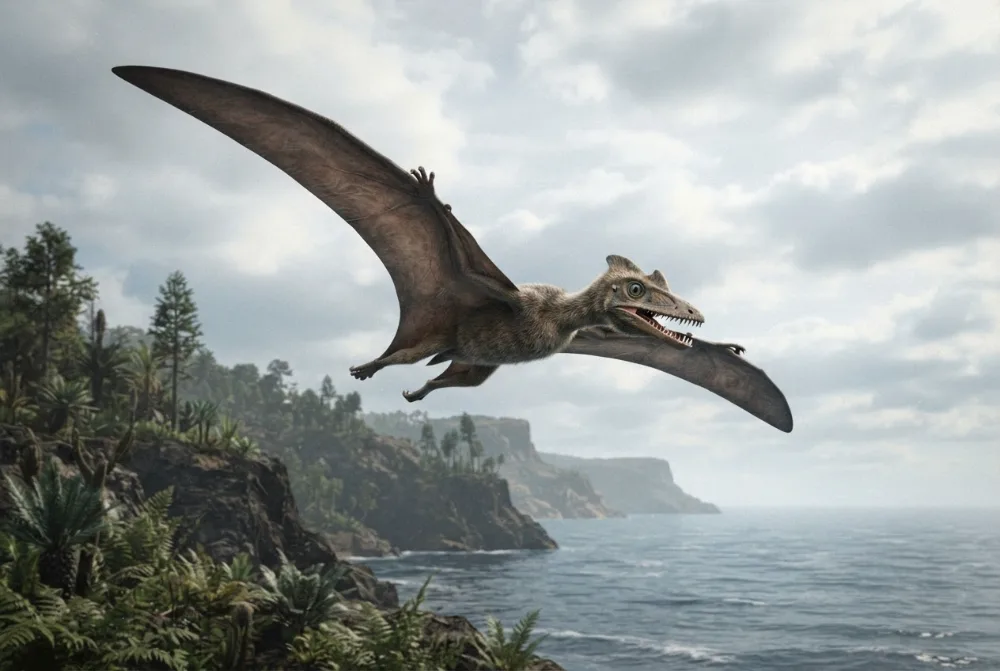
Bergamodactylus was a small flying reptile that lived in the Late Triassic, about 215 to 211 million years ago. It had a long wing finger and sharp teeth, and it soared over ancient seas in what is now Italy. It was not a dinosaur, but a pterosaur, a cousin of dinosaurs.13
Noiz bizi izan zen?
Zein handia zen?
Zein zabalak ziren bere hegoak?
Zein handia zen Bergamodactylus ZUREKIN alderatuta?
Zure nabigatzaileko kalkulu hutsak. Ez da ezer gordetzen ez inora bidaltzen.
Zein azkarra zen?


Datu dibertigarriak
Bergamodactylus was named in 2015 by Alexander Kellner, but the same fossil was earlier thought to be a young Eudimorphodon or Carniadactylus.1
The only known specimen is a skeleton with parts of the skull and most of the body, but it lacks the tail.1
Its teeth were complex with multiple cusps, similar to its relative Eudimorphodon, but they show little wear, so it probably ate soft food.1
The fossil was found in the Zorzino Limestone Formation, which was a marine environment, so it likely flew over the sea.3
Some scientists think Bergamodactylus is actually the same animal as Carniadactylus, because the differences might just be due to age or individual variation.1
Bergamodactylus: gehien egindako galderak
?How big was Bergamodactylus?
It was small, with a wingspan of about 70 centimetres (roughly 2.3 feet). That is about as wide as a large pizza.12
?What did Bergamodactylus eat?
It probably ate soft-bodied prey like worms and insect larvae. Its teeth show little wear, unlike the fish-eating Eudimorphodon.2
?Is Bergamodactylus a dinosaur?
No, it is a pterosaur, a flying reptile that is a cousin of dinosaurs.1
?When did Bergamodactylus live?
It lived in the Late Triassic, about 215 to 211 million years ago.1
Mito-hauslea
Mitoa: Bergamodactylus was a dinosaur.
Egia: It was a pterosaur, a flying reptile that is a close cousin of dinosaurs, but not a dinosaur itself.1
Dino adituentzat
- Izen zientifikoa
- Bergamodactylus
- Izendatzailea:
- Kellner 20153
- Taldea
- Narrasti hegalariak
- Familia / klada
- Campylognathoididae3
- Sailkapena
- Pterosauria3
- Arroken adina
- 215 eta 211 milioi urte artean (Norian)3
- Arroka-formazioak
- Zorzino Limestone3
- Herrialdeak
- Italia3
- Fosil-erregistroak
- 1 The Paleobiology Database datu-basean3
- Aurkikuntza
- The fossil was first described in 1978 by Rupert Wild, who thought it was a young Eudimorphodon. In 2015, Alexander Kellner named it Bergamodactylus wildi, honoring Wild.1
- Oraindik eztabaidagai
- Scientists still debate whether Bergamodactylus is a separate species or just a young Carniadactylus, because the differences might be due to growth stage.1
Datuak nondik datozen
- Carniadactylus (en.wikipedia.org)
- Carniadactylus (Wikipedia) (Wikipedia)
- Bergamodactylus in The Paleobiology Database (CC BY 4.0): adina, tokiak, arroka-formazioak, sailkapena.
Orrialde honetako datu bakoitzak zenbaki bat du, bere iturrira eramaten zaituena. Zerbait gaizki badugu, barkatu, dino-zaleak gara, ez zientzia-aldizkari bat. Idatzi [email protected] helbidera eta konponduko dugu.
 Rex gose da! Dino Wiki aita baten proiektua da, dinosauroak maite dituen bere semearentzat, doakoa, iragarkirik eta jarraitzailerik gabe. Helduek mokadutxo bat eman diezaiokete Rexi, sarean jarraitzen laguntzeko.Eman jaten Rexi
 Pteranodon
 Quetzalcoatlus
 Dorygnathus
 Rhamphorhynchus
 Anhanguera
 Pterodactylus
 Nothosaurus
 Massospondylus
 Plateosaurus
 Coelophysis
 Podokesaurus
 Simosaurus