 Zer dino zara? Galdetegia
 Dino borroka
 Dino lasterketa
 Dino minijokoak
 Pegatina-albuma
 Dino TOP zerrendak
 Harritu nazazu!
Darwinopterus
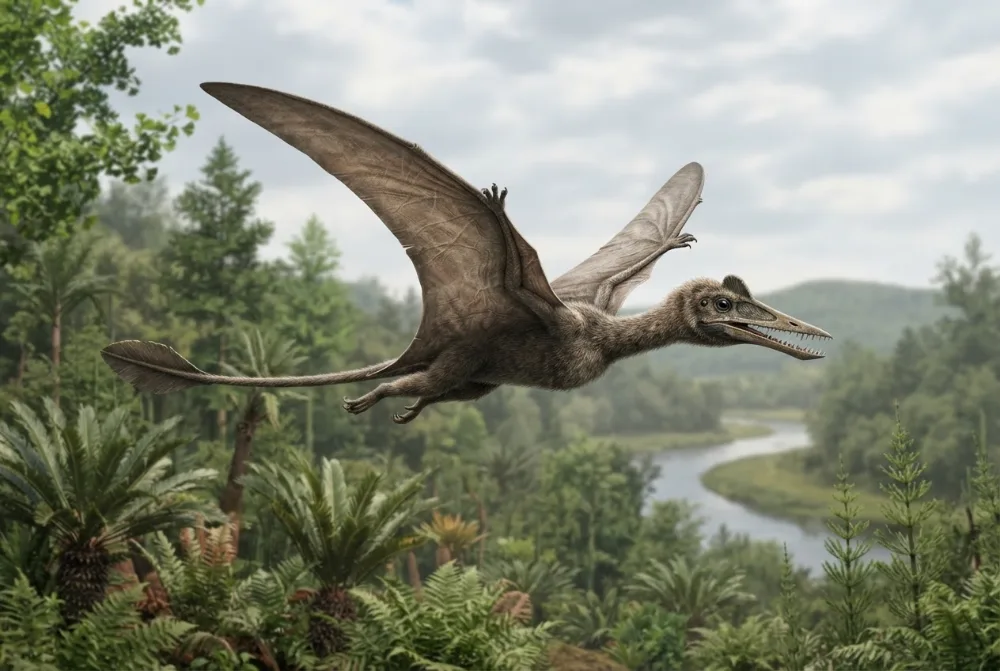
Imagine a flying reptile that looks like it got its head from one group and its tail from another. That is Darwinopterus. It lived in the middle Jurassic period, about 160 million years ago, in what is now China.12
Noiz bizi izan zen?
Zein handia zen?
Zein luzea zen?
Zein handia zen Darwinopterus ZUREKIN alderatuta?
Zure nabigatzaileko kalkulu hutsak. Ez da ezer gordetzen ez inora bidaltzen.
Zein azkarra zen?


Datu dibertigarriak
Darwinopterus was a 'transitional fossil' because it had a head and neck like later short-tailed pterosaurs, but a long tail like earlier ones.12
More than 30 fossils of Darwinopterus have been found, all from the same rock layer in China.1
The name Darwinopterus honors Charles Darwin, the famous scientist who came up with the idea of evolution by natural selection.12
Darwinopterus had a very long tail, made of more than 20 vertebrae, with thin bony rods wrapping around it.2
Its skull was huge, almost twice as long as the bones of its back. That's even bigger than many later pterosaurs.2
Darwinopterus had about 15 pairs of slender, spike-like teeth in its mouth, good for gripping prey.2
Darwinopterus: gehien egindako galderak
?Was Darwinopterus a dinosaur?
No, Darwinopterus was a pterosaur, a flying reptile that lived while dinosaurs walked on land. Pterosaurs are not dinosaurs.41
?How big was Darwinopterus?
It was a relatively small pterosaur. Its skull was about 0.14 to 0.19 metres long, and its forelimbs were about 0.34 to 0.46 metres long.2
Dino adituentzat
- Izen zientifikoa
- Darwinopterus
- Izendatzailea:
- Lü et al. 20105
- Taldea
- Narrasti hegalariak
- Familia / klada
- Monofenestrata5
- Sailkapena
- Pterosauria5
- Arroken adina
- 168 eta 152 milioi urte artean (Bathonian / Kimmeridgian)5
- Arroka-formazioak
- Tiaojishan5
- Herrialdeak
- Txina5
- Fosil-erregistroak
- 4 The Paleobiology Database datu-basean5
- Aurkikuntza
- The first Darwinopterus fossil was found at Linglongta, Liaoning Province, China, in rocks of the Tiaojishan Formation. Scientists Lü Junchang, David Unwin, and others named it in 2010. It was described in the journal Proceedings of the Royal Society B.12
- Oraindik eztabaidagai
- Scientists are still debating whether Darwinopterus was a fast aerial hunter or mainly an insectivore that hopped on the ground.1
Datuak nondik datozen
- Darwinopterus (en.wikipedia.org)
- Evidence for modular evolution in a long-tailed pterosaur with a pterodactyloid skull (pmc.ncbi.nlm.nih.gov)
- Brazil - A new species of Darwinopterus (Wukongopteridae, Pterosauria) from western Liaoning provides some new information on the ontogeny of this clade A new species of <i>Darwinopterus</i> (Wukongopteridae, Pterosauria) from western Liaoning provides some new information on the ontogeny of this clade (scielo.br)
- Darwinopterus, a Transitional Pterosaur (smithsonianmag.com)
- Darwinopterus in The Paleobiology Database (CC BY 4.0): adina, tokiak, arroka-formazioak, sailkapena.
Orrialde honetako datu bakoitzak zenbaki bat du, bere iturrira eramaten zaituena. Zerbait gaizki badugu, barkatu, dino-zaleak gara, ez zientzia-aldizkari bat. Idatzi [email protected] helbidera eta konponduko dugu.
 Rex gose da! Dino Wiki aita baten proiektua da, dinosauroak maite dituen bere semearentzat, doakoa, iragarkirik eta jarraitzailerik gabe. Helduek mokadutxo bat eman diezaiokete Rexi, sarean jarraitzen laguntzeko.Eman jaten Rexi
 Pteranodon
 Quetzalcoatlus
 Dorygnathus
 Rhamphorhynchus
 Anhanguera
 Pterodactylus
 Brachiosaurus
 Diplodocus
 Allosaurus
 Brontosaurus
 Compsognathus
 Camarasaurus