 Zer dino zara? Galdetegia
 Dino borroka
 Dino lasterketa
 Dino minijokoak
 Pegatina-albuma
 Dino TOP zerrendak
 Harritu nazazu!
Germanodactylus
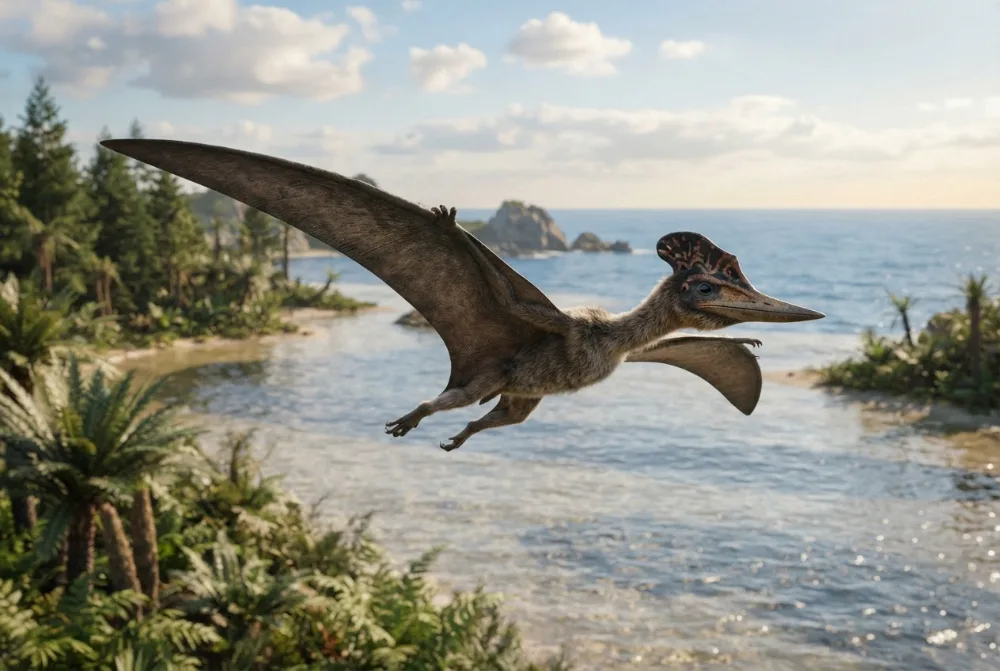
Germanodactylus was a small pterosaur that flew over warm lagoons during the Late Jurassic. It had a pointed beak and a fancy crest on its head, which may have been used to attract mates.1
Noiz bizi izan zen?
Zein handia zen?
Zein zabalak ziren bere hegoak?
 2 etxeko katu bezain luze, sudurretik buztanera⚽futbol zelai oso bat zeharkatu zezakeen hegan 10 segundotan
Zein handia zen Germanodactylus ZUREKIN alderatuta?
Zure nabigatzaileko kalkulu hutsak. Ez da ezer gordetzen ez inora bidaltzen.
Zein azkarra zen?


Datu dibertigarriak
Germanodactylus had a head crest with a bony part and a soft-tissue part that more than doubled its height. The soft part was probably made of skin-like material.1
Its skull was about 13 centimeters (5.1 inches) long for G. cristatus, and 21 centimeters (8.3 inches) for G. rhamphastinus.1
Germanodactylus had sharp teeth, with about 13 teeth in each side of the upper jaw for G. cristatus, and 16 for G. rhamphastinus.1
For a long time, scientists thought Germanodactylus was just a species of Pterodactylus, but it got its own genus in 1964.1
Some scientists think the two species of Germanodactylus might not be closely related, and one might belong to a different group.1
Germanodactylus lived about 150 to 148 million years ago, during the Late Jurassic period.1
Germanodactylus: gehien egindako galderak
?Was Germanodactylus a dinosaur?
No, Germanodactylus was a pterosaur, a flying reptile that lived during the time of dinosaurs, but it is not a dinosaur.1
?How big was Germanodactylus?
Germanodactylus was about the size of a raven. G. cristatus had a wingspan of about 0.98 meters (3.2 feet), and G. rhamphastinus was a bit larger with a wingspan of 1.08 meters (3.5 feet).1
?What did Germanodactylus eat?
Scientists are not sure exactly what it ate, but its sharp teeth suggest it may have eaten fish or other small animals.1
?Why did Germanodactylus have a crest?
The crest may have been used to attract mates, like a peacock's tail. It had a bony part and a soft part that more than doubled its height.1
Mito-hauslea
Mitoa: Germanodactylus was a dinosaur.
Egia: Germanodactylus was a pterosaur, a flying reptile that is not a dinosaur.1
Dino adituentzat
- Izen zientifikoa
- Germanodactylus
- Izendatzailea:
- Young 19642
- Taldea
- Narrasti hegalariak
- Familia / klada
- Lophocratia2
- Sailkapena
- Pterosauria > Pterodactyloidea2
- Arroken adina
- 155 eta 145 milioi urte artean (Kimmeridgian / Tithonian)2
- Arroka-formazioak
- Solnhofen, Kimmeridge Clay, Altmühltal2
- Herrialdeak
- Alemania, Erresuma Batua2
- Fosil-erregistroak
- 5 The Paleobiology Database datu-basean2
- Aurkikuntza
- The first specimen was found in the Solnhofen Limestone of Germany and was named Pterodactylus cristatus by Carl Wiman in 1925. Yang Zhongjian gave it its own genus, Germanodactylus, in 1964.1
- Oraindik eztabaidagai
- Scientists still debate whether the two species of Germanodactylus belong in the same genus, or if one should be moved to a new genus.1
Datuak nondik datozen
- Germanodactylus (en.wikipedia.org)
- Germanodactylus in The Paleobiology Database (CC BY 4.0): adina, tokiak, arroka-formazioak, sailkapena.
Orrialde honetako datu bakoitzak zenbaki bat du, bere iturrira eramaten zaituena. Zerbait gaizki badugu, barkatu, dino-zaleak gara, ez zientzia-aldizkari bat. Idatzi [email protected] helbidera eta konponduko dugu.
 Rex gose da! Dino Wiki aita baten proiektua da, dinosauroak maite dituen bere semearentzat, doakoa, iragarkirik eta jarraitzailerik gabe. Helduek mokadutxo bat eman diezaiokete Rexi, sarean jarraitzen laguntzeko.Eman jaten Rexi
 Pteranodon
 Quetzalcoatlus
 Dorygnathus
 Rhamphorhynchus
 Anhanguera
 Pterodactylus
 Brachiosaurus
 Diplodocus
 Allosaurus
 Brontosaurus
 Compsognathus
 Camarasaurus