 Zer dino zara? Galdetegia
 Dino borroka
 Dino lasterketa
 Dino minijokoak
 Pegatina-albuma
 Dino TOP zerrendak
 Harritu nazazu!
Mikadocephalus
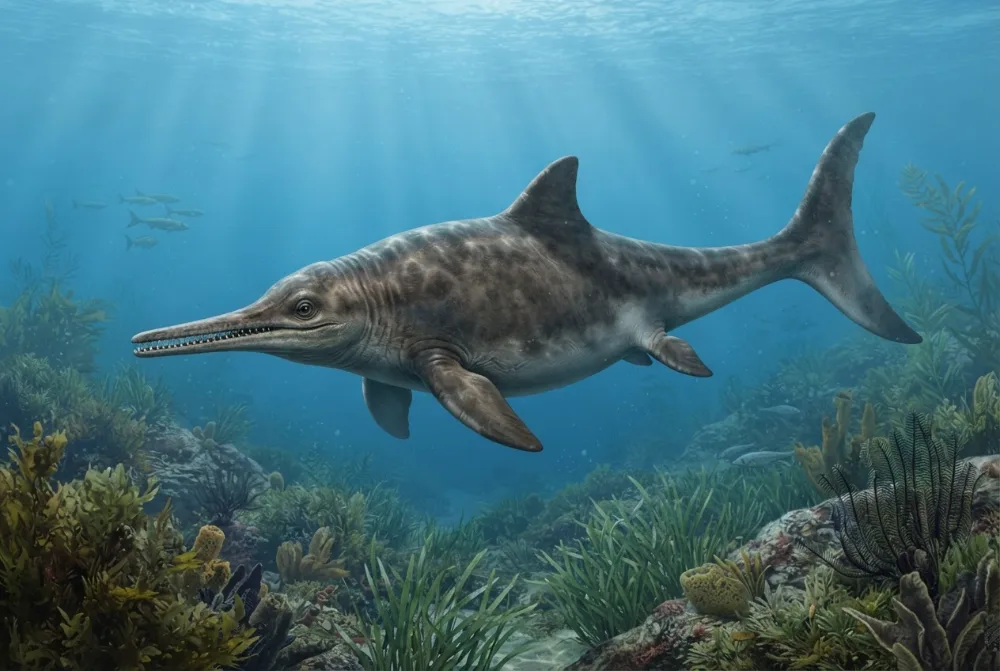
Mikadocephalus was a big, fish-shaped marine reptile that swam in warm seas during the Triassic Period. It was not a dinosaur, but a kind of ichthyosaur, with a long snout full of teeth for catching fish and squid.14
Noiz bizi izan zen?
Zein handia zen?
Zein luzea zen?
 8 txakur bezain luze, sudurretik buztanera🍌bata bestearen atzean jarritako 44 banana bezain luze🏊igerileku handi baten luzera (50 m) 4,6 segundotan egin zezakeen igerian
Zein handia zen Mikadocephalus ZUREKIN alderatuta?
Zure nabigatzaileko kalkulu hutsak. Ez da ezer gordetzen ez inora bidaltzen.
Zein azkarra zen?


Datu dibertigarriak
Mikadocephalus is known from a skull that was so crushed and jumbled that it looked like a game of pick-up sticks, which is how it got its name.1
It lived about 247 to 237 million years ago, during the Middle Triassic, making it one of the earliest big ichthyosaurs.4
Its fossils were found in the Besano Formation, which was once a warm, shallow lagoon with poor oxygen at the bottom.1
Scientists think Mikadocephalus might actually be the same animal as another ichthyosaur called Besanosaurus, because they look very similar.1
The species name gracilirostris means 'slender snout', because its jaws were long and thin.1
Mikadocephalus: gehien egindako galderak
?How big was Mikadocephalus?
About 8 metres (26 feet) long, based on the largest known specimen of Besanosaurus, which scientists think is the same animal.2
?What did Mikadocephalus eat?
It ate small fish and squid, catching them with its long, slender snout and tiny pointed teeth.2
?Is Mikadocephalus a dinosaur?
No, it is not a dinosaur. It is a kind of ichthyosaur, a fish-shaped marine reptile that lived in the sea.1
?Why is it called Mikadocephalus?
Its name means 'Mikado head,' because its skull was so crushed and jumbled that it looked like a game of pick-up sticks.1
Mito-hauslea
Mitoa: Some people think Mikadocephalus was a dinosaur because it lived long ago and had a long snout.
Egia: Mikadocephalus was an ichthyosaur, a marine reptile that lived in the sea. Ichthyosaurs are not dinosaurs.1
Dino adituentzat
- Izen zientifikoa
- Mikadocephalus
- Izendatzailea:
- Maisch and Matzke 19974
- Taldea
- Iktiosauroak
- Familia / klada
- Guanlingsauridae4
- Sailkapena
- Ichthyosauria > Ichthyosauromorpha4
- Arroken adina
- 247 eta 237 milioi urte artean ()4
- Arroka-formazioak
- Monte San Giorgio bituminous shales, Tschermakfjellet4
- Herrialdeak
- Suitza, Svalbard4
- Fosil-erregistroak
- 2 The Paleobiology Database datu-basean4
- Aurkikuntza
- The skull was found in Switzerland, in the Besano Formation, and was named by Michael Maisch and Andreas Matzke in 1997.1
- Oraindik eztabaidagai
- Scientists still debate whether Mikadocephalus is its own species or the same as Besanosaurus, since the skull is so crushed.1
Datuak nondik datozen
- Besanosaurus (en.wikipedia.org)
- Besanosaurus (Wikipedia) (Wikipedia)
- Cranial anatomy of Besanosaurus leptorhynchus Dal Sasso & Pinna, 1996 (Reptilia: Ichthyosauria) from the Middle Triassic Besano Formation of Monte San Giorgio, Italy/Switzerland: taxonomic and palaeobiological implications [PeerJ] (peerj.com)
- Mikadocephalus in The Paleobiology Database (CC BY 4.0): adina, tokiak, arroka-formazioak, sailkapena.
Orrialde honetako datu bakoitzak zenbaki bat du, bere iturrira eramaten zaituena. Zerbait gaizki badugu, barkatu, dino-zaleak gara, ez zientzia-aldizkari bat. Idatzi [email protected] helbidera eta konponduko dugu.
 Rex gose da! Dino Wiki aita baten proiektua da, dinosauroak maite dituen bere semearentzat, doakoa, iragarkirik eta jarraitzailerik gabe. Helduek mokadutxo bat eman diezaiokete Rexi, sarean jarraitzen laguntzeko.Eman jaten Rexi
 Ichthyosaurus
 Platypterygius
 Stenopterygius
 Khudiakovia
 Ophthalmosaurus
 Chonespondylus
 Placodus
 Lariosaurus
 Cyamodus
 Cymatosaurus
 Proneusticosaurus
 Neusticosaurus