 Zer dino zara? Galdetegia
 Dino borroka
 Dino lasterketa
 Dino minijokoak
 Pegatina-albuma
 Dino TOP zerrendak
 Harritu nazazu!
Pachyrhinosaurus
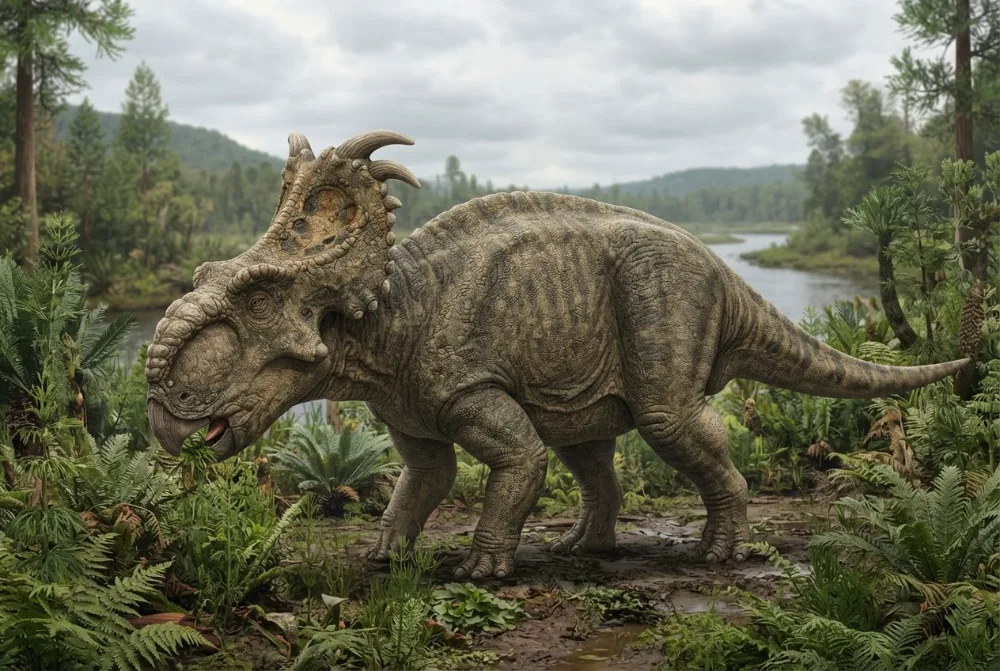
Pachyrhinosaurus was a plant-eating dinosaur that lived in herds. Instead of a nose horn like Triceratops, it had a big, flat bony bump on its snout and another over its eyes. These bumps are called bosses.2
Noiz bizi izan zen?
Zein handia zen?
Zein luzea zen?
Zein altua zen?
kalkulua
Zein astuna zen?

 8 txakur bezain luze, sudurretik buztanera🍌bata bestearen atzean jarritako 44 banana bezain luze200 txakur bezain astun🍉800 angurria bezain astun🎒haurrez betetako 5 ikasgela oso bezain astun🐻❄️9 hartz zuri bezain astun🏃100 metro 13 segundotan egin zitzakeen korrika (gizakirik azkarrenak 9,6 behar ditu)
Zein handia zen Pachyrhinosaurus ZUREKIN alderatuta?
Zure nabigatzaileko kalkulu hutsak. Ez da ezer gordetzen ez inora bidaltzen.
Zein azkarra zen?


Datu dibertigarriak
Pachyrhinosaurus had a large, flat boss on its nose and a smaller one over its eyes, instead of a nose horn.1
Three species of Pachyrhinosaurus have been found: P. canadensis, P. lakustai, and P. perotorum.1
Fossils of adults and juveniles are often found together, suggesting that Pachyrhinosaurus lived in herds and cared for its young.2
One bonebed in Alberta contained up to 100 bones per square metre, with over 3,500 bones and 14 skulls.1
The northernmost species, P. perotorum, lived in what is now Alaska about 73 million years ago.1
Pachyrhinosaurus lived during the Late Cretaceous, between about 74 and 68 million years ago.2
Pachyrhinosaurus: gehien egindako galderak
?How big was Pachyrhinosaurus?
The largest species, P. canadensis, was about 6 to 8 metres (20 to 26 feet) long and weighed 3 to 4 tonnes (3.3 to 4.4 tons). The other species were smaller, about 5 metres (16 feet) long and 2 tonnes (2.2 tons).12
?What did Pachyrhinosaurus eat?
Pachyrhinosaurus was a herbivore, meaning it ate plants. It had strong cheek teeth to cut tough, fibrous plants.12
?Did Pachyrhinosaurus have horns?
Instead of a nose horn like Triceratops, Pachyrhinosaurus had big, flat bony bumps called bosses on its snout and over its eyes. It did have a pair of horns that grew from its frill and pointed upward.12
?When did Pachyrhinosaurus live?
Pachyrhinosaurus lived during the Late Cretaceous Period, between about 74 and 68 million years ago.21
?Where was Pachyrhinosaurus found?
Fossils have been found in Alberta, Canada, and Alaska, USA. The first fossils were discovered in Alberta in 1946.21
?Did Pachyrhinosaurus live in herds?
Yes. Fossils of adults and juveniles are often found together, which suggests they lived in herds and cared for their young.21
Dino adituentzat
- Izen zientifikoa
- Pachyrhinosaurus
- Izendatzailea:
- Sternberg 19503
- Taldea
- Dino adardunak
- Familia / klada
- Ceratopsidae3
- Sailkapena
- Ornithischia > Ceratopsia > Ceratopsidae3
- Arroken adina
- 84 eta 66 milioi urte artean (Campanian / Maastrichtian)3
- Arroka-formazioak
- Horseshoe Canyon, Wapiti, St. Mary River3
- Herrialdeak
- Kanada, AEB3
- Fosil-erregistroak
- 16 The Paleobiology Database datu-basean3
- Aurkikuntza
- The first Pachyrhinosaurus fossils were found in 1946 in Alberta, Canada, by Charles M. Sternberg. He named the dinosaur Pachyrhinosaurus in 1950.12
- Oraindik eztabaidagai
- Scientists are still debating whether the differences in the shape of the bosses (some convex, some concave) are due to male and female differences or just erosion.1
Datuak nondik datozen
- Pachyrhinosaurus (en.wikipedia.org)
- Pachyrhinosaurus | Natural History Museum (nhm.ac.uk)
- Pachyrhinosaurus in The Paleobiology Database (CC BY 4.0): adina, tokiak, arroka-formazioak, sailkapena.
Orrialde honetako datu bakoitzak zenbaki bat du, bere iturrira eramaten zaituena. Zerbait gaizki badugu, barkatu, dino-zaleak gara, ez zientzia-aldizkari bat. Idatzi [email protected] helbidera eta konponduko dugu.
 Rex gose da! Dino Wiki aita baten proiektua da, dinosauroak maite dituen bere semearentzat, doakoa, iragarkirik eta jarraitzailerik gabe. Helduek mokadutxo bat eman diezaiokete Rexi, sarean jarraitzen laguntzeko.Eman jaten Rexi
 Triceratops
 Protoceratops
 Ojoceratops
 Tatankaceratops
 Psittacosaurus
 Centrosaurus
 Tyrannosaurus
 Velociraptor
 Spinosaurus
 Ankylosaurus
 Parasaurolophus
 Pteranodon