 Zer dino zara? Galdetegia
 Dino borroka
 Dino lasterketa
 Dino minijokoak
 Pegatina-albuma
 Dino TOP zerrendak
 Harritu nazazu!
Noiz bizi izan zen?

Zein handia zen?
Zein luzea zen?
Zein altua zen?
kalkulua
 2 etxeko katu bezain luze, sudurretik buztanera🍌bata bestearen atzean jarritako 5 banana bezain luze🪑aulki baten azpitik ibiltzeko bezain txikia🏊igerileku handi baten luzera (50 m) 20 segundotan egin zezakeen igerian
Zein handia zen Parahesperornis ZUREKIN alderatuta?
Zure nabigatzaileko kalkulu hutsak. Ez da ezer gordetzen ez inora bidaltzen.
Zein azkarra zen?


Datu dibertigarriak
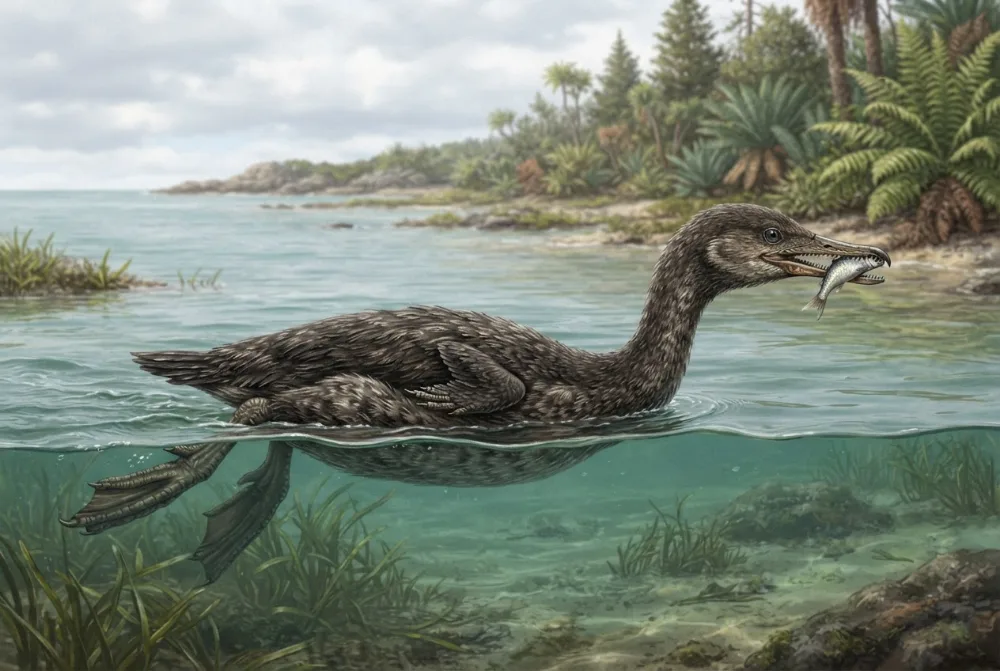
Parahesperornis could not fly. Its wings were tiny and useless for flying, but its legs were strong for swimming.12
It had sharp teeth in its beak, which is unusual for modern birds. These teeth helped it grab slippery fish.12
Parahesperornis is known from two nearly complete skeletons, which is rare for ancient birds. Most are found as just a few bones.2
It lived in the Western Interior Seaway, a shallow sea that covered central North America during the Cretaceous.1
The first fossil of Parahesperornis was found in 1894, but it was not named until 1984 by scientist L. D. Martin.24
Parahesperornis was about the size of a modern loon or a small penguin, around 60 to 90 centimeters long.2
Parahesperornis: gehien egindako galderak
?Was Parahesperornis a dinosaur?
Yes, it was a type of prehistoric bird. While birds are descendants of dinosaurs, scientists classify Parahesperornis as an avialan bird rather than a dinosaur.1
?How big was Parahesperornis?
It was about 60 to 90 centimetres (2 to 3 feet) long, roughly the size of a modern loon or a small penguin.1
?Did Parahesperornis have teeth?
Yes, it had sharp teeth in its beak, which helped it grab slippery fish.2
?Could Parahesperornis swim?
Yes, it was a foot-propelled diving bird that swam like a penguin, using its strong legs to chase fish underwater.3
Dino adituentzat
- Izen zientifikoa
- Parahesperornis
- Izendatzailea:
- Martin 19844
- Taldea
- Lehen hegaztiak
- Familia / klada
- Hesperornithidae4
- Sailkapena
- Theropoda > Avialae4
- Arroken adina
- 90 eta 84 milioi urte artean (Coniacian / Santonian)4
- Arroka-formazioak
- Niobrara4
- Herrialdeak
- AEB4
- Fosil-erregistroak
- 3 The Paleobiology Database datu-basean4
- Aurkikuntza
- The first fossil of Parahesperornis alexi was found in 1894 by H. T. Martin in Graham County, Kansas. It was later named by L. D. Martin in 1984.24
- Oraindik eztabaidagai
- Scientists are not sure if some fossils from Mongolia belong to Parahesperornis or a different, similar bird.1
Datuak nondik datozen
- Parahesperornis (en.wikipedia.org)
- Anatomy of Parahesperornis: Evolutionary Mosaicism in the Cretaceous Hesperornithiformes (Aves) (mdpi.com)
- Anatomy of Parahesperornis: Evolutionary Mosaicism in the Cretaceous Hesperornithiformes (Aves) (pmc.ncbi.nlm.nih.gov)
- Parahesperornis in The Paleobiology Database (CC BY 4.0): adina, tokiak, arroka-formazioak, sailkapena.
Orrialde honetako datu bakoitzak zenbaki bat du, bere iturrira eramaten zaituena. Zerbait gaizki badugu, barkatu, dino-zaleak gara, ez zientzia-aldizkari bat. Idatzi [email protected] helbidera eta konponduko dugu.
 Rex gose da! Dino Wiki aita baten proiektua da, dinosauroak maite dituen bere semearentzat, doakoa, iragarkirik eta jarraitzailerik gabe. Helduek mokadutxo bat eman diezaiokete Rexi, sarean jarraitzen laguntzeko.Eman jaten Rexi
 Archaeopteryx
 Hesperornis
 Ichthyornis
 Baptornis
 Jurapteryx
 Gobipteryx
 Tyrannosaurus
 Triceratops
 Velociraptor
 Spinosaurus
 Ankylosaurus
 Parasaurolophus