 Zer dino zara? Galdetegia
 Dino borroka
 Dino lasterketa
 Dino minijokoak
 Pegatina-albuma
 Dino TOP zerrendak
 Harritu nazazu!
Sinomacrops
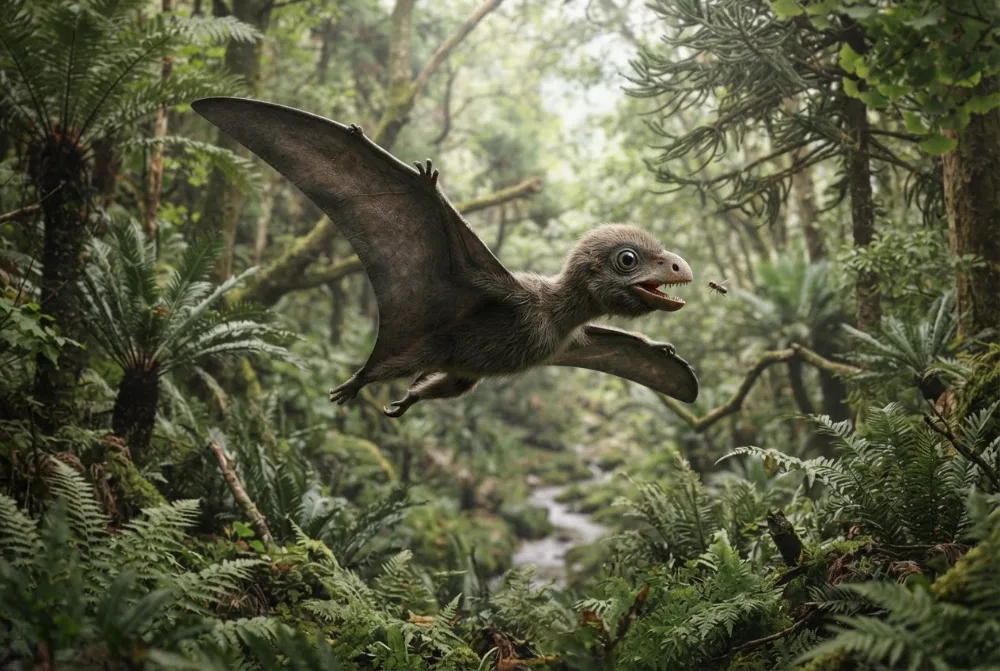
Sinomacrops was a tiny flying reptile that lived about 160 million years ago. It had huge eyes and a short, rounded snout, and it probably fluttered between trees catching insects.1
Noiz bizi izan zen?
Zein handia zen?
Zein luzea zen?
Zein handia zen Sinomacrops ZUREKIN alderatuta?
Zure nabigatzaileko kalkulu hutsak. Ez da ezer gordetzen ez inora bidaltzen.
Zein azkarra zen?


Datu dibertigarriak
Sinomacrops is known from a single crushed skeleton, but it is the first anurognathid skull seen from the side.1
Its lower leg bone, the tibiotarsus, was twice as long as its thigh bone, which is unusual.1
It had three closely spaced teeth in the front of its upper jaw, a feature unique to this species.1
Sinomacrops is the second anurognathid pterosaur found in the Tiaojishan Formation in China.1
Its closest relative is Batrachognathus, and together they form a group called Batrachognathinae.1
The fossil was found in rocks that are between 165 and 155 million years old, from the Middle to Late Jurassic.3
Sinomacrops: gehien egindako galderak
?Was Sinomacrops a dinosaur?
No, Sinomacrops was a pterosaur, a flying reptile that lived at the same time as dinosaurs, but it was not a dinosaur itself.2
?How big was Sinomacrops?
It was tiny, but the exact size is not known because only one crushed skeleton has been found. It was small enough to flutter between trees.2
?What did Sinomacrops eat?
It probably ate insects. Its short snout and teeth suggest it caught bugs while flying, like other anurognathid pterosaurs.1
?When did Sinomacrops live?
It lived about 164 to 158 million years ago, during the Middle to Late Jurassic period.2
Mito-hauslea
Mitoa: Some people think Sinomacrops was a dinosaur because it lived with dinosaurs.
Egia: Sinomacrops was a pterosaur, a flying reptile, not a dinosaur.1
Dino adituentzat
- Izen zientifikoa
- Sinomacrops
- Izendatzailea:
- Wei et al. 20213
- Taldea
- Narrasti hegalariak
- Familia / klada
- Anurognathidae3
- Sailkapena
- Pterosauria3
- Arroken adina
- 165 eta 155 milioi urte artean (Callovian / Oxfordian)3
- Arroka-formazioak
- Tiaojishan3
- Herrialdeak
- Txina3
- Fosil-erregistroak
- 1 The Paleobiology Database datu-basean3
- Aurkikuntza
- Scientists named Sinomacrops in 2021 after studying a fossil found at Mutoudeng in China. The species name bondei honors paleontologist Niels Bonde.1
- Oraindik eztabaidagai
- Scientists still debate exactly where anurognathids like Sinomacrops fit in the pterosaur family tree, and whether they lived mostly in trees.1
Datuak nondik datozen
- Sinomacrops bondei , a new anurognathid pterosaur from the Jurassic of China and comments on the group (pmc.ncbi.nlm.nih.gov)
- Sinomacrops (en.wikipedia.org)
- Sinomacrops in The Paleobiology Database (CC BY 4.0): adina, tokiak, arroka-formazioak, sailkapena.
Orrialde honetako datu bakoitzak zenbaki bat du, bere iturrira eramaten zaituena. Zerbait gaizki badugu, barkatu, dino-zaleak gara, ez zientzia-aldizkari bat. Idatzi [email protected] helbidera eta konponduko dugu.
 Rex gose da! Dino Wiki aita baten proiektua da, dinosauroak maite dituen bere semearentzat, doakoa, iragarkirik eta jarraitzailerik gabe. Helduek mokadutxo bat eman diezaiokete Rexi, sarean jarraitzen laguntzeko.Eman jaten Rexi
 Pteranodon
 Quetzalcoatlus
 Dorygnathus
 Rhamphorhynchus
 Anhanguera
 Pterodactylus
 Brachiosaurus
 Diplodocus
 Allosaurus
 Brontosaurus
 Compsognathus
 Camarasaurus