 Zer dino zara? Galdetegia
 Dino borroka
 Dino lasterketa
 Dino minijokoak
 Pegatina-albuma
 Dino TOP zerrendak
 Harritu nazazu!
Spicomellus
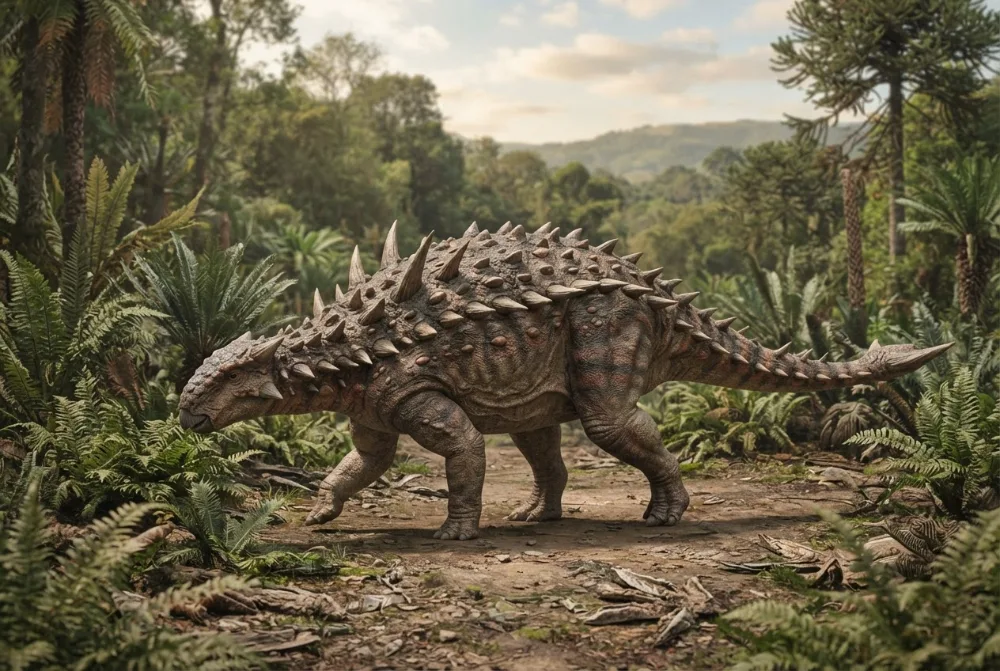
Spicomellus was an armoured dinosaur that walked on four legs and had a bulky body covered in spikes. It lived in Africa during the Middle Jurassic, about 167 to 163 million years ago, and was one of the earliest armoured dinosaurs ever found.1
Noiz bizi izan zen?
Zein handia zen?
Zein luzea zen?
Zein altua zen?
kalkulua
Zein astuna zen?

 4 txakur bezain luze, sudurretik buztanera🍌bata bestearen atzean jarritako 22 banana bezain luze91 txakur bezain astun🍉360 angurria bezain astun🧸haur-eskolako 95 haur bezain astun🎒57 eskolaume bezain astun🐻❄️4 hartz zuri bezain astun🏃100 metro 21 segundotan egin zitzakeen korrika (gizakirik azkarrenak 9,6 behar ditu)
Zein handia zen Spicomellus ZUREKIN alderatuta?
Zure nabigatzaileko kalkulu hutsak. Ez da ezer gordetzen ez inora bidaltzen.
Zein azkarra zen?


Datu dibertigarriak
Spicomellus is the first and only ankylosaur ever found in Africa, and it is also the oldest ankylosaur known to science.1
Unlike most armoured dinosaurs, Spicomellus had spikes that fused directly to its rib bones. No other animal, living or extinct, has this feature.13
Its spikes were probably covered in keratin, the same substance that makes up your hair and fingernails, which would have made them even longer.1
Spicomellus had a bony 'handle' in its tail, a feature only seen in ankylosaurs that had a tail weapon. This suggests it had a spiked tail club, even though the weapon itself hasn't been found yet.12
Scientists used to think that tail weapons in ankylosaurs evolved only in the Cretaceous Period, but Spicomellus lived much earlier, in the Middle Jurassic. This shows that these features are older than expected.12
Spicomellus had a bony collar with metre-long spikes, which is why its name means 'spiked collar'.1
Spicomellus: gehien egindako galderak
?How big was Spicomellus?
About 4 metres (13 feet) long, which is around the size of a small car.1
?What did Spicomellus eat?
It was an herbivore, meaning it ate plants.1
?Did Spicomellus have a tail club?
Scientists think so. It had a bony 'handle' in its tail that is only seen in ankylosaurs with a tail weapon, but the weapon itself has not been found yet.15
?Where did Spicomellus live?
It lived in what is now Morocco, Africa. Back then, the area was a wetland with lots of plants to eat.1
?When did Spicomellus live?
It lived during the Middle Jurassic Period, about 167 to 163 million years ago.1
?Was Spicomellus a dinosaur?
Yes, it was an armoured dinosaur called an ankylosaur.1
?How fast could Spicomellus run?
Nobody knows for sure. It walked on four legs and had a bulky body, so it probably moved slowly.1
Dino adituentzat
- Izen zientifikoa
- Spicomellus
- Izendatzailea:
- Maidment et al. 20216
- Taldea
- Dino kuirasdunak
- Familia / klada
- Ankylosauria6
- Sailkapena
- Ornithischia > Ankylosauria > Thyreophora6
- Arroken adina
- 168 eta 162 milioi urte artean (Bathonian / Callovian)6
- Arroka-formazioak
- El Mers III6
- Herrialdeak
- Maroko6
- Fosil-erregistroak
- 1 The Paleobiology Database datu-basean6
- Aurkikuntza
- Spicomellus was named by Maidment and colleagues in 2021, based on a partial skeleton from Morocco. The first fossil was a rib with spikes, and later more bones were found, including a bony collar.13
- Oraindik eztabaidagai
- Scientists are still debating exactly how Spicomellus is related to other ankylosaurs, and whether its tail weapon was a club or just spikes.2
Datuak nondik datozen
- Spicomellus | Natural History Museum (nhm.ac.uk)
- Extreme armour in the world’s oldest ankylosaur | Nature (nature.com)
- Bizarre dermal armour suggests the first African ankylosaur | Nature Ecology & Evolution (nature.com)
- 'Jaw-droppingly weird' dinosaur from Morocco was studded with spikes | Reuters (reuters.com)
- Spicomellus (en.wikipedia.org)
- Spicomellus in The Paleobiology Database (CC BY 4.0): adina, tokiak, arroka-formazioak, sailkapena.
Orrialde honetako datu bakoitzak zenbaki bat du, bere iturrira eramaten zaituena. Zerbait gaizki badugu, barkatu, dino-zaleak gara, ez zientzia-aldizkari bat. Idatzi [email protected] helbidera eta konponduko dugu.
 Rex gose da! Dino Wiki aita baten proiektua da, dinosauroak maite dituen bere semearentzat, doakoa, iragarkirik eta jarraitzailerik gabe. Helduek mokadutxo bat eman diezaiokete Rexi, sarean jarraitzen laguntzeko.Eman jaten Rexi
 Ankylosaurus
 Sauropelta
 Pinacosaurus
 Scutellosaurus
 Struthiosaurus
 Euoplocephalus
 Ichthyosaurus
 Khudiakovia
 Ophthalmosaurus
 Pterodactylus
 Peloneustes
 Rhamphocephalus