
Barapasaurus
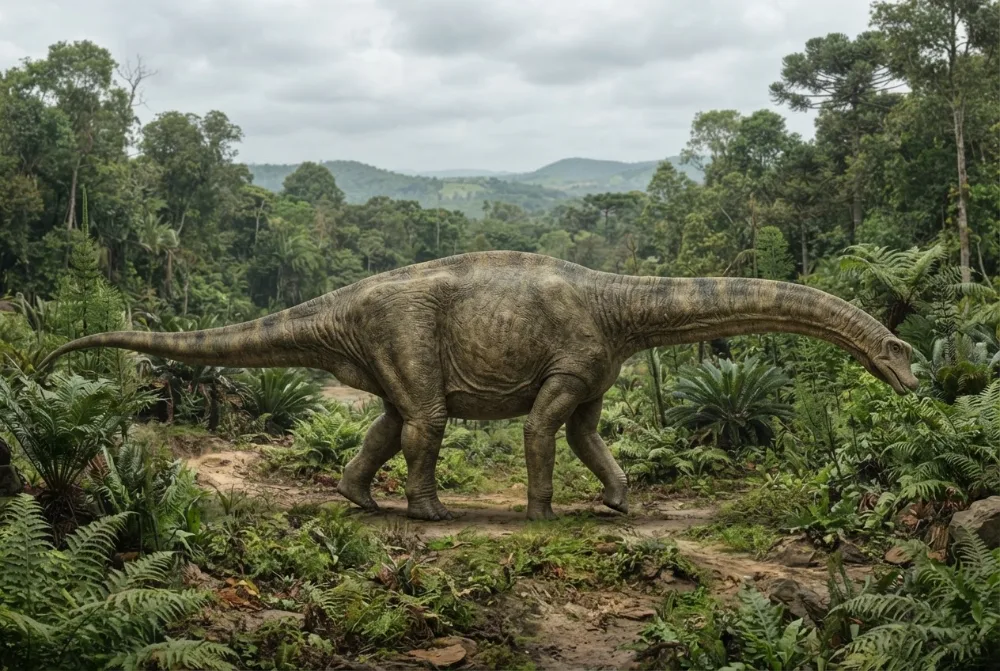
Barapasaurus was one of the very first giant long-necked dinosaurs. It lived in India about 190 million years ago and grew as long as a bus! Even though it was an early sauropod, it already had the long neck and big body that later giants like Brachiosaurus would have.1
Ɗuum wuurii nde?
Hol no o mawni?
No juutuno?
No tedduno?
Hol no Barapasaurus mawninoo, so fondaama bee AAN?
Hiisa tan nder browser maa. Walaa huunde danndetee walla neldetee ka nokku fuu.
How fast was it?
Anndal belɗungal
Barapasaurus is known from about 300 bones from at least six different individuals, making it one of the most complete early sauropods ever found.1
Its name means 'big-legged lizard' in several Indian languages, because a single thigh bone (femur) was over 1.7 metres (5.6 feet) long.1
No skull has ever been found, only a few teeth. The largest tooth is just 5.8 centimetres (2.3 inches) tall.1
The fossils were discovered in 1958 and dug up in 1960 and 1961, but the dinosaur was not officially named until 1975.1
Barapasaurus lived alongside another early sauropod called Kotasaurus, as well as some of the earliest mammals like Kotatherium.1
Its backbone already had hollow spaces and extra joints that helped support its huge body, a feature later sauropods perfected.1
Naamne ɓurɗe naamneede fii Barapasaurus
?How big was Barapasaurus?
Barapasaurus was about 12 to 14 metres long and weighed around 7 tonnes. That is about as long as a bus.12
?What did Barapasaurus eat?
Barapasaurus was a herbivore, meaning it ate plants. Its spoon-shaped teeth were good for stripping leaves.12
?When did Barapasaurus live?
Barapasaurus lived during the Early Jurassic period, about 184 to 200 million years ago. Some scientists think it might have lived a bit later, in the Middle Jurassic.12
?Where was Barapasaurus found?
Barapasaurus fossils were found in central India, near the village of Pochampally. The first bones were discovered in 1958.1
?Why is it called Barapasaurus?
Barapasaurus means big legged lizard in several Indian languages. It got that name because its thigh bone was over 1.7 metres long.1
?Did Barapasaurus have a long neck?
Yes, Barapasaurus had a long neck, just like later sauropods. Its neck bones were elongated, which helped it reach high plants.1
Naamnu Rex fii Barapasaurus
Rex jaabata ƴamle dow hello ngo'o tan. Ƴamle 10 e lewru.
Rex ko AI, o waawi waɗugo juumre. O golla ka serverji nder EU, naamne danndetaake abada. Taa winndu innde maa walla huunde goɗnde ngam maa.
Feññinoowo goonga
Fenaande: Barapasaurus had a tiny head like later sauropods such as Brachiosaurus.
Goonga: Scientists have not found a skull, only a few teeth, so we do not know what its head looked like.1
Ngam annduɓe dino
- Innde ganndal
- Barapasaurus
- Inndoowo
- Jain et al. 19753
- Fedde
- Daaɗe juutɗe
- Fedde / clade
- Gravisauria3
- Fedde
- Sauropodomorpha > Sauropoda3
- Duuɓi kaaƴe
- 200 haa 184 miliyon duuɓi (Sinemurian / Pliensbachian)3
- Cuuɗi kaaƴe
- Kota3
- Leyɗe
- India3
- Fosilji tawaaɗi
- 2 nder Paleobiology Database3
- Tawgol
- The first bones were found in 1958 near Pochampally, India. Most fossils were collected in 1960 and 1961, and the dinosaur was named Barapasaurus tagorei in 1975 by paleontologist Sohan Lal Jain and colleagues.1
- Haa jooni ɓe ɗon yeddondira
- Scientists disagree on whether Barapasaurus was more primitive than the early sauropod Vulcanodon or more advanced. Some place it inside the group Eusauropoda, others outside it.1
To haalaaji ummii
- Barapasaurus (en.wikipedia.org)
- Barapasaurus | Natural History Museum (nhm.ac.uk)
- Barapasaurus in The Paleobiology Database (CC BY 4.0): duuɓi, nokkuuje, cuuɗi kaaƴe, pecce.
Kala anndal nder ngal hello mari limre holloore iwdi mum. Si min mbaɗii juumre, yaafo min, min ko yiɗɓe dino, min wanaa jaaynde anndal. Haalan min ka [email protected], min moƴƴinan ɗum.
 Rex ɗon weelo! Dino Wiki, ɗum golle baaba ngam ɓiyiiko gorko mo yiɗi dinosauruuji, alaa njoɓdi, alaa ko yeeyata. Mawɓe mbaawi hokkude Rex ñaamdu ngam wallude lowre ndee heddoo e internet.Nyaamnu Rex
 Brachiosaurus
 Diplodocus
 Brontosaurus
 Argentinosaurus
 Camarasaurus
 Morosaurus
 Dilophosaurus
 Stenopterygius
 Dorygnathus
 Scutellosaurus
 Sinosaurus
 Temnodontosaurus