
Hamipterus
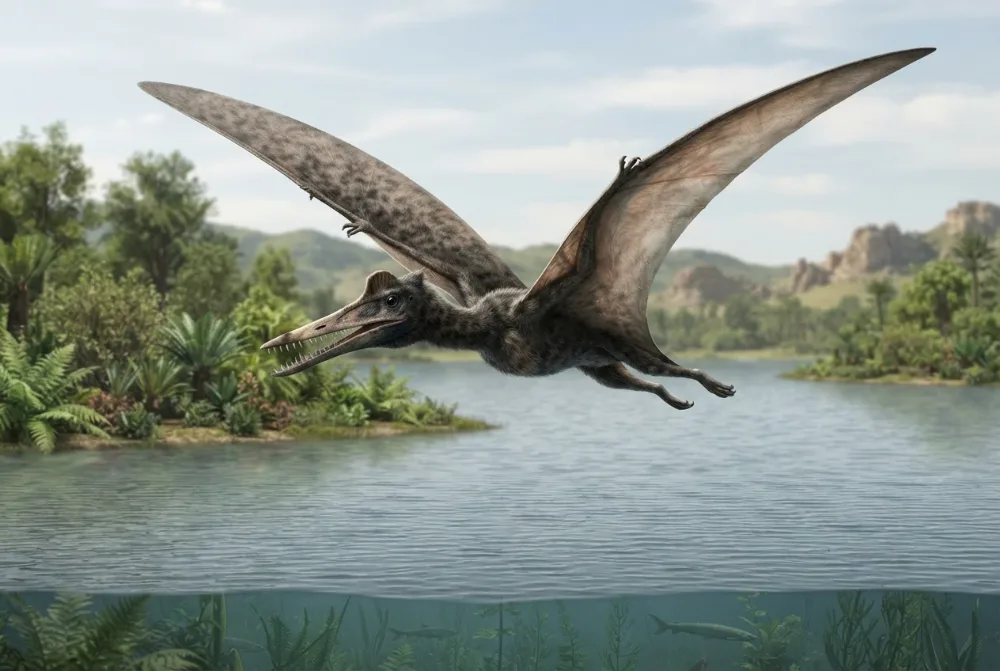
Hamipterus was a flying reptile with a wingspan as wide as a car! It lived in a big lake area in China and ate fish. Hundreds of Hamipterus fossils were found together, including eggs and soft parts like skin.12
Ɗuum wuurii nde?
Hol no o mawni?
No yaajuno bibbe mum?
Hol no Hamipterus mawninoo, so fondaama bee AAN?
Hiisa tan nder browser maa. Walaa huunde danndetee walla neldetee ka nokku fuu.
How fast was it?
Anndal belɗungal
Hamipterus fossils were found in huge numbers, probably from a nesting colony that was buried by a storm. Over 40 individuals were collected, and there may have been hundreds.1
Unlike most pterosaurs, Hamipterus bones are three-dimensional and not squashed flat. Scientists even found the horny sheaths that covered its head crests.1
Five uncrushed eggs were found with the Hamipterus fossils. That is very rare for pterosaurs.1
Hamipterus had a hook-shaped bony process on the tip of its lower jaw, which scientists think helped it grab slippery fish.3
Male and female Hamipterus looked different. The paratype skull is thought to be from a male, while the holotype is probably a female.1
The tooth enamel of Hamipterus was very thin, only covering about half of each tooth crown.1
Naamne ɓurɗe naamneede fii Hamipterus
?How big was Hamipterus?
Hamipterus had a wingspan of 1.5 to 3.5 metres, which is about as wide as a small car.1
?Did Hamipterus have feathers?
No, Hamipterus was a pterosaur, a flying reptile, not a dinosaur. Pterosaurs did not have feathers; they had a fur-like covering called pycnofibers.1
?What did Hamipterus eat?
Hamipterus ate fish. It had a hook-shaped bony process on the tip of its lower jaw that helped it grab slippery fish.1

Naamnu Rex fii Hamipterus
Rex jaabata ƴamle dow hello ngo'o tan. Ƴamle 10 e lewru.
Rex ko AI, o waawi waɗugo juumre. O golla ka serverji nder EU, naamne danndetaake abada. Taa winndu innde maa walla huunde goɗnde ngam maa.
Ngam annduɓe dino
- Innde ganndal
- Hamipterus
- Inndoowo
- Wang et al. 20144
- Fedde
- Reptilji diwooji
- Fedde / clade
- Pteranodontoidea4
- Fedde
- Pterosauria > Pterodactyloidea4
- Duuɓi kaaƴe
- 137 haa 133 miliyon duuɓi (Valanginian)4
- Cuuɗi kaaƴe
- Shengjinkou4
- Leyɗe
- China4
- Fosilji tawaaɗi
- 4 nder Paleobiology Database4
- Tawgol
- Hamipterus was named in 2014 by Wang Xiaolin and a team of scientists. The fossils were found in the Hami region of Xinjiang, China, starting in 2006.1
- Haa jooni ɓe ɗon yeddondira
- Scientists are not sure exactly where Hamipterus fits in the pterosaur family tree. It may be close to Istiodactylus, Ludodactylus, or the Anhangueridae.1
To haalaaji ummii
- Hamipterus (en.wikipedia.org)
- The first dinosaurs from the Early Cretaceous Hami Pterosaur Fauna, China (pmc.ncbi.nlm.nih.gov)
- PBDB Taxon (paleobiodb.org)
- Hamipterus in The Paleobiology Database (CC BY 4.0): duuɓi, nokkuuje, cuuɗi kaaƴe, pecce.
Kala anndal nder ngal hello mari limre holloore iwdi mum. Si min mbaɗii juumre, yaafo min, min ko yiɗɓe dino, min wanaa jaaynde anndal. Haalan min ka [email protected], min moƴƴinan ɗum.
 Rex ɗon weelo! Dino Wiki, ɗum golle baaba ngam ɓiyiiko gorko mo yiɗi dinosauruuji, alaa njoɓdi, alaa ko yeeyata. Mawɓe mbaawi hokkude Rex ñaamdu ngam wallude lowre ndee heddoo e internet.Nyaamnu Rex
 Pteranodon
 Quetzalcoatlus
 Dorygnathus
 Rhamphorhynchus
 Anhanguera
 Pterodactylus
 Stegosaurus
 Iguanodon
 Archaeopteryx
 Giganotosaurus
 Microraptor
 Deinonychus