
Procompsognathus
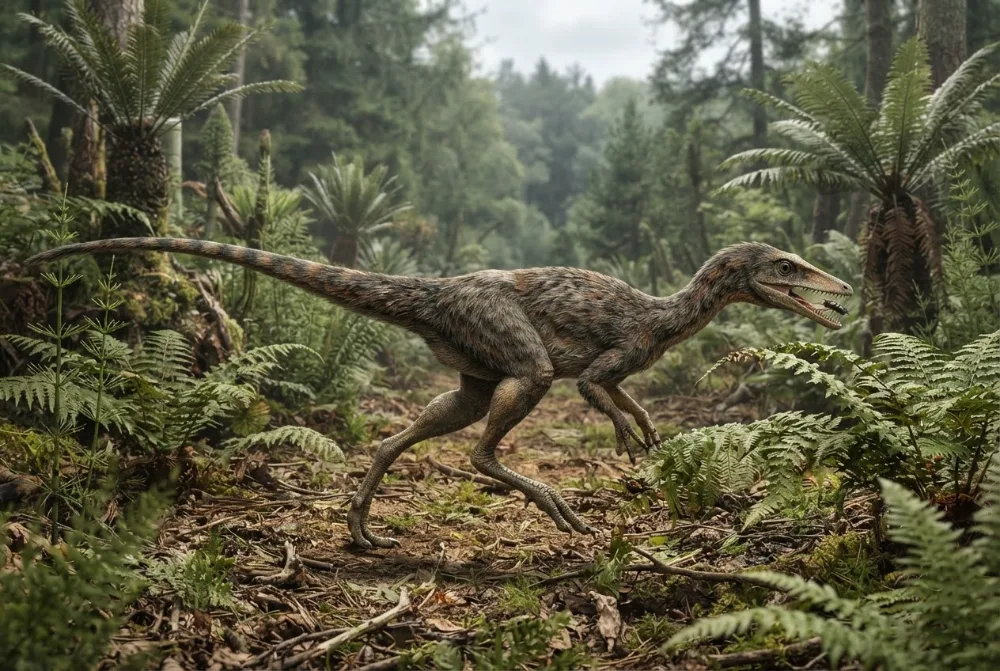
Procompsognathus was a tiny, fast-running dinosaur that lived in what is now Germany. It had long legs and a stiff tail, and it chased after insects and lizards for dinner.1
Ɗuum wuurii nde?
Hol no o mawni?
No juutuno?
No toowuno?
No tedduno?
Hol no Procompsognathus mawninoo, so fondaama bee AAN?
Hiisa tan nder browser maa. Walaa huunde danndetee walla neldetee ka nokku fuu.
How fast was it?
Anndal belɗungal
Procompsognathus means 'before elegant jaw' because it lived earlier than a similar dinosaur called Compsognathus.1
Its shin bone was about 20 percent longer than its thigh bone, which helped it run very fast.1
Some scientists once thought the skull belonged to a crocodile relative, but later studies showed it was a true dinosaur.1
It shared its home with other early dinosaurs like Plateosaurus and the meat-eating Halticosaurus.1
Naamne ɓurɗe naamneede fii Procompsognathus
?How big was Procompsognathus?
Procompsognathus was about 1 meter (3.3 feet) long and weighed around 1 kilogram (2.2 pounds).12
?What did Procompsognathus eat?
It was a carnivore that ate small animals like insects, lizards, and other tiny prey.13
?When did Procompsognathus live?
It lived during the Late Triassic period, about 221 to 210 million years ago.21
?Where was Procompsognathus found?
Its fossils were found in Germany, near Pfaffenhofen in the state of Württemberg.12
?How fast could Procompsognathus run?
It was a very fast runner. Its shin bone was 20% longer than its thigh bone, which is a sign of a good runner.1
?Is Procompsognathus a dinosaur?
Yes, it is a small theropod dinosaur, though some scientists once thought parts of its skull came from a crocodile relative.12
?Why is it called Procompsognathus?
Its name means 'before elegant jaw' because it lived earlier than a similar dinosaur called Compsognathus, which means 'elegant jaw'.12
?Did Procompsognathus have venom?
No, there is no evidence it had venom. The idea of a venomous bite comes from the Jurassic Park books, not real science.1
Naamnu Rex fii Procompsognathus
Rex jaabata ƴamle dow hello ngo'o tan. Ƴamle 10 e lewru.
Rex ko AI, o waawi waɗugo juumre. O golla ka serverji nder EU, naamne danndetaake abada. Taa winndu innde maa walla huunde goɗnde ngam maa.
Feññinoowo goonga
Fenaande: Procompsognathus was a direct ancestor of Compsognathus.
Goonga: The name means 'before Compsognathus', but scientists do not think it was a direct ancestor. They are separate branches of the dinosaur family tree.1
Ngam annduɓe dino
- Innde ganndal
- Procompsognathus
- Inndoowo
- Fraas 19134
- Fedde
- Dinosauruuji ñaamooji teewu
- Fedde / clade
- Coelophysidae4
- Fedde
- Theropoda > Coelophysoidea4
- Duuɓi kaaƴe
- 215 haa 211 miliyon duuɓi (Norian)4
- Cuuɗi kaaƴe
- Löwenstein4
- Leyɗe
- Germany4
- Fosilji tawaaɗi
- 1 nder Paleobiology Database4
- Tawgol
- The fossil was found in 1909 by Albert Burrer in a quarry near Pfaffenhofen, Germany. Professor Eberhard Fraas named it Procompsognathus in 1913.1
- Haa jooni ɓe ɗon yeddondira
- Scientists are not sure exactly where Procompsognathus fits in the dinosaur family tree. Some think it is a coelophysid, others place it outside that group.1
To haalaaji ummii
- Procompsognathus (en.wikipedia.org)
- Procompsognathus | Natural History Museum (nhm.ac.uk)
- Procompsognathus Fact Sheet (enchantedlearning.com)
- Procompsognathus in The Paleobiology Database (CC BY 4.0): duuɓi, nokkuuje, cuuɗi kaaƴe, pecce.
Kala anndal nder ngal hello mari limre holloore iwdi mum. Si min mbaɗii juumre, yaafo min, min ko yiɗɓe dino, min wanaa jaaynde anndal. Haalan min ka [email protected], min moƴƴinan ɗum.
 Rex ɗon weelo! Dino Wiki, ɗum golle baaba ngam ɓiyiiko gorko mo yiɗi dinosauruuji, alaa njoɓdi, alaa ko yeeyata. Mawɓe mbaawi hokkude Rex ñaamdu ngam wallude lowre ndee heddoo e internet.Nyaamnu Rex
 Allosaurus
 Carnotaurus
 Dilophosaurus
 Giganotosaurus
 Compsognathus
 Paronychodon
 Nothosaurus
 Massospondylus
 Plateosaurus
 Simosaurus
 Thecodontosaurus
 Eudimorphodon