
Proteosaurus
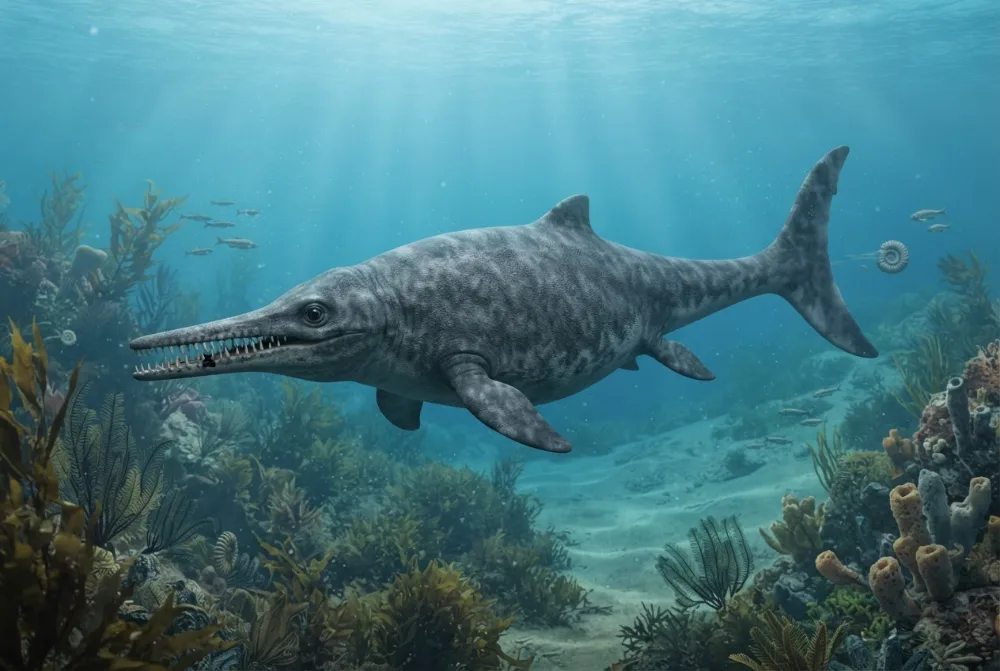
Proteosaurus was an ancient marine reptile that swam in the seas over 190 million years ago. It looked a bit like a dolphin with a long snout and lots of sharp teeth. It was one of the first complete ichthyosaur skeletons ever found!1
Ɗuum wuurii nde?
Hol no o mawni?
No juutuno?
Hol no Proteosaurus mawninoo, so fondaama bee AAN?
Hiisa tan nder browser maa. Walaa huunde danndetee walla neldetee ka nokku fuu.
How fast was it?
Anndal belɗungal
Proteosaurus was named by Sir Everard Home in 1819, but the name didn't stick. Today scientists call it Ichthyosaurus platyodon instead.21
The first complete skeleton of Proteosaurus was discovered by Mary Anning in 1818 in Lyme Regis, England. She was only about 19 years old at the time.1
Sir Everard Home thought Proteosaurus was a link between salamanders and lizards in the 'Great Chain of Being'. That's why he gave it a name that means 'proteus lizard'.1
The original Proteosaurus skeleton was bought by the Royal College of Surgeons for £100 in 1819. Sadly, it was destroyed during a World War Two air raid in May 1941.1
Proteosaurus lived during the Early Jurassic period, between about 201 and 193 million years ago, in the Hettangian and Sinemurian ages.2
Fossils of Proteosaurus have been found in the Blue Lias formation in England and in Luxembourg, Belgium. These rocks were once the bottom of a warm, shallow sea.2
Naamne ɓurɗe naamneede fii Proteosaurus
?How big was Proteosaurus?
The largest Ichthyosaurus species, I. somersetensis, reached about 3 to 3.3 metres (9.8 to 10.8 feet) long. Other species were smaller, like I. communis at up to 2 metres (6.6 feet).4
?What did Proteosaurus eat?
It ate fish and squid-like animals called belemnites. Stomach contents show it was a fast swimmer that chased its prey.4
?Did Proteosaurus give birth to live young?
Yes. Fossil evidence shows that Ichthyosaurus gave birth to live babies, not eggs. Some fossils even have baby skeletons inside the mother.4
?Is Proteosaurus a dinosaur?
No, it is not a dinosaur. It is a marine reptile called an ichthyosaur that lived in the sea.4
?When did Proteosaurus live?
It lived during the Early Jurassic period, between about 201 and 193 million years ago.4
?Where was Proteosaurus found?
The first complete skeleton was found in Lyme Regis, England, by Mary Anning in 1818. Fossils have also been found in Belgium, Luxembourg, and Germany.41
?Why is it called Proteosaurus?
Sir Everard Home named it Proteosaurus because he thought it was a link between a salamander (genus Proteus) and a lizard (sauros in Greek). The name means 'proteus lizard'.1
?What happened to the original Proteosaurus fossil?
The original skeleton was destroyed during a World War Two air raid in May 1941. But two casts of it were rediscovered in 2022 in the USA and Germany.5

Naamnu Rex fii Proteosaurus
Rex jaabata ƴamle dow hello ngo'o tan. Ƴamle 10 e lewru.
Rex ko AI, o waawi waɗugo juumre. O golla ka serverji nder EU, naamne danndetaake abada. Taa winndu innde maa walla huunde goɗnde ngam maa.
Feññinoowo goonga
Fenaande: Proteosaurus was a dinosaur.
Goonga: Proteosaurus was an ichthyosaur, a marine reptile that lived in the sea. It was not a dinosaur. Dinosaurs lived on land.1
Ngam annduɓe dino
- Innde ganndal
- Proteosaurus
- Inndoowo
- Home 18196
- Fedde
- Ichthyosaurs
- Fedde / clade
- Proteosauridae6
- Fedde
- Ichthyosauria > Ichthyosauromorpha6
- Duuɓi kaaƴe
- 201 haa 193 miliyon duuɓi (Hettangian / Sinemurian)6
- Cuuɗi kaaƴe
- Blue Lias, Luxembourg6
- Leyɗe
- United Kingdom, Belgium6
- Fosilji tawaaɗi
- 6 nder Paleobiology Database6
- Tawgol
- The first complete skeleton of Proteosaurus was found by Mary Anning in 1818 in Lyme Regis, England. Sir Everard Home named it Proteosaurus in 1819.1
- Haa jooni ɓe ɗon yeddondira
- Scientists are not sure exactly how Proteosaurus gave birth. But other ichthyosaurs gave birth to live young in the water, so Proteosaurus probably did too.2
To haalaaji ummii
- Proteosaurus | The Geological Society of London (geolsoc.org.uk)
- PBDB Taxon (paleobiodb.org)
- Rediscovery of two casts of the historically important ‘Proteo-saurus’, the first complete ichthyosaur skeleton | Royal Society Open Science | The Royal Society (royalsocietypublishing.org)
- Ichthyosaurus (Wikipedia) (Wikipedia)
- Rediscovered casts bring back historic ichthyosaur fossil destroyed in war | Natural History Museum (nhm.ac.uk)
- Proteosaurus in The Paleobiology Database (CC BY 4.0): duuɓi, nokkuuje, cuuɗi kaaƴe, pecce.
Kala anndal nder ngal hello mari limre holloore iwdi mum. Si min mbaɗii juumre, yaafo min, min ko yiɗɓe dino, min wanaa jaaynde anndal. Haalan min ka [email protected], min moƴƴinan ɗum.
 Rex ɗon weelo! Dino Wiki, ɗum golle baaba ngam ɓiyiiko gorko mo yiɗi dinosauruuji, alaa njoɓdi, alaa ko yeeyata. Mawɓe mbaawi hokkude Rex ñaamdu ngam wallude lowre ndee heddoo e internet.Nyaamnu Rex
 Ichthyosaurus
 Platypterygius
 Stenopterygius
 Khudiakovia
 Ophthalmosaurus
 Chonespondylus
 Dilophosaurus
 Dorygnathus
 Lufengosaurus
 Scutellosaurus
 Yunnanosaurus
 Sinosaurus