
Suzhousaurus
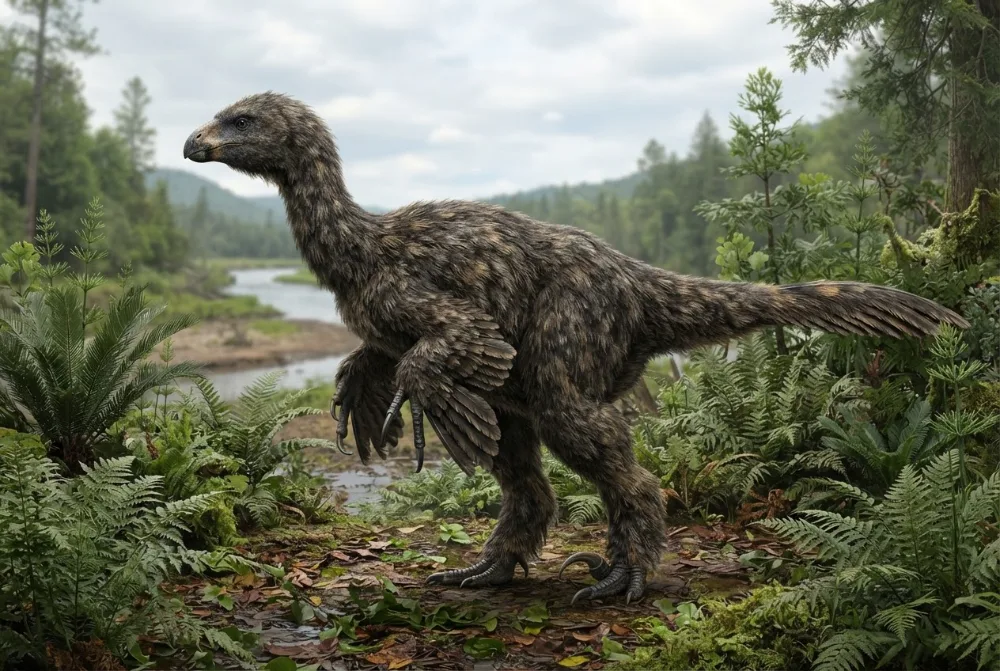
Suzhousaurus was a huge, plant-eating dinosaur with a big belly, strong legs, and long claws. It lived in China during the Early Cretaceous, about 124 to 113 million years ago. It probably had feathers, just like its close relatives!1
Ɗuum wuurii nde?
Hol no o mawni?
No juutuno?
No tedduno?
Hol no Suzhousaurus mawninoo, so fondaama bee AAN?
Hiisa tan nder browser maa. Walaa huunde danndetee walla neldetee ka nokku fuu.
How fast was it?
Anndal belɗungal
Suzhousaurus was one of the largest Early Cretaceous therizinosauroids, reaching about 6 metres (20 feet) long and weighing around 3.1 tonnes (3,100 kilograms).1
Its upper arm bone (humerus) had very expanded ends and a big entepicondyle, which helped scientists identify it as a therizinosauroid.3
Unlike more advanced therizinosaurids, Suzhousaurus's backbone was not highly pneumatized, meaning it had fewer air spaces in its vertebrae.1
Its pelvis was opisthopubic, a feature that is typical of therizinosaurids, even though Suzhousaurus was a more basal member of the group.1
Suzhousaurus had a large belly and a reduced tail, which helped it balance its heavy body.1
Feather impressions from the related Beipiaosaurus suggest that Suzhousaurus was probably at least partially feathered.1
The first specimen, FRDC-GSJB-99, was found in 1999 and includes a right humerus, shoulder bones, ten back vertebrae, and part of the pelvis, but no skull.1
A second, more complete skeleton found in 2004 includes the sacrum, tail vertebrae, a nearly complete pelvis, and both thigh bones.1
Naamne ɓurɗe naamneede fii Suzhousaurus
?How big was Suzhousaurus?
Suzhousaurus was about 6 metres (20 feet) long and weighed around 3.1 tonnes (3,100 kilograms). That makes it one of the largest Early Cretaceous therizinosauroids.1
?What did Suzhousaurus eat?
It was a plant-eater. It had a big belly, strong legs, and long claws for browsing on plants.1
?Did Suzhousaurus have feathers?
Probably yes. Feather impressions from its close relative Beipiaosaurus suggest that Suzhousaurus was at least partially feathered.1
?When did Suzhousaurus live?
It lived during the Early Cretaceous, about 124 to 113 million years ago, in what is now China.1
?Was Suzhousaurus a dinosaur?
Yes, it was a theropod dinosaur, specifically a therizinosauroid.1
?Why did Suzhousaurus have long claws?
Its long claws were probably used for pulling down branches and leaves to eat, like other therizinosauroids.1
Naamnu Rex fii Suzhousaurus
Rex jaabata ƴamle dow hello ngo'o tan. Ƴamle 10 e lewru.
Rex ko AI, o waawi waɗugo juumre. O golla ka serverji nder EU, naamne danndetaake abada. Taa winndu innde maa walla huunde goɗnde ngam maa.
Ngam annduɓe dino
- Innde ganndal
- Suzhousaurus
- Inndoowo
- Li et al. 20074
- Fedde
- Dinosauri kaawniiɗi marɗi leeɓi
- Fedde / clade
- Therizinosauridae4
- Fedde
- Theropoda > Therizinosauria4
- Duuɓi kaaƴe
- 121 haa 110 miliyon duuɓi (Aptian / Albian)4
- Cuuɗi kaaƴe
- Xiagou, Zhonggou4
- Leyɗe
- China4
- Fosilji tawaaɗi
- 2 nder Paleobiology Database4
- Tawgol
- The first Suzhousaurus fossil was found in 1999 in the Yujingzi Basin, China. Scientists named it Suzhousaurus megatherioides in 2007, and the name means 'Suzhou lizard' after the old name for the Jiuquan area.1
- Haa jooni ɓe ɗon yeddondira
- Scientists are not sure if Suzhousaurus is the same animal as another therizinosauroid called 'Nanshiungosaurus' bohlini, because the fossils do not overlap and the original specimen is lost.1
To haalaaji ummii
- Suzhousaurus (en.wikipedia.org)
- PBDB Taxon (paleobiodb.org)
- A Large Therizinosauroid (Dinosauria: Theropoda) from the Early Cretaceous of Northwestern China (onlinelibrary.wiley.com)
- Suzhousaurus in The Paleobiology Database (CC BY 4.0): duuɓi, nokkuuje, cuuɗi kaaƴe, pecce.
Kala anndal nder ngal hello mari limre holloore iwdi mum. Si min mbaɗii juumre, yaafo min, min ko yiɗɓe dino, min wanaa jaaynde anndal. Haalan min ka [email protected], min moƴƴinan ɗum.
 Rex ɗon weelo! Dino Wiki, ɗum golle baaba ngam ɓiyiiko gorko mo yiɗi dinosauruuji, alaa njoɓdi, alaa ko yeeyata. Mawɓe mbaawi hokkude Rex ñaamdu ngam wallude lowre ndee heddoo e internet.Nyaamnu Rex
 Therizinosaurus
 Oviraptor
 Chirostenotes
 Citipes
 Leptorhynchos
 Avimimus
 Stegosaurus
 Iguanodon
 Archaeopteryx
 Giganotosaurus
 Microraptor
 Deinonychus