 Que dino es ti? O test
 Batalla de dinos
 Carreira de dinos
 Minixogos de dinos
 Álbum de cromos
 Listas TOP de dinos
 Sorpréndeme!
Achillobator
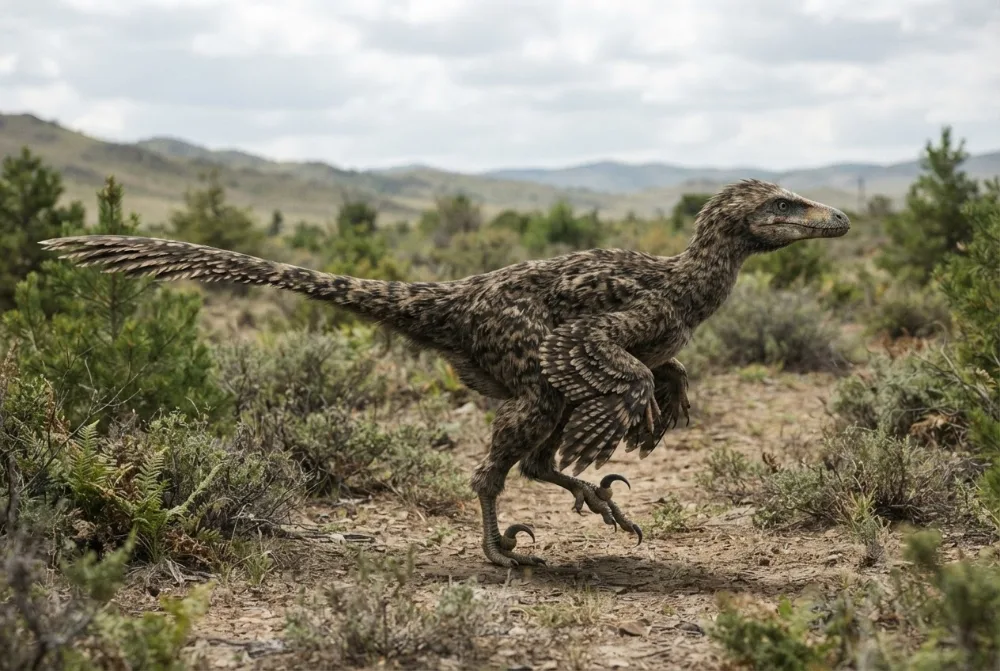
Achillobator was a huge, feathered raptor that lived in what is now Mongolia. It was one of the biggest dromaeosaurs, as long as a car and as heavy as a polar bear. It used a giant sickle claw on each foot to hunt large prey.1
Cando viviu?
Como era de grande?
Canto medía de longo?
Canto medía de alto?
estimación
Canto pesaba?
 tan longo coma 5 cans do fociño á cola🍌tan longo coma 28 plátanos postos un tras outro🍉tan pesado coma 60 sandías🧸tan pesado coma 16 nenos de infantil🎒tan pesado coma 9 nenos de primaria🏃podería correr 100 metros en 7,7 segundos (o humano máis rápido necesita 9,6)
Como era de grande Achillobator comparado CONTIGO?
Só son contas no teu navegador. Non se garda nin se envía nada.
Que velocidade alcanzaba?


Datos curiosos
Achillobator is named after the Greek hero Achilles, because of the large Achilles tendon that helped power its sickle claw.1
It was one of the largest dromaeosaurs, along with Utahraptor and Austroraptor, reaching about 5 metres (16 feet) long.1
Unlike many other raptors, Achillobator had a very robust, heavily built skeleton and short, stocky legs.1
Its legs were not built for high-speed running; instead, it was a powerful ambush predator that could leap onto prey.1
The first fossils were found in 1989 by a Mongolian-Russian expedition, but the dinosaur was not named until 1999.1
Achillobator lived in a warm, wet environment with rivers and lakes, about 96 to 89 million years ago.1
Scientists think Achillobator may have used its feathered arms to help balance while wrestling with prey.1
As preguntas máis frecuentes sobre Achillobator
?How big was Achillobator?
About 4.5 to 5 metres (15 to 16 feet) long and weighed 250 to 300 kilograms (550 to 660 pounds). That is as long as a car and as heavy as a polar bear.12
?Did Achillobator have feathers?
Yes, scientists are confident it had feathers. Although no feathers were found with its fossils, its close relatives had feathers, so Achillobator almost certainly did too.1
?What did Achillobator eat?
It was a carnivore that hunted large prey. It used its giant sickle claw on each foot to help it catch and hold onto animals.1
?How fast could Achillobator run?
Not very fast. Its short, stocky legs were built for power, not speed. It was an ambush predator that leaped onto prey rather than chasing it.1
?When did Achillobator live?
It lived during the Late Cretaceous period, about 96 to 89 million years ago.12
?Where was Achillobator found?
Its fossils were discovered in the Bayan Shireh Formation of Mongolia, in the Gobi Desert.1
?Why is it called Achillobator?
Its name means 'Achilles hero' in Latin and Mongolian. It is named after the Greek hero Achilles because of the large Achilles tendon that helped power its sickle claw.1
?Was Achillobator bigger than Velociraptor?
Yes, much bigger. Achillobator was about 5 metres long, while Velociraptor was only about 2 metres long. Achillobator was one of the largest dromaeosaurs.1
Cazamitos
Mito: Some people think all raptors were fast runners.
Verdade: Achillobator had short, stocky legs and was not built for speed. It was a powerful ambush predator that used strength and leaping to catch prey.1
Para expertos en dinos
- Nome científico
- Achillobator
- Bautizado por
- Perle et al. 19993
- Grupo
- Raptores
- Familia / clado
- Dromaeosauridae3
- Clasificación
- Theropoda > Dromaeosauridae3
- Idade das rochas
- de 100 a 84 millóns de anos (Cenomanian / Santonian)3
- Formacións rochosas
- Baynshire3
- Países
- Mongolia3
- Rexistros fósiles
- 1 na Paleobiology Database3
- Descubrimento
- The first partial skeleton of Achillobator was found in 1989 at the Burkhant locality in Mongolia. It was named in 1999 by paleontologists Altangerel Perle, Mark Norell, and James Clark.1
- Aínda en debate
- Scientists are not sure whether giant dromaeosaurs like Achillobator used their sickle claws for climbing trees or for holding onto large prey.1
De onde veñen os datos
- Achillobator (en.wikipedia.org)
- Achillobator | Natural History Museum (nhm.ac.uk)
- Achillobator in The Paleobiology Database (CC BY 4.0): idade, lugares, formacións rochosas, clasificación.
Cada dato desta páxina ten un número que leva á súa fonte. Se nos equivocamos nalgo, sentímolo, somos fans dos dinos, non unha revista científica. Escríbenos a [email protected] e arranxámolo.
 Rex ten fame! Dino Wiki é o proxecto dun pai para o seu fillo, que adora os dinosauros, gratis, sen anuncios e sen rastrexadores. Os adultos poden darlle un petisco a Rex para mantelo en liña.Dálle de comer a Rex
 Velociraptor
 Microraptor
 Deinonychus
 Asiamericana
 Richardoestesia
 Saurornitholestes
 Tyrannosaurus
 Triceratops
 Spinosaurus
 Ankylosaurus
 Parasaurolophus
 Pteranodon