 Que dino es ti? O test
 Batalla de dinos
 Carreira de dinos
 Minixogos de dinos
 Álbum de cromos
 Listas TOP de dinos
 Sorpréndeme!
Cando viviu?

Como era de grande?
Canto medía de longo?
Canto pesaba?

 tan longo coma 4 gatos domésticos do fociño á cola🍌tan longo coma 10 plátanos postos un tras outrotan pesado coma 10 gatos domésticos🍉tan pesado coma 8 sandías🧸tan pesado coma 2 nenos de infantil🎒tan pesado coma 1 nenos de primaria🏃podería correr 100 metros en 8,2 segundos (o humano máis rápido necesita 9,6)
Como era de grande Acrotholus comparado CONTIGO?
Só son contas no teu navegador. Non se garda nin se envía nada.
Que velocidade alcanzaba?


Datos curiosos
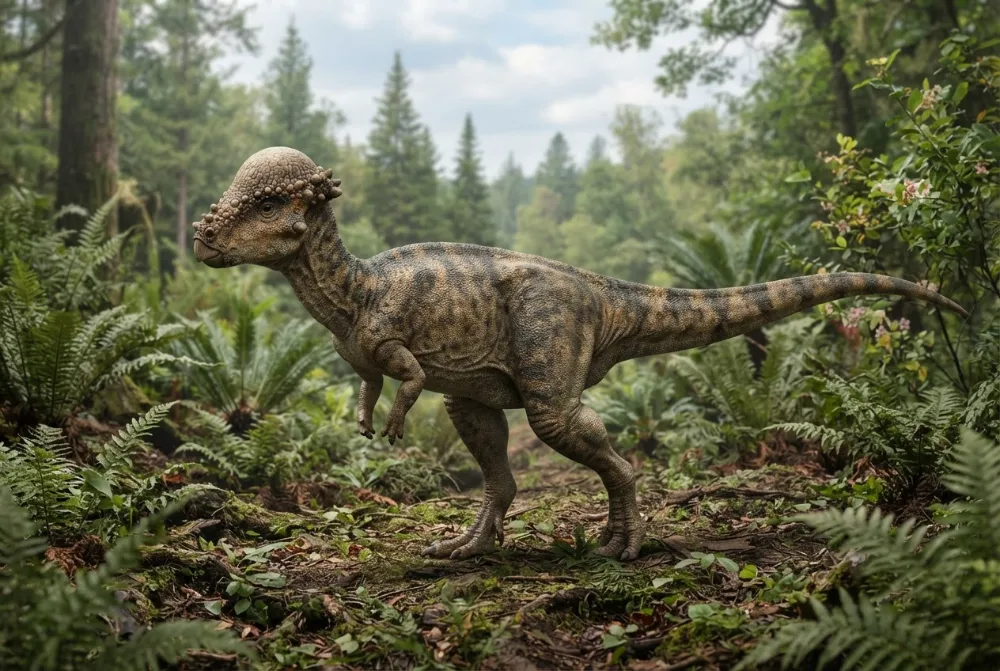
Acrotholus is the oldest known pachycephalosaur from North America, and possibly the world.2
Its dome was very thick, up to 55 millimetres (about 2 inches) above the brain, which is almost half the total length of the dome.2
The dome was fully developed even though Acrotholus lived earlier than other pachycephalosaurs, showing that this feature evolved earlier than scientists thought.2
The name Acrotholus means 'highest dome' in Greek, referring to its thick skull roof.1
The species name audeti honors Roy Audet, a rancher who allowed scientists to dig on his land where the first skull was found.12
Acrotholus had a smooth dome without the bumps or grooves seen in some other pachycephalosaurs, which suggests the known fossils are from adults.2
As preguntas máis frecuentes sobre Acrotholus
?How big was Acrotholus?
Acrotholus was a small dinosaur, weighing 40 kg (88 lb) or less. Its skull dome was about 55 mm (2.2 in) thick.12
?What did Acrotholus eat?
Acrotholus was a plant-eating dinosaur, like other pachycephalosaurs.1
?Why did Acrotholus have a dome on its head?
The dome was probably used for head-butting contests between rivals, though scientists debate exactly how they used it.1
?When did Acrotholus live?
Acrotholus lived about 84 to 83.5 million years ago, during the Late Cretaceous period.1
Cazamitos
Mito: Some people think Acrotholus used its dome to butt heads like bighorn sheep.
Verdade: Scientists are not sure. The dome might have been for display or for fighting, but there is no direct evidence of head-butting in Acrotholus.1
Para expertos en dinos
- Nome científico
- Acrotholus
- Bautizado por
- Evans et al. 20134
- Grupo
- Cabezas de cúpula
- Familia / clado
- Pachycephalosauridae4
- Clasificación
- Ornithischia > Pachycephalosauria4
- Idade das rochas
- de 86 a 84 millóns de anos (Santonian)4
- Formacións rochosas
- Milk River4
- Países
- Canadá4
- Rexistros fósiles
- 1 na Paleobiology Database4
- Descubrimento
- The first fossil, a nearly complete skull dome, was found on Roy Audet's ranch in Alberta, Canada, and was named by David Evans and colleagues in 2013.12
- Aínda en debate
- Scientists still debate whether the dome was used for fighting between males or for showing off to mates, since no complete skeleton has been found.1
De onde veñen os datos
- Acrotholus (en.wikipedia.org)
- The oldest North American pachycephalosaurid and the hidden diversity of small-bodied ornithischian dinosaurs | Nature Communications (nature.com)
- Study of new 'bone-head' hints at higher diversity of small dinosaurs | EurekAlert! (eurekalert.org)
- Acrotholus in The Paleobiology Database (CC BY 4.0): idade, lugares, formacións rochosas, clasificación.
Cada dato desta páxina ten un número que leva á súa fonte. Se nos equivocamos nalgo, sentímolo, somos fans dos dinos, non unha revista científica. Escríbenos a [email protected] e arranxámolo.
 Rex ten fame! Dino Wiki é o proxecto dun pai para o seu fillo, que adora os dinosauros, gratis, sen anuncios e sen rastrexadores. Os adultos poden darlle un petisco a Rex para mantelo en liña.Dálle de comer a Rex
 Pachycephalosaurus
 Stegoceras
 Prenocephale
 Sphaerotholus
 Foraminacephale
 Brontotholus
 Tyrannosaurus
 Triceratops
 Velociraptor
 Spinosaurus
 Ankylosaurus
 Parasaurolophus