 Que dino es ti? O test
 Batalla de dinos
 Carreira de dinos
 Minixogos de dinos
 Álbum de cromos
 Listas TOP de dinos
 Sorpréndeme!
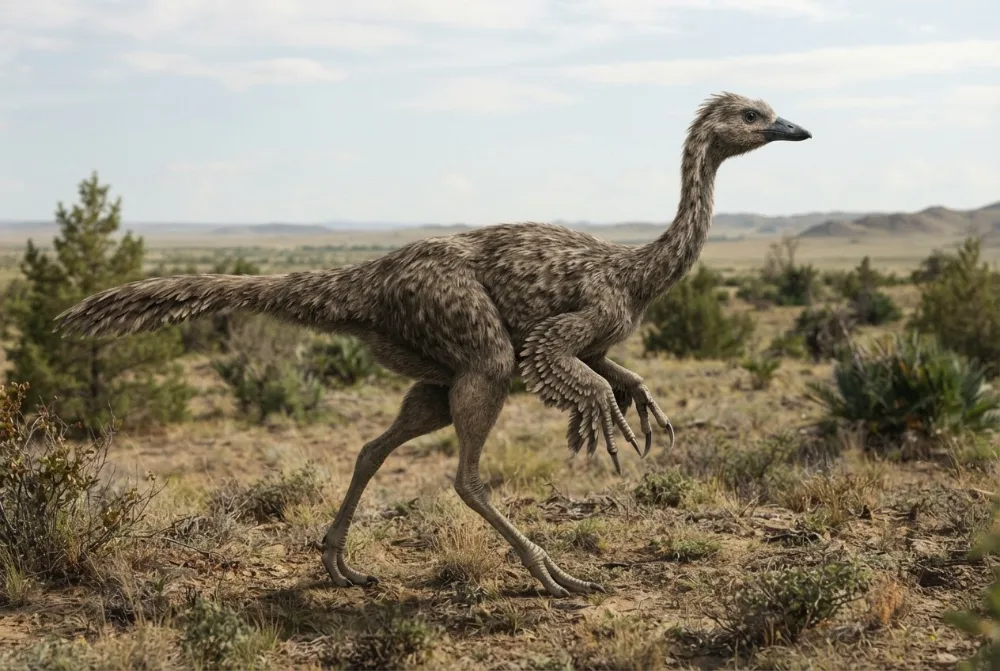
Anserimimus
Anserimimus was a fast, long-legged dinosaur that looked a bit like an ostrich. It had strong arms with flat claws, which made it different from its relatives. This dinosaur lived in what is now Mongolia during the Late Cretaceous period.2
Cando viviu?
Como era de grande?
Canto medía de longo?
Canto medía de alto?
estimación
Canto pesaba?
 tan longo coma 4 cans do fociño á cola🍌tan longo coma 19 plátanos postos un tras outro🍉tan pesado coma 34 sandías🧸tan pesado coma 9 nenos de infantil🎒tan pesado coma 5 nenos de primaria🏃podería correr 100 metros en 5,5 segundos (o humano máis rápido necesita 9,6)
Como era de grande Anserimimus comparado CONTIGO?
Só son contas no teu navegador. Non se garda nin se envía nada.
Que velocidade alcanzaba?


Datos curiosos
Anserimimus had flat, straight claws on its hands, unlike the curved claws of other ornithomimids.2
Its arms were more powerful than those of other ornithomimids, with large crests for strong muscles like the biceps.2
The hand bones (metacarpals) were fused together, making the hand stronger.2
Anserimimus lived about 70 million years ago, during the Maastrichtian stage of the Late Cretaceous.2
Only one complete skeleton of Anserimimus has been found, and it is missing the skull and lower jaws.2
Its closest relative might be Gallimimus, another ornithomimid from the same formation in Mongolia.2
Anserimimus lived alongside giant dinosaurs like Tarbosaurus and Deinocheirus in the Nemegt Formation.2
As preguntas máis frecuentes sobre Anserimimus
?How big was Anserimimus?
About 3 metres long and weighed around 50 kilograms, though some estimates suggest up to 170 kilograms.2
?What did Anserimimus eat?
Scientists think it was probably an omnivore, but since its skull is missing, its exact diet is unknown.2
?When did Anserimimus live?
It lived about 70 million years ago, during the Late Cretaceous Period.2
?Why did Anserimimus have flat claws?
Nobody knows for sure. The flat, straight claws may have been used for a different way of gathering food, but the animal's skull is missing so its diet is hard to study.2
Para expertos en dinos
- Nome científico
- Anserimimus
- Bautizado por
- Barsbold 19884
- Grupo
- Dinos avestruz
- Familia / clado
- Ornithomimidae4
- Clasificación
- Theropoda > Ornithomimosauria4
- Idade das rochas
- de 72 a 66 millóns de anos (Maastrichtian)4
- Formacións rochosas
- Nemegt4
- Países
- Mongolia4
- Rexistros fósiles
- 2 na Paleobiology Database4
- Descubrimento
- Anserimimus was named by Mongolian paleontologist Rinchen Barsbold in 1988, based on a skeleton found during a Soviet-Mongolian expedition to the Gobi Desert in the late 1970s.2
- Aínda en debate
- Scientists are not sure what Anserimimus ate, because its skull has never been found. Its strong arms and flat claws might mean it had a different diet or way of gathering food than other ornithomimids.2
De onde veñen os datos
- Anserimimus | Natural History Museum (nhm.ac.uk)
- Anserimimus (en.wikipedia.org)
- PBDB Taxon (paleobiodb.org)
- Anserimimus in The Paleobiology Database (CC BY 4.0): idade, lugares, formacións rochosas, clasificación.
Cada dato desta páxina ten un número que leva á súa fonte. Se nos equivocamos nalgo, sentímolo, somos fans dos dinos, non unha revista científica. Escríbenos a [email protected] e arranxámolo.
 Rex ten fame! Dino Wiki é o proxecto dun pai para o seu fillo, que adora os dinosauros, gratis, sen anuncios e sen rastrexadores. Os adultos poden darlle un petisco a Rex para mantelo en liña.Dálle de comer a Rex
 Gallimimus
 Ornithomimus
 Struthiomimus
 Deinocheirus
 Dromiceiomimus
 Archaeornithomimus
 Tyrannosaurus
 Triceratops
 Velociraptor
 Spinosaurus
 Ankylosaurus
 Parasaurolophus