 Que dino es ti? O test
 Batalla de dinos
 Carreira de dinos
 Minixogos de dinos
 Álbum de cromos
 Listas TOP de dinos
 Sorpréndeme!
Cando viviu?

Como era de grande?
Canto medía de longo?
Canto medía de alto?
Canto pesaba?
 tan longo coma 5 cans do fociño á cola🍌tan longo coma 27 plátanos postos un tras outro🍉tan pesado coma 70 sandías🧸tan pesado coma 18 nenos de infantil🎒tan pesado coma 11 nenos de primaria🏃podería correr 100 metros en 5,1 segundos (o humano máis rápido necesita 9,6)
Como era de grande Struthiomimus comparado CONTIGO?
Só son contas no teu navegador. Non se garda nin se envía nada.
Que velocidade alcanzaba?


Datos curiosos
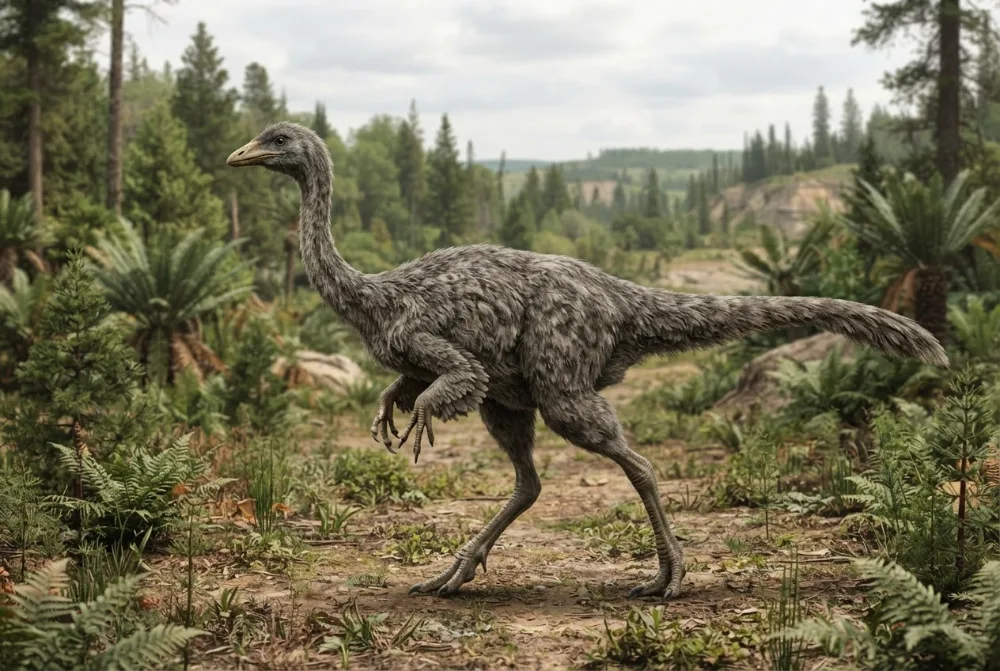
Struthiomimus looked a bit like a featherless ostrich with a long tail.1
Its neck made up about 40% of the length of its body in front of the hips.2
It had three fingers on each hand that were roughly the same length, which is unusual for a theropod.2
Its tail was relatively stiff and probably helped it keep balance while running.2
Some scientists think its hands worked like a hook or clamp to pull branches close, but others think they supported wing feathers.2
As preguntas máis frecuentes sobre Struthiomimus
?How big was Struthiomimus?
About 4.3 metres (14 feet) long, 1.4 metres (4.5 feet) tall at the hips, and weighed around 150 kilograms (330 pounds). A larger specimen weighed about 234 kilograms (515 pounds).21
?How fast could Struthiomimus run?
It could run between 50 and 80 km/h (31 to 50 mph), using its long legs to escape predators like tyrannosaurs.2
?What did Struthiomimus eat?
It was probably an omnivore, eating both plants and small animals like insects, mammals, and reptiles. Its toothless beak was good for cropping plants and maybe filtering food from water.21
?Did Struthiomimus have feathers?
Yes, it likely had feathers all over its body. Its arm bones show adaptations that may have supported wing feathers.2
?Where did Struthiomimus live?
It lived in western North America, in what is now Canada and the United States, during the Late Cretaceous period.21
?Why is it called Struthiomimus?
Its name means 'ostrich mimic' because it looked a lot like a modern ostrich, with long legs, a long neck, and a toothless beak.21
?Was Struthiomimus bigger than a human?
Yes, it was about 4.3 metres long and stood about 1.4 metres tall at the hips, which is taller than most people.2
Cazamitos
Mito: Struthiomimus was a fierce meat-eater like other theropods.
Verdade: It had no teeth and a beak, and most scientists think it ate both plants and small animals, not just meat.2
Para expertos en dinos
- Nome científico
- Struthiomimus
- Bautizado por
- Osborn 19163
- Grupo
- Dinos avestruz
- Familia / clado
- Ornithomimidae3
- Clasificación
- Theropoda > Ornithomimosauria3
- Idade das rochas
- de 84 a 66 millóns de anos (Campanian / Maastrichtian)3
- Formacións rochosas
- Oldman, Kirtland, Dinosaur Park3
- Países
- Canadá, EUA3
- Rexistros fósiles
- 18 na Paleobiology Database3
- Descubrimento
- Lawrence Lambe found the first remains in 1901 and named them Ornithomimus altus. In 1914, Barnum Brown found a nearly complete skeleton in Alberta, and Henry Fairfield Osborn named it Struthiomimus in 1917.2
- Aínda en debate
- Scientists still debate what Struthiomimus ate. Some think it was a plant-eater, others think it was a meat-eater, and some even suggest it filtered food from water.2
De onde veñen os datos
- Struthiomimus | Natural History Museum (nhm.ac.uk)
- Struthiomimus (en.wikipedia.org)
- Struthiomimus in The Paleobiology Database (CC BY 4.0): idade, lugares, formacións rochosas, clasificación.
Cada dato desta páxina ten un número que leva á súa fonte. Se nos equivocamos nalgo, sentímolo, somos fans dos dinos, non unha revista científica. Escríbenos a [email protected] e arranxámolo.
 Rex ten fame! Dino Wiki é o proxecto dun pai para o seu fillo, que adora os dinosauros, gratis, sen anuncios e sen rastrexadores. Os adultos poden darlle un petisco a Rex para mantelo en liña.Dálle de comer a Rex
 Gallimimus
 Ornithomimus
 Deinocheirus
 Dromiceiomimus
 Archaeornithomimus
 Anserimimus
 Tyrannosaurus
 Triceratops
 Velociraptor
 Spinosaurus
 Ankylosaurus
 Parasaurolophus