 Que dino es ti? O test
 Batalla de dinos
 Carreira de dinos
 Minixogos de dinos
 Álbum de cromos
 Listas TOP de dinos
 Sorpréndeme!
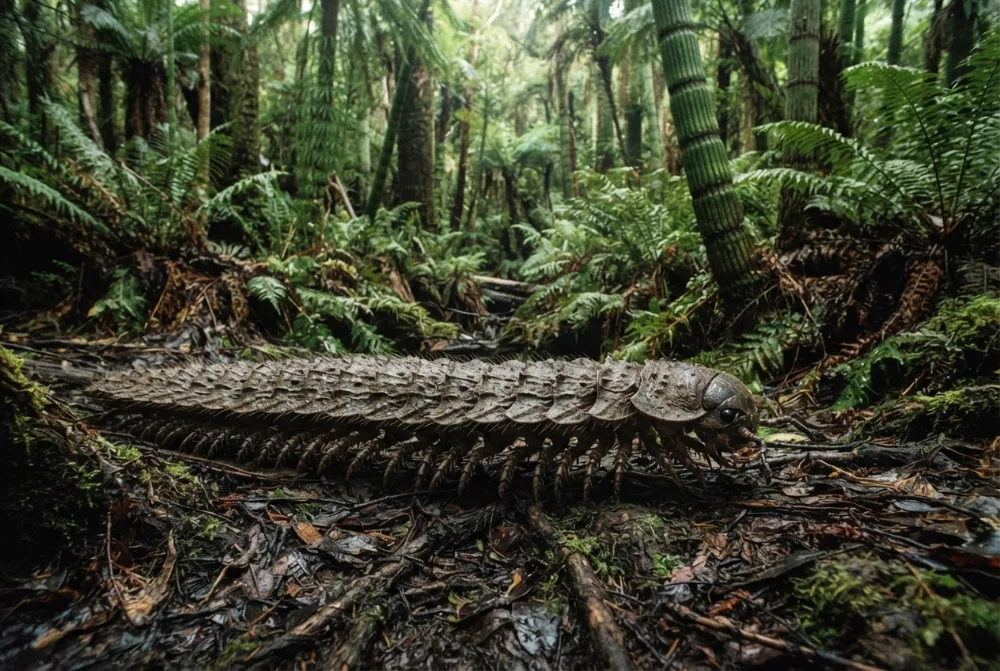
Arthropleura
Arthropleura was a giant millipede that lived long before the dinosaurs. It could grow as long as a car, making it the biggest land bug ever! It crawled through ancient forests near water.1
Cando viviu?
Como era de grande?
Canto medía de longo?
Canto pesaba?
 tan longo coma 2,5 cans do fociño á cola🍌tan longo coma 14 plátanos postos un tras outro
 tan pesado coma 12 gatos domésticos🍉tan pesado coma 10 sandías🧸tan pesado coma 2,5 nenos de infantil🎒tan pesado coma 1,5 nenos de primaria🏃podería correr 100 metros en 90 segundos (o humano máis rápido necesita 9,6)
Como era de grande Arthropleura comparado CONTIGO?
Só son contas no teu navegador. Non se garda nin se envía nada.
Que velocidade alcanzaba?


Datos curiosos
Arthropleura is the largest known land arthropod of all time, reaching at least 2 metres (6.5 feet) long.1
It left giant trackways up to 50 centimetres (20 inches) wide, which are fossilized footprints of its many legs.1
Its head had features of both millipedes and centipedes, showing it was a mix of both groups.2
Arthropleura lived in open, sparsely wooded areas near water and may have been able to go on land and in water.1
It was a slow mover, not a fast runner like centipedes, based on its short legs and trackways.2
Some Arthropleura fossils are so well preserved that scientists can see the details of its head and mouthparts using special scanners.2
As preguntas máis frecuentes sobre Arthropleura
?How big was Arthropleura?
About 2 metres (6.5 feet) long, possibly up to 2.63 metres (8.6 feet). That makes it the largest known land arthropod of all time.12
?What did Arthropleura eat?
It probably ate dead plants and other detritus, like modern millipedes. It did not have venom fangs or legs for catching prey.5
?Was Arthropleura a dinosaur?
No, it was a giant millipede, not a dinosaur. It lived long before the dinosaurs, from about 344 to 292 million years ago.1
?Could Arthropleura swim?
It may have been amphibious, meaning it could live both on land and in water. It lived in open, sparsely wooded areas near water.1
?How fast could Arthropleura move?
Probably only about 4 km/h (2 mph), a slow walking pace. This is a guess: it was a giant millipede with short legs, and its trackways show it did not hurry.5
?Did Arthropleura have a head?
Yes, and scientists recently used special scanners to see its head in detail. It had antennae, mandibles, and two pairs of maxillae.2
?When did Arthropleura go extinct?
It died out around 292 million years ago, during the early Permian period.1
?Where did Arthropleura live?
It lived in what is now Europe and North America, in open, sparsely wooded forests near water.1
?Is Arthropleura related to centipedes?
It is a millipede, but its head has features of both millipedes and centipedes, showing it was a mix of both groups.5
?How much did Arthropleura weigh?
One large fossil suggests it weighed about 50 kilograms (110 pounds), as heavy as a small human.1
Cazamitos
Mito: Arthropleura was a giant centipede that hunted other animals.
Verdade: Arthropleura was actually a millipede, and it was likely a slow plant-eater, not a predator.2
Para expertos en dinos
- Nome científico
- Arthropleura
- Bautizado por
- (Jordan 1854)6
- Grupo
- Lendas prehistóricas
- Familia / clado
- Arthropleuridae6
- Clasificación
- Myriapoda > Arthropleurida > Arthropleuridae6
- Idade das rochas
- de 347 a 290 millóns de anos (Visean / Sakmarian)6
- Formacións rochosas
- Saarbrucker layers, Farrington6
- Países
- Alemaña, Francia, Bélxica, Reino Unido, España, EUA6
- Rexistros fósiles
- 61 na Paleobiology Database6
- Descubrimento
- Arthropleura was first named by Jordan in 1854, based on fossils found in Europe.3
- Aínda en debate
- Scientists still debate whether Arthropleura was a true millipede or a more primitive relative, and they are not sure exactly what it ate.2
De onde veñen os datos
- Arthropleura (en.wikipedia.org)
- Head anatomy and phylogenomics show the Carboniferous giant Arthropleura belonged to a millipede-centipede group (science.org)
- PBDB Taxon (paleobiodb.org)
- Millipedes ‘as big as cars’ once roamed England | University of Cambridge (cam.ac.uk)
- Largest ever millipede’s head revealed by 300-million-year-old fossils | Natural History Museum (nhm.ac.uk)
- Arthropleura in The Paleobiology Database (CC BY 4.0): idade, lugares, formacións rochosas, clasificación.
Cada dato desta páxina ten un número que leva á súa fonte. Se nos equivocamos nalgo, sentímolo, somos fans dos dinos, non unha revista científica. Escríbenos a [email protected] e arranxámolo.
 Rex ten fame! Dino Wiki é o proxecto dun pai para o seu fillo, que adora os dinosauros, gratis, sen anuncios e sen rastrexadores. Os adultos poden darlle un petisco a Rex para mantelo en liña.Dálle de comer a Rex
 Megalodon
 Sabre-toothed cat
 Dimetrodon
 Woolly mammoth
 Helicoprion
 Deinosuchus