 Que dino es ti? O test
 Batalla de dinos
 Carreira de dinos
 Minixogos de dinos
 Álbum de cromos
 Listas TOP de dinos
 Sorpréndeme!
Dimetrodon
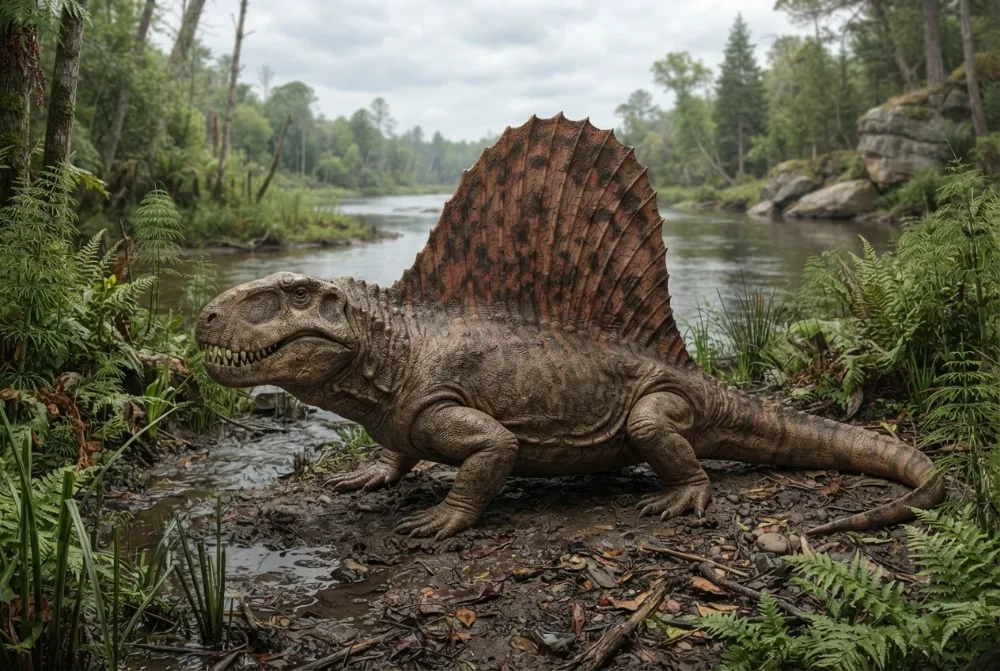
Dimetrodon was a fierce predator that lived long before the first dinosaurs. It had a big sail on its back made of long spines, and it is actually more closely related to mammals like us than to dinosaurs.12
Cando viviu?
Como era de grande?
Canto medía de longo?
Canto pesaba?
 tan longo coma 5 cans do fociño á cola🍌tan longo coma 26 plátanos postos un tras outro🍉tan pesado coma 50 sandías🧸tan pesado coma 13 nenos de infantil🎒tan pesado coma 8 nenos de primaria🏃podería correr 100 metros en 18 segundos (o humano máis rápido necesita 9,6)
Como era de grande Dimetrodon comparado CONTIGO?
Só son contas no teu navegador. Non se garda nin se envía nada.
Que velocidade alcanzaba?


Datos curiosos
Dimetrodon is often mistaken for a dinosaur, but it is actually a synapsid, meaning it is more closely related to mammals than to reptiles.12
The sail on its back was made of very long bones from its spine, and scientists think it might have been used to attract mates or scare off rivals.1
Dimetrodon had different-sized teeth in its jaws, including sharp fangs, which helped it eat a variety of prey.1
It lived during the Permian Period, about 40 million years before the first dinosaurs appeared.1
Fossils show that Dimetrodon sometimes ate other animals that were hiding in burrows during droughts.1
Another sail-backed animal called Edaphosaurus lived at the same time, but it was a plant-eater and its sail evolved separately.2
As preguntas máis frecuentes sobre Dimetrodon
?Is Dimetrodon a dinosaur?
No, Dimetrodon is not a dinosaur. It is a synapsid, which means it is more closely related to mammals (including humans) than to reptiles or dinosaurs.12
?How big was Dimetrodon?
Most Dimetrodon species were 1.7 to 4.6 metres (5.6 to 15.1 feet) long and weighed 28 to 250 kilograms (62 to 551 pounds).1
?What did Dimetrodon eat?
Dimetrodon was a carnivore that ate fish, amphibians, reptiles, and other land animals. It was probably the top predator of its time.1
?When did Dimetrodon live?
Dimetrodon lived during the Permian Period, about 294 to 271 million years ago. That is about 40 million years before the first dinosaurs appeared.1
?Why did Dimetrodon have a sail?
Scientists think the sail was mostly used for courtship display, like showing off to mates or scaring rivals. It may also have helped warm up the body, but that is not its main purpose.1
?How fast could Dimetrodon run?
Probably up to about 20 km/h (12 mph), about as fast as a grown-up riding a bike. This is an estimate: nobody knows for sure. Dimetrodon walked on four sprawling legs, a bit like a Komodo dragon.1
?Could Dimetrodon swim?
Dimetrodon lived on land, but it may have hunted in shallow water. Its bone structure shows it was mostly terrestrial, not a strong swimmer.1
?Where did Dimetrodon live?
Most Dimetrodon fossils have been found in the southwestern United States, especially Texas and Oklahoma. Some have also been found in Germany.1
?Did Dimetrodon have feathers?
No, Dimetrodon did not have feathers. It was a reptile-like synapsid with scaly skin, not related to birds.1
Para expertos en dinos
- Nome científico
- Dimetrodon
- Bautizado por
- Cope 18783
- Grupo
- Lendas prehistóricas
- Familia / clado
- Sphenacodontidae3
- Clasificación
- Synapsida > Sphenacodontia > Sphenacodontidae3
- Idade das rochas
- de 299 a 267 millóns de anos (Asselian / Roadian)3
- Formacións rochosas
- Vale, Arroyo, Belle Plains3
- Países
- EUA, Canadá, Alemaña3
- Rexistros fósiles
- 94 na Paleobiology Database3
- Descubrimento
- Dimetrodon was named by the American paleontologist Edward Drinker Cope in 1878, based on fossils found in Texas.13
- Aínda en debate
- Scientists still debate whether the sail of Dimetrodon was mainly used for temperature control, display, or something else.1
De onde veñen os datos
- Dimetrodon (en.wikipedia.org)
- Dimetrodon Is Not a Dinosaur: Using Tree Thinking to Understand the Ancient Relatives of Mammals and their Evolution | Evolution: Education and Outreach | Springer Nature Link (link.springer.com)
- Dimetrodon in The Paleobiology Database (CC BY 4.0): idade, lugares, formacións rochosas, clasificación.
Cada dato desta páxina ten un número que leva á súa fonte. Se nos equivocamos nalgo, sentímolo, somos fans dos dinos, non unha revista científica. Escríbenos a [email protected] e arranxámolo.
 Rex ten fame! Dino Wiki é o proxecto dun pai para o seu fillo, que adora os dinosauros, gratis, sen anuncios e sen rastrexadores. Os adultos poden darlle un petisco a Rex para mantelo en liña.Dálle de comer a Rex
 Megalodon
 Sabre-toothed cat
 Woolly mammoth
 Arthropleura
 Helicoprion
 Deinosuchus