 Que dino es ti? O test
 Batalla de dinos
 Carreira de dinos
 Minixogos de dinos
 Álbum de cromos
 Listas TOP de dinos
 Sorpréndeme!
Brighstoneus
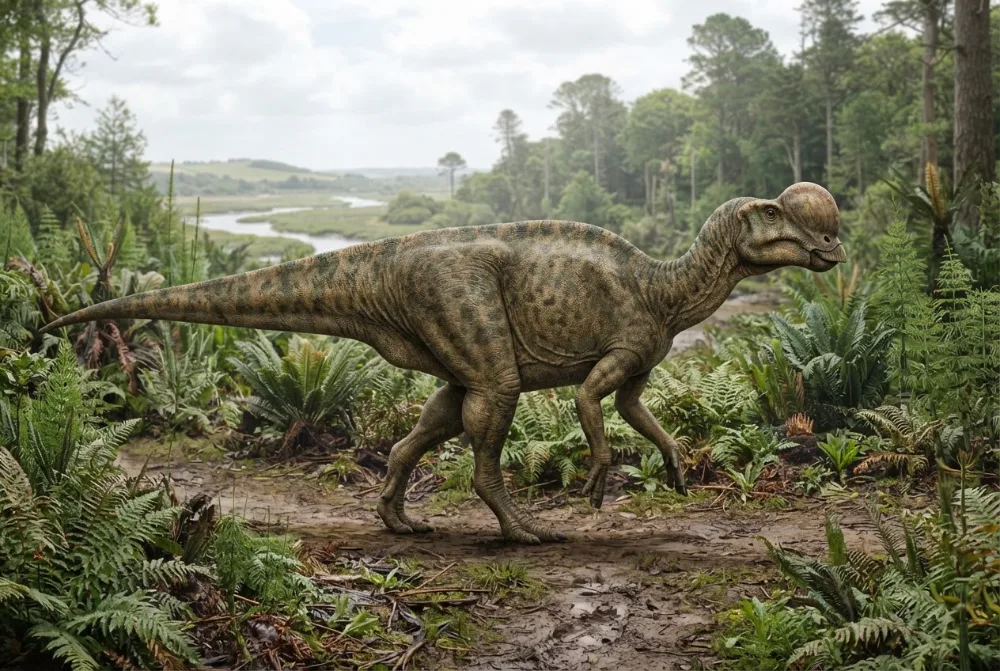
Brighstoneus was a big, plant-eating dinosaur that lived on the Isle of Wight in England about 125 million years ago. It had a strange, bulbous nose that made it look different from its relatives. Scientists think it used its big nose to show off to other dinosaurs or to scare away rivals.12
Cando viviu?
Como era de grande?
Canto medía de longo?
Canto medía de alto?
estimación
Canto pesaba?
 tan longo coma 6 cans do fociño á cola🍌tan longo coma 33 plátanos postos un tras outro🍉tan pesado coma 200 sandías🧸tan pesado coma 53 nenos de infantil🎒tan pesado coma 31 nenos de primaria🐻❄️tan pesado coma 2 osos polares🏃podería correr 100 metros en 11 segundos (o humano máis rápido necesita 9,6)
Como era de grande Brighstoneus comparado CONTIGO?
Só son contas no teu navegador. Non se garda nin se envía nada.
Que velocidade alcanzaba?


Datos curiosos
Brighstoneus had a bulbous bump on its nose, called a nasal bulla, which made its snout look S-shaped from the side.1
Its fossils were found mixed up with the bones of a meat-eating dinosaur called Neovenator after a storm in 1978.1
The dinosaur was named by a retired doctor, Jeremy Lockwood, who spent years studying old bones in museum collections.2
Brighstoneus lived in a floodplain environment that had rivers, lakes, and frequent wildfires.1
Its teeth were different from other similar dinosaurs because they had ridges on both sides.2
The name Brighstoneus honors the village of Brighstone, where a famous Victorian fossil collector named Reverend William Fox once lived.1
As preguntas máis frecuentes sobre Brighstoneus
?How big was Brighstoneus?
Brighstoneus was probably about 6 metres long and weighed around 1 tonne.1
?What did Brighstoneus eat?
Brighstoneus was a plant-eater. It had a beak and teeth with ridges to chew tough plants.1
?Why did Brighstoneus have a bulbous nose?
Scientists think the bulbous nose, called a nasal bulla, was used to show off to attract mates or scare away rivals.2
?When did Brighstoneus live?
Brighstoneus lived about 125 million years ago, during the Early Cretaceous period.1
Cazamitos
Mito: Some people think Brighstoneus was just another Iguanodon.
Verdade: Scientists proved it is a separate species because of its unique bulbous nose and different teeth.2
Para expertos en dinos
- Nome científico
- Brighstoneus
- Bautizado por
- Lockwood et al. 20213
- Grupo
- Herbívoros con bico
- Familia / clado
- Hadrosauriformes3
- Clasificación
- Ornithischia > Ornithopoda > Iguanodontia3
- Idade das rochas
- de 126 a 121 millóns de anos (Barremian)3
- Formacións rochosas
- Wessex3
- Países
- Reino Unido3
- Rexistros fósiles
- 1 na Paleobiology Database3
- Descubrimento
- Brighstoneus was discovered in 1978 after a storm on the Isle of Wight, but it was not named until 2021. Jeremy Lockwood, a retired doctor and PhD student, studied the bones and realized they belonged to a new species.12
- Aínda en debate
- Scientists are not sure exactly what the bulbous nose was used for. It might have been for attracting mates or for fighting rivals.2
De onde veñen os datos
- Brighstoneus (en.wikipedia.org)
- New bulbous nosed dinosaur discovered (csd.docstore.port.ac.uk)
- Brighstoneus in The Paleobiology Database (CC BY 4.0): idade, lugares, formacións rochosas, clasificación.
Cada dato desta páxina ten un número que leva á súa fonte. Se nos equivocamos nalgo, sentímolo, somos fans dos dinos, non unha revista científica. Escríbenos a [email protected] e arranxámolo.
 Rex ten fame! Dino Wiki é o proxecto dun pai para o seu fillo, que adora os dinosauros, gratis, sen anuncios e sen rastrexadores. Os adultos poden darlle un petisco a Rex para mantelo en liña.Dálle de comer a Rex
 Iguanodon
 Tenontosaurus
 Thescelosaurus
 Zalmoxes
 Camptosaurus
 Rhabdodon
 Stegosaurus
 Archaeopteryx
 Giganotosaurus
 Microraptor
 Deinonychus
 Baryonyx